BOGOTA: Colombian troops killed 11 dissidents of the disbanded FARC guerrilla group, officials said Monday, as a fight looms over the future of a 2016 peace agreement in runoff presidential elections.
The military operation took place Sunday in the south of the country as Colombians voted in the first round of presidential elections that left a hard-line conservative and a former leftist guerrilla vying for the presidency.
Defense Minister Luis Carlos Villegas said the operation in Montanita in the southern department of Caqueta left “11 dead and two wounded, including a minor who had been recruited by force.”
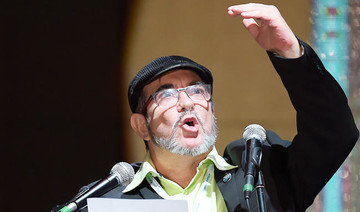
The 13 were part of an armed faction commanded by a former FARC rebel leader, Rodrigo Cadete, who rejected the 2016 peace agreement with the government of President Juan Manuel Santos.
The minister said the groups had been making threats against the mayor of the Caqueta capital of Florencia as well as an energy company in the region.
“The criminals had been demanding extortion payments from businesses” in Florencia and its surrounding area, the army said in a statement.
Under the peace accord, the Revolutionary Armed Forces of Colombia (FARC) disarmed its 7,000 fighters in order to join the political process. It is now a political party.
However, remnants of the rebel force — estimated by the army to number about 1,200 — are still active in the southern border areas, financing their operations through drug trafficking and extortion rackets.
“We will not drop our guard against residual groups. We will continue fighting them with the utmost forcefulness,” Santos said on Twitter.
Sunday’s military action was a jarring reminder that embers of Colombia’s 50-year-old conflict are still burning despite the peace accord with the FARC, once Latin America’s largest guerrilla group.
Besides contending with remnants of the FARC, Santos’s government has yet to conclude a peace accord with the smaller National Liberation Army, or ELN.
Negotiations with the ELN resumed in Havana earlier this month, and its rebel forces observed a five-day cease-fire during the elections.
But the future of the peace accord has emerged as a key and divisive issue in the elections, which go to a runoff June 17.
The top vote-getter in Sunday’s round of balloting was conservative Ivan Duque, who has vowed to rewrite the accord with the FARC if elected.
Duque, who argues that FARC leaders got off too lightly, called for a “Colombia where peace coincides with justice” after the results were announced, reiterating his desire to revise — without “shredding” — the pact with FARC.
He faces off against Gustavo Petro, a former Bogota mayor who received 25 percent of the vote to Duque’s 39.7.
A past member of the now disbanded M-19 guerrilla group, Petro is the first leftist to contest a runoff in Colombia.
Promising “change” and to fight corruption and inequality, Petro gained momentum as the campaign progressed, outdistancing two other candidates — former Medellin mayor Sergio Fajardo and Santos’s peace negotiator, Humberto de la Calle.
“It’s obviously going to be very polarized in the second round,” said analyst Andres Macais.


11 FARC dissidents killed in Colombian military operation

11 FARC dissidents killed in Colombian military operation
- Defense Minister Luis Carlos Villegas said the operation in Montanita in the southern department of Caqueta left “11 dead and two wounded, including a minor who had been recruited by force.”
- The 13 were part of an armed faction commanded by a former FARC rebel leader, Rodrigo Cadete, who rejected the 2016 peace agreement with the government of President Juan Manuel Santos.

Nestle acknowledges delay before baby milk recall
- The company in December recalled batches of its infant formula in 16 European countries
- Nestle said routine checks at its Dutch plant at the end of November 2025 had detected “very low levels” of cereulide
GENEVA: Swiss food giant Nestle has acknowledged that it waited days for a health-risk analysis before alerting authorities after detecting a toxin in its baby milk at a Dutch factory.
But in an open letter to campaign group Foodwatch France Friday it denied accusations of negligence.
The company in December recalled batches of its infant formula in 16 European countries after detecting cereulide, a bacterial toxin that can cause diarrhea and vomiting.
French newspaper Le Monde reported Friday that traces of cereulide had been found in late November — 10 days before the first recalls of the product — because the company waited for a “health?risk analysis” before informing regulators.
Nestle said in a statement online that routine checks at its Dutch plant at the end of November 2025 had detected “very low levels” of cereulide after new equipment was installed in a factory.
It said there was no maximum limit for cereulide indicated by regulations.
The company halted production and launched further tests, which in early December confirmed minute quantities in products that had yet to leave the warehouse.
Nestle said it informed Dutch, European and other national authorities on December 10 and began a precautionary recall of all products made since the new equipment was installed — 25 batches across 16 European countries.
- Response to Foodwatch -
Friday’s open letter responded to claims by Foodwatch France, which a day earlier announced it was filing a legal complaint in the French courts against Nestle on behalf of several families whose babies had fallen ill.
Nestle denied Foodwatch’s suggestions that its product recall had been late without any reasonable excuse and that it had displayed “alarming negligence.”
They said they had acted in December and January as soon as they had identified there was an issue, said the company.
“We recognize the stress and worry that the recall has caused for parents and caregivers,” it said.
“To date, we have not received any medical reports confirming a link to illness associated with our products,” it added.
The company has said from the start of the affair that the recall stemmed from a “quality issue” and that it had seen no evidence linking its products to illness.
French authorities launched an investigation into the deaths in December and January of two babies who were thought to have drunk possibly contaminated powdered milk.
Nestle said in its statement that “nothing indicates any link between these tragic events in these two instances and the consumption of our products.”


