BOGOTA: Colombia’s FARC — a political party formed from a former rebel group following a historic peace deal — said Wednesday it was fielding its leader as a candidate in next year’s presidential elections.
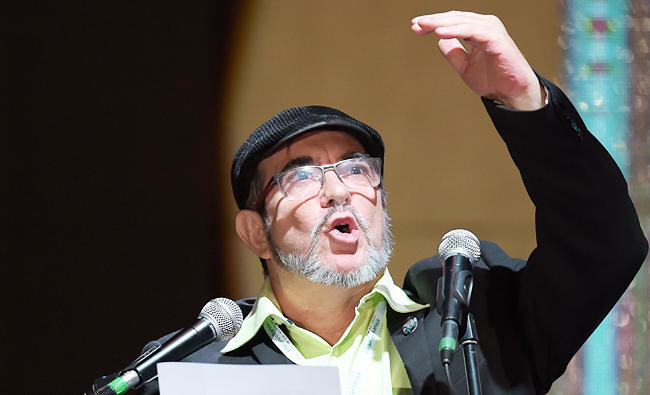
Rodrigo Londono, 58, better known by his nickname “Timochenko,” will be the party’s choice for the polls, a FARC spokesman told a news conference. The first round of voting is scheduled for May 2018.
Timochenko was previously the supreme commander of the Revolutionary Armed Forces of Colombia — FARC in Spanish — a Marxist guerrilla group that for half a century battled the government and right-wing paramilitaries.
The conflict, marked by kidnappings and disappearances, left some 260,000 people dead, 60,000 unaccounted for and seven million displaced.
The FARC rebels agreed in 2016 to a landmark peace deal with the government. It disarmed and in September transformed itself into a political party, keeping the same initials but changing its official name to the Common Alternative Revolutionary Force.
Just ahead of the political FARC’s founding congress in August, Timochenko — who suffered a temporary arterial brain blockage in July, impeding his speech — had ruled out the party putting forward a presidential candidate next year.
But the party named Timochenko its leader, and with Wednesday’s announcement showed it changed its mind, and intended to have him try to succeed current President Juan Manuel Santos, who is ineligible to stand for re-election.
Timochenko was not present at the news conference declaring his candidacy.
He stayed away for “health reasons,” a FARC official, Marco Calarca, told AFP, but added that the party leader had a medical green light to contest the elections.
Instead the FARC chief’s Twitter account posted the message: “For landless peasants, young people with no opportunities, we are launching our candidacy.”
The FARC party also put forward other prominent members as candidates for congressional elections in March 2018. They included Ivan Marquez — a former commander and party spokesman who declared Timochenko’s candidacy — and three former negotiators who saw through the peace deal.
The FARC, however, has a negative image for the majority of Colombians, according to surveys, making its election bids uncertain.
Under the peace deal, former rebels and government soldiers guilty of crimes during the conflict can receive non-prison punishment if they confess, make reparations to victims, and renounce violence.
It is unclear if FARC candidates who win elections can take up their mandates before being judged by an extraordinary tribunal, a Special Jurisdiction for Peace. Some say they would be disqualified from public office if convicted, but the party maintains there are no obstacles to its political ambitions.
Under the peace deal’s terms, the FARC is guaranteed 10 seats in Colombia’s Congress for two terms, though the party must take part in elections.
The UN, meanwhile, has heard concerns about progress under the peace deal.
In October, UN assistant secretary-general for human rights Andrew Gilmour warned that reintegration of former FARC fighters “is not going so well.”
Many are finding it difficult or impossible to return to civilian life, raising the risk they might turn to crime rings, illegal mining or drugs, he said.
“If you don’t reintegrate the fighters then there is a strong chance that they will go back to something worse, even if they’ve given up their weapons,” Gilmour told reporters at UN headquarters on October 20.
An analyst on Colombia’s conflict, Victor de Currea Lugo, said the FARC “knows they are not going to win (the presidential election), but they know they can strengthen their political movement” by taking part.
Carlos Arias, another analyst and a professor, said Timochenko’s candidacy was part of “a positioning strategy” to gauge the party’s electoral support and possible political alliances.