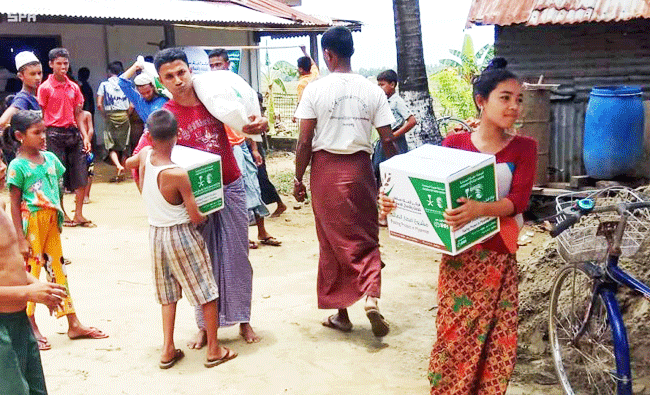
KSRelief steps up humanitarian assistance in Myanmar

KSrelief field teams periodically carry out inspections to follow up on the center’s projects in various countries.
Updated 22 May 2018
Follow

KSRelief steps up humanitarian assistance in Myanmar

  • KSRelief donated $300,000 to the hospital for the equipment
  • The plight of Rohingya Muslims is the world’s fastest-growing refugee crisis, with more than 705,000 risking death to leave by sea or on foot since August 2017

RIYADH: The King Salman Center for Humanitarian Aid and Relief (KSRelief) has increased humanitarian efforts providing food and medical assistance to the victims of human rights abuses in Myanmar.
Azzam Obaid, a media adviser at KSRelief headquarters in Riyadh, told Arab News on Monday that KSRelief distributed food baskets to needy families in the villages of Arakan province in Myanmar.
Rohingya Muslims, representing the largest percentage of Muslims in Myanmar, live in Rakhine state.
The food basket distribution comes within the framework of humanitarian projects carried out by KSRelief for distressed people in a number of countries including Myanmar.
Dr. Abdullah Al-Moallem, director for health and environment aid at KSRelief, told Arab News that a medical team from the center visited Myanmar and assessed the requirements of the hospital in Yangon, which provides medical services to all in need.
“A specialized medical team by the order of King Salman traveled to Myanmar to provide medical assistance, mainly equipment to the Islamic charity hospital,” said Al-Moallem, adding that the team visited to see the reality on the ground, interact with staff and return an assessment.
KSRelief donated $300,000 to the hospital for the equipment.
The medical team’s visit was coordinated by the Ministry of Foreign Affairs through the Saudi Embassy in Myanmar. KSrelief field teams periodically carry out inspections to follow up on the center’s projects in various beneficiary countries around the world.
The plight of Rohingya Muslims is said to be the world’s fastest-growing refugee crisis, with more than 705,000 risking death to leave by sea or on foot since August 2017. They are fleeing to neighboring Bangladesh after the destruction of their homes.
The UN described the offensive in Rakhine, which provoked the exodus, as a “textbook example of ethnic cleansing.”


Saudi hospitality boom sparks innovation beyond the plate

Chefs at Julien prepare meals to pair with Diageo drinks. (AN photo by Basmah Albasrawi)
Updated 11 January 2026
Follow

Saudi hospitality boom sparks innovation beyond the plate

  • At the Four Seasons Riyadh, Diageo hosted a private tasting at Tonic Bar followed by a 10-course dinner at Julien
  • Dinner at Julien paired dishes with drinks made using Tanqueray 0.0, Captain Morgan 0.0, and Guinness 0.0

RIYADH: As restaurants and hotels in Saudi Arabia refine their culinary identities, beverages are increasingly being treated as crafted experiences in their own right, shaped by technique and intention.

At the Four Seasons Riyadh, Diageo hosted a private tasting at Tonic Bar followed by a 10-course dinner at Julien, offering a snapshot of how this evolution is beginning to take shape, as international players and local venues test new approaches to pairing and presentation. 

Speaking to Arab News, Nick Rees, marketing director of Diageo MENA, pointed to the rapid growth of the nonalcoholic segment globally and in the region: “There’s a far faster growing percentage of it (the industry) is non-alcohol … There (are) trends globally … A lot of it will be pointed to wellness, mindful drinking.”

Rees said that Saudi Arabia’s fast-developing culinary and hospitality scene calls for beverages that match the level of excellence seen in kitchens across the Kingdom.

“It’s kind of the lack of choices and that’s where we want to be able to provide people the option, and people here absolutely have the same kind of talent and desire as their counterparts behind the kitchen,” he said.

“That’s where our role is to give people the kind of core ingredients for them to be able to work with … we have many more brands that we would love to introduce to the Kingdom.”

The dinner at Julien paired dishes with drinks made using Tanqueray 0.0, Captain Morgan 0.0, and Guinness 0.0, offering a glimpse into the range of styles Diageo is bringing to the market.

Flavor profiles ranged from light and refreshing combinations with cucumber and capers brine to richer, malt-forward blends, each designed to complement the accompanying dishes, from ravioli to black cod. 

Rees emphasized that pairing food with thoughtfully crafted beverages is becoming an essential part of the hospitality experience. 

“In the Kingdom, we’re looking at giving people the experience that currently is not available to them because I know for sure that the kind of quality and expertise and craftsmanship that can go into creating some of these drinks is absolutely as exciting as the work that the chefs would do with their food,” he said.

Anthony Abou Haider, head of Gulf at Diageo, said the company sees long-term potential in Saudi Arabia’s hospitality sector. 

“It’s such an opportunity to be a part of this transformation journey,” he told Arab News. “We’re not looking for a short-term gain, we’re looking at a very long-term gain here because whatever we do now is building for the future.”