

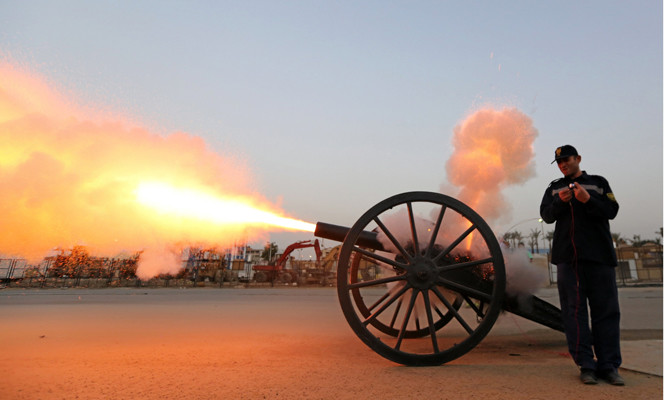


JEDDAH: One of the most popular Ramadan traditions has been the firing of a cannon at the start of Maghreb prayers.
It is a tradition that is still carried out in several Muslim countries including Egypt, the UAE, Bangladesh, Kuwait, and, most famously, in the mountainous region of Makkah.
The cannon has a very special place in the hearts of many in Makkah. It is a tradition that has always been handled by the Makkah police every Ramadan. Children particularly look forward to it as sunset approaches.
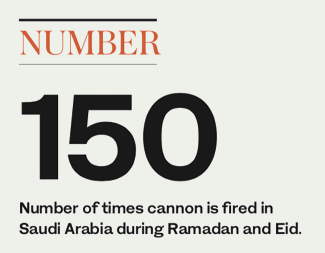 Maj. Abdul Mohsin Al-Maimani, a spokesman for the Makkah police department, said that the public eagerly wait for the sound of the cannon during Ramadan.
“When Makkah police was founded 75 years ago, it was entrusted with the maintenance and care of this cannon. After Eid, the cannon is returned to a special department. A few days before Ramadan, it is sent back to the mountain. The powder is handled by a special team so that no one gets hurt,” he said.
The official Saudi government network channel often focuses on the famous cannon being fired on the mountain during its coverage of Maghreb prayers in Makkah, as viewers around the world share in this decades-long Ramadan tradition, a cannon blast triggering feelings of nostalgia.
Today, there are two cannons in Madinah, one of them on Salaa Mountain. During the reign of King Faisal, the second cannon was placed on the hill outside Quba Castle. However this year Arab News has learned that Madinah will not be carrying out the cannon-firing tradition due to operational malfunctions and technical requirements. Next year, however, the city plans on reintroducing it.
Cannon firing has roots that can be traced to 19th-century Egypt, and according to some accounts even as far back as the 15th century, in the era of the Mamluks.
 The cannon was fired to notify Muslim worshippers that the time to break their fast had arrived. A second firing followed much later, in the early-morning hours during the call to Fajr prayers, and signalled the start of a new fasting day.
There are a few different versions of the story of how the cannon tradition came about. One is that the Mamluk sultan in Cairo wanted to test-fire one of his new cannons, and the experiment coincided with Maghreb prayers. Residents thought the sultan had fired the cannon to notify worshipers that it was time to break their fast. When the sultan saw how happy the people were with this new “innovation,” he decided to do it every day.
A second account says that it was Muhammad Ali, the ruler of Egypt in the early 19th century, who fired a German-made cannon at Maghreb time and people thought that this gesture was a sign to break their fast.
A third story places the origin of this practice later, during the time of Khedive Ismail in late-19th century Egypt. The story similarly goes that soldiers were testing a cannon that went off at Maghreb time.
When Fatimah, the khedive’s daughter, heard about this, she issued a decree saying that the cannon should be used at Maghreb and during official events on Eid days. For this reason, some call the cannon firing during Ramadan “Fatimah’s cannon.”


