DUBAI: For many, the 1948 Palestinian mass exodus, more commonly known in the region as the Nakba, is only known from the heart-wrenching tales that parents and grandparents pass down to their children.
Now, 70 years after more than 700,000 Palestinians were forced to flee from their homes and villages, the third generation since the Nakba still struggles with national identity and where to call home.
“I never say I’m just Palestinian because I have never lived there,” Tamara Yassin, 25, told Arab News. “My ties to it are just my grandparents. My mom was born in 1967 and that is when they left Palestine. I know my roots are Palestinians, but the UAE raised me.” Yassin’s grandparents are originally from Jaffa but had to migrate to Gaza before leaving Palestine for the UAE.
“Life just turned out that way and it’s a place I’ve visited for a couple of weeks when I was 16… I know the history. I know my grandparents’ stories, but three places are part of me growing up and they’re the UAE, the USA and Palestine,” said Yassin, who now lives in UAE-emirate of Sharjah.
After the Nakba, Palestinians were dispersed all across the globe, seeking refuge and another place to temporarily call home. Families were formed and children were born outside the country their parents grew up in, so differing ideologies often clashed.
“I’m a Palestinian who grew up in Saudi Arabia,” said 28-year old Dania Husseini, whose family hails from Jerusalem. “I guess I’m one of those who have an identity crisis. I don’t fit into the typical Palestinian culture or the Saudi or the Western, really. I have a mentality of my own that developed after living in all the environments I lived in and met the people that were part of them.”
Yazan Samir Al-Khatib, whose family moved from Nablus to Puerto Rico during the exodus, said: “I cannot deny the fact that my thoughts and ideologies have been heavily influenced by Puerto Rico as well as the United States. I have a profound love for the Latin culture and somewhat a sense of belonging to the American civilization.”
While most third generation Palestinians have never lived in Palestine, some still feel a strong sense of belonging to the land that was stripped away from their parents and grandparents – one that will never fade.
“I would, without fail, travel to Palestine (West Bank) every summer and it was there that I felt most at home. I would go to school in Puerto Rico and later the US in anxious anticipation for the summer to come along so I can finally board a plane to Amman, cross the Jordan-Israeli border and take a taxi to my beloved Lubban,” Al-Khatib said.
While many have a sense of belonging like Al-Khatib, some believe that it’s where they grew up, and not where they hail from, that forms who they are and where they’re from. “When anyone asks me, I say I’m Jordanian,” said Rand Fermawi, whose family moved to Amman from Jaffa. “I grew up there and so did my parents. I know a lot of die-hard Palestinians who are like that because their parents made sure to let them know what their ancestors went through, but other parents chose not to do that,” Fermawi said.

Third-generation Palestinians look to their roots
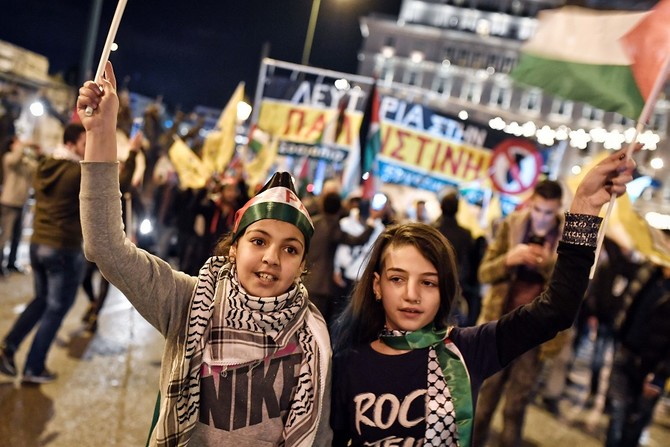
- Now, 70 years after more than 700,000 Palestinians were forced to flee from their homes and villages, the third generation still struggles with national identity and where to call home
- While most third generation Palestinians have never lived in Palestine, some still feel a strong sense of belonging to the land that was stripped away from their parents and grandparents

Yemen PM Al-Zindani to Asharq Al-Awsat: Govt. to move to Aden soon, Foreign Ministry retained to complete reforms
- Dr. Shaya Al-Zindani pledges gradual institutional rebuilding as government prepares to relocate to Aden and restore effective governance
- New prime minister retains foreign affairs portfolio to complete diplomatic restructuring and reinforce Yemen’s international standing
RIYADH: Yemen’s Prime Minister and Foreign Minister, Dr. Shaya Al-Zindani, has signaled the first concrete move by his newly sworn-in government, announcing that it will relocate to Aden in the near future, just 24 hours after taking the constitutional oath.
In remarks to Asharq Al-Awsat, Al-Zindani said his decision to retain the foreign affairs portfolio was driven by the need “to complete the work already begun,” stressing that a return to Yemen is essential to restoring effective governance.
He noted that the move inside the country is a necessary step to activate performance, adding that a presence in Aden must be linked to a genuine ability to manage state files and restore regular institutional functioning.
The comments came during a special episode of the Asharq Al-Awsat Podcast, recorded at Asharq TV studios at the Saudi Research and Media Group headquarters in Riyadh’s King Abdullah Financial District.
Al-Zindani spoke at a time of acute economic pressure and heightened political expectations.
He said the current phase does not allow for expansive rhetoric, but rather requires gradual, practical work to rebuild confidence, noting that stabilizing institutional rhythm must precede any expansion of objectives.
Addressing questions on the composition of his cabinet, Al-Zindani highlighted that ministers were selected on purely professional criteria, based on competence, specialization, and experience, away from partisan dictates.
He emphasized that weak institutional foundations had been a central cause of past failures, underscoring the need to rebuild state structures and strengthen oversight.
He pointed to relative improvements in some public services, particularly electricity, with Saudi support, while noting that the real challenge lies in sustaining economic reforms and managing resources effectively.
On accountability, he argued that unifying political decision-making has opened the door to enforcing the rule of law. When authority is unified, reward and punishment become possible, he underlined.
On economic policy, Al-Zindani avoided quick promises, instead focusing on resource management and reprioritization.
Recovery, he said, cannot be achieved through piecemeal decisions but requires restructuring public finance, enhancing transparency, and activating oversight mechanisms.
He stressed that financial stability is the foundation for any tangible improvement in citizens’ lives and for restoring domestic and international confidence.
He continued that working from within Yemen will enable the government to better understand societal priorities and reassert the state’s presence in public life, an influence eroded by years of conflict.
He described taking the oath in Riyadh as a constitutional and security necessity dictated by circumstances, arguing that attention should focus on the substance of government action rather than symbolism.
On security, Al-Zindani adopted a cautious, realistic tone, acknowledging that years of accumulated challenges cannot be erased quickly.
Still, he said coordination among security agencies and unified political leadership have led to relative improvements.
While recognizing protests as part of transitional phases, he stressed the need for adherence to legal frameworks to preserve stability and avoid derailment of recovery efforts.
According to the Yemeni official, reorganizing the armed forces requires unified command and redeploying units outside cities to consolidate state authority and reduce overlap between military and security roles.
He noted that multiple loyalties in previous phases weakened institutions and must be overcome to restore stability.
Internationally, he said unified political representation strengthens Yemen’s legal and diplomatic standing.
He justified retaining the foreign ministry to complete reforms already underway, including restructuring the ministry and overseas missions, describing diplomatic normalization as integral to rebuilding the state.
He further described relations with Saudi Arabia as having evolved from traditional support into a multi-dimensional partnership impacting vital sectors, with scope to expand cooperation in development and economic stability.
On the Houthis, Al-Zindani said the government showed flexibility in peace efforts but faced repeated noncompliance, adding that recent military and economic developments have weakened the group’s position.
Any future negotiations, he stressed, must rest on clear references, with unified anti-Houthi forces giving the government a stronger negotiating hand amid rapid regional and international shifts.


