

‘Jerusalem will always be home, wherever I am’: Dr. Bishara A. Bahbah

Updated 26 July 2018
Follow

‘Jerusalem will always be home, wherever I am’: Dr. Bishara A. Bahbah

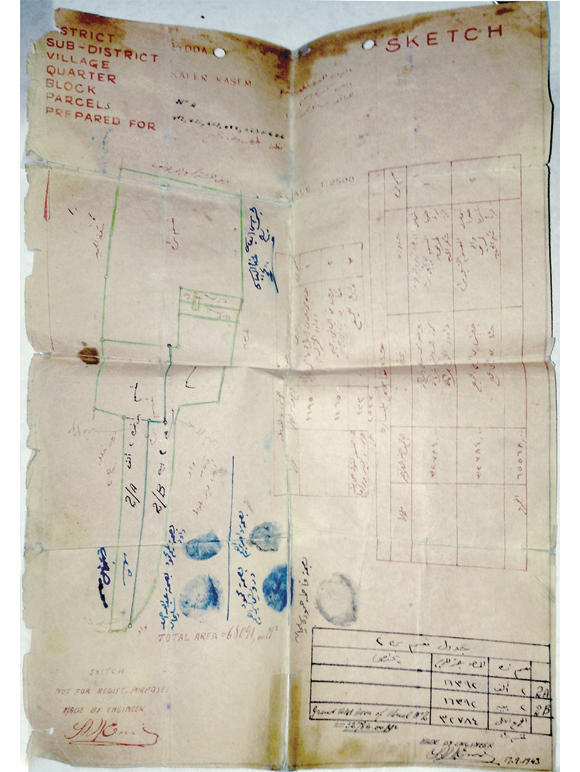
Dr. Bishara A. Bahbah, a professor of investment, finance and wealth management who lives in the United States, is one of many Palestinians whose family still has the deed to their land in Palestine, a 68-dunum orchard in the Lod-Jaffa area. 

He also has his family’s UNRWA food card which shows the monthly rations they received when they were living both in the Zarqa Refugee Camp and then the Old City of Jerusalem.

“In contrast,” he wrote us when we were setting up this photograph, “I have on my wall my Harvard PhD which clearly demonstrates that even if Israel takes our lands, they can never take away our brainpower and our unshakable will and determination to succeed. They would have to chop off our heads from our bodies first for them to ultimately succeed.” And with that, we thought it was best to let Dr. Bahbah speak for himself. 

Name: Bishara Assad Rizek Issa Bahbah.

Age: 60.

Where you live now:  United States.

Where your family lived in Palestine: The Old City of Jerusalem

What happened to you/them in 1948

My father, who was a barber, had a barbershop at the King David Hotel. When Zionists blew up the hotel, my father was in his shop at the hotel. Some woman, we don’t know who, said to him: “Bahbah, jump! A bomb is about to explode.”  

He jumped from the second floor as the bomb was exploding. The shock caused my father’s hair to turn grey within a a few months.  Shortly after, my family fled to Jordan and ended up in the Zarqa refugee camp, where they took shelter for two years.  After that, the family returned to the Old City.
One of my sisters was born in the refugee camp.
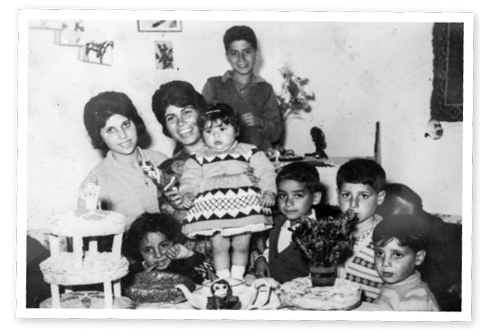
What memories do you have of your home?

Our rented house in the Old City still exists. Nine of us lived in one bedroom with no running water or electricity. I remember as a child studying using a lantern. I also remember when it rained, the water would seep through the aluminum blocks that made up the roof and the room would be full of buckets to catch the water.

However, my grandfather, on my mother’s side, owned along with his brother, some 68 dunums (orchard) close to Jaffa. My grandparents fled and came to live with us at first in the refugee camp, and later in the Old City. You have a copy of the deed/map of the orchard. An Israeli hospital has been built on the family orchard and by most estimates the land is worth today more than $100 million.

How do you identify yourself now, in terms of nationality?

I am a Palestinian national and a US citizen. I have no other passport than the US one. In 2009, Israel took away my Jerusalem residency, represented by the blue ID card that they issued. They claimed that since I am now a US citizen, my
center of life is no longer Jerusalem and simply took away my right to reside in Jerusalem. Now, when I go back to visit family, I go in using the US passport and I am given a 90-day visa like any other American citizen. Of course, I am fortunate that I have the US passport. At least I get to visit my own land.

Where is home for you?

Home is in the United States. I cannot live in Jerusalem even though I lived there when Israel occupied Jerusalem. 

I stayed in Jerusalem until 1976 when I went to the United States to continue my college education. I went back in 1983 after receiving my PhD from Harvard University and became the editor-in-chief of Al-Fajr newspaper. 

My travels in and out of the country were the excuse that the Israelis used to strip me of my residency and right to live in Jerusalem.

Do you have hope that you will ever get the right of return?

Absolutely! It will always be home, no matter where I live in the world. In fact, I registered my children who were born in the United States in my UNRWA registry. 

When I die, I want there to be a record that we are Palestinian and Jerusalemites. It is our eternal right and no one can take it away from us.

What would you like to tell the world about the Nakba?

The Nakba is a tragedy perpetrated against us by the world. The UN General Assembly voted to divide Palestine into an Arab and Jewish state. 

It is the world’s moral obligation for having given away what was not theirs (Palestine, my homeland) to the Jews/Zionists. By attempting to absolve themselves from the horrors that befell the Jews at the hand of Hitler, they committed a bigger injustice against the Palestinians. Shame on them.

US military launches strikes in Syria against Daesh fighters after American deaths

Updated 5 min 37 sec ago
Follow

US military launches strikes in Syria against Daesh fighters after American deaths

  • “This is not the beginning of a war — it is a declaration of vengeance,” Defense Secretary Pete Hegseth says
  • President Trump earlier pledged “very serious retaliation” but stressed that Syria was fighting alongside US troops

WASHINGTON: The Trump administration launched military strikes Friday in Syria to “eliminate” Daesh group fighters and weapons sites in retaliation for an ambush attack that killed two US troops and an American interpreter almost a week ago.
A US official described it as “a large-scale” strike that hit 70 targets in areas across central Syria that had Daesh (also known as Islamic State or IS) infrastructure and weapons. Another US official, who also spoke on condition of anonymity to discuss sensitive operations, said more strikes should be expected.
The attack was conducted using F-15 Eagle jets, A-10 Thunderbolt ground attack aircraft and AH-64 Apache helicopters, the officials said. F-16 fighter jets from Jordan and HIMARS rocket artillery also were used, one official said.
“This is not the beginning of a war — it is a declaration of vengeance. The United States of America, under President Trump’s leadership, will never hesitate and never relent to defend our people,” Defense Secretary Pete Hegseth said on social media.
President Donald Trump had pledged “very serious retaliation” after the shooting in the Syrian desert, for which he blamed Daesh. The troops were among hundreds of US troops deployed in eastern Syria as part of a coalition fighting the terrorist group.
Trump in a social media post said the strikes were targeting Daesh “strongholds.” He reiterated his support for Syrian President Ahmad Al-Sharaa, who he said was “fully in support” of the US effort to target the militant group.
Trump also offered an all-caps threat, warning the group against attacking US personnel again.
“All terrorists who are evil enough to attack Americans are hereby warned — YOU WILL BE HIT HARDER THAN YOU HAVE EVER BEEN HIT BEFORE IF YOU, IN ANY WAY, ATTACK OR THREATEN THE USA.,” the president added.
The attack was a major test for the warming ties between the United States and Syria since the ouster of autocratic leader Bashar Assad a year ago. Trump has stressed that Syria was fighting alongside US troops and said Al-Sharaa was “extremely angry and disturbed by this attack,” which came as the US military is expanding its cooperation with Syrian security forces.
Syria’s foreign ministry in a statement on X following the launch of US strikes said that last week’s attack “underscores the urgent necessity of strengthening international cooperation to combat terrorism in all its forms” and that Syria is committed “to fighting Daesh and ensuring that it has no safe havens on Syrian territory and will continue to intensify military operations against it wherever it poses a threat.”
IS has not claimed responsibility for the attack on the US service members, but the group has claimed responsibility for two attacks on Syrian security forces since, one of which killed four Syrian soldiers in Idlib province. The group in its statements described Al-Sharaa’s government and army as “apostates.” While Al-Sharaa once led a group affiliated with Al-Qaeda, he has had a long-running enmity with IS.
Syrian state television reported that the US strikes hit targets in rural areas of Deir ez-Zor and Raqqa provinces and in the Jabal Al-Amour area near Palmyra. It said they targeted “weapons storage sites and headquarters used by Daesh as launching points for its operations in the region.”

Map showing the location of Syria's provinces of Deir ez-Zor and Raqqa and the city of Palmyra, where Daesh positions were targetted on Dec. 19, 2025 by US air strikes. (Map courtesy of Gemini)

Trump this week met privately with the families of the slain Americans at Dover Air Force Base in Delaware before he joined top military officials and other dignitaries on the tarmac for the dignified transfer, a solemn and largely silent ritual honoring US service members killed in action.
The guardsmen killed in Syria last Saturday were Sgt. Edgar Brian Torres-Tovar, 25, of Des Moines, and Sgt. William Nathaniel Howard, 29, of Marshalltown, according to the US Army. Ayad Mansoor Sakat, of Macomb, Michigan, a US civilian working as an interpreter, was also killed.
The shooting nearly a week ago near the historic city of Palmyra also wounded three other US troops as well as members of Syria’s security forces, and the gunman was killed. The assailant had joined Syria’s internal security forces as a base security guard two months ago and recently was reassigned because of suspicions that he might be affiliated with Daesh, Interior Ministry spokesperson Nour Al-Din Al-Baba has said.
The man stormed a meeting between US and Syrian security officials who were having lunch together and opened fire after clashing with Syrian guards.
When asked for further information, the Pentagon referred AP to Hegseth’s social media post.