North Korea agrees to warn of activity hazardous to aviation: UN agency

North Korea had provided warnings of all missile launches until around 2014 but that gradually ended and by 2016 airlines avoided the airspace entirely. (Reuters)
Updated 10 May 2018
Follow

North Korea agrees to warn of activity hazardous to aviation: UN agency

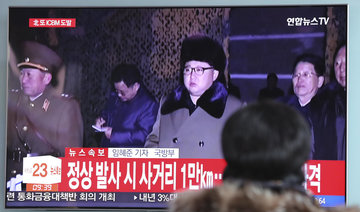
BEIJING: North Korea has agreed not to engage in activities hazardous to aviation without advanced notice, a UN aviation agency official said on Thursday, an assurance that could lead to major airlines resuming flights through its airspace.
Airlines take indirect routings to avoid North Korea due to the threat posed from unannounced missile launches that are worrisome in the wake of the 2014 downing of Malaysia Airlines Flight MH17 over Ukraine.
If the airspace was deemed safe, carriers could save fuel and time on some routes between Asia and Europe and North America.
Officials from the Montreal-based International Civil Aviation Organization (ICAO) visited North Korea this week to discuss a request by Pyongyang to open a new air route that would pass through North Korean and South Korean airspace.
“We received a solid assurance from the Democratic People’s Republic of Korea that they will not be engaging in activities hazardous for aviation without full advanced notice for the other states in the region, and that they would coordinate that activity to ensure that we could retain safety,” ICAO Air Navigation Bureau Director Stephen Creamer said upon his return to Beijing.
Asked whether this meant international airlines would resume flights over North Korea, ICAO Regional Director Arun Mishra said: “It’s always a possibility ... We’re continuing toward establishing a more healthy relationship.”
It is the latest sign of practical reconciliation measures taken since North Korean and South Korean leaders met last month for a first summit in years, and signed a pledge to pursue peace on the peninsula.
Countries such as Britain, France, Germany and the United States have advised airlines not to fly in North Korean airspace, called the Pyongyang flight information region (FIR).
Mark Zee of Flight Service Bureau, which provides safety information on airspace to airlines, said on Wednesday that North Korea had provided warnings of all missile launches until around 2014 but that gradually ended and by 2016 airlines avoided the airspace entirely.
He said a guarantee by North Korea that it would provide warning if it fired a missile would likely be enough for regulators to remove warnings about the airspace.
“It seems very likely that in the coming months, we will start to see international traffic start to use the Pyongyang FIR again, and may even see some new airways being established,” Zee said in a website post before the ICAO meeting concluded.


Four cops killed as separatist militants launch ‘coordinated’ attacks in Pakistan’s southwest — police

Updated 6 sec ago
Follow

Four cops killed as separatist militants launch ‘coordinated’ attacks in Pakistan’s southwest — police

  • The attacks began in Balochistan’s capital of Quetta at around 6am with a powerful explosion, followed by intense gunfire

QUETTA: Separatist militants, affiliated with the Balochistan Liberation Army (BLA), have launched “coordinated” attacks in several cities of Pakistan’s southwestern Balochistan province and killed at least four policemen, officials said early Saturday.

The attacks in the provincial capital of Quetta began at around 6am with a powerful explosion, followed by intense gunfire that lasted for two hours along with multiple explosions.

Residents of Dalbandin and Nuhski said they heard explosions and gunfire in the districts early Saturday morning, while there were reports of similar attacks in Mastung, Gwadar, Pasni and Turbat.

A senior police official, who requested anonymity, told Arab News that the militants attempted to enter the provincial capital of Quetta but police and other law enforcement agencies stopped them.

“The terrorists attacked a police mobile at Sariab road which resulted in the killing of two policemen,” he said. “Police and other law enforcement agencies denied space to the terrorists in Quetta city and a clearance operation is still going on.”

Balochistan, which borders Iran and Afghanistan, is the site of a decades-long insurgency waged by Baloch separatist groups who often attack security forces and foreigners, and kidnap government officials.

Shahid Rind, the Balochistan chief minister’s aide for media and political affairs, said police and paramilitary Frontier Corps (FC) had foiled the attacks and were chasing the assailants.

“After the killing of more than 70 terrorists at different places in Balochistan in the last two days, terrorists have attempted to attack at a few places in Balochistan, which have been foiled by timely action by the police and FC,” he said on X.

“At present, the pursuit of the fleeing terrorists is underway. More details will be revealed very soon.”

In a statement issued on Saturday, BLA said the group had launched ‘Operation Herof 2.0,’ which included a series of attacks in multiple cities of Balochistan.

Saturday’s attacks follow coordinated attacks carried out by the group in Aug. 2024 in various districts of Balochistan which killed dozens of people.

The separatists accuse the central government of stealing the region’s resources to fund development elsewhere in the country. The Pakistani government denies the allegations and says it is working for the uplift of local communities in Balochistan.

Pakistan Railways has suspended train service from Balochistan to other parts of the country for a day, following Saturday’s attacks.

“Quetta-Peshawar bound Jaffar Express, and Quetta-Chaman passenger trains have been canceled due to the prevailing security situation in Balochistan,” Muhammad Kashif, the railways controller in Quetta division, told Arab News.

At least four police officials in as many districts confirmed to AFP the situation was not completely under control yet.
“At least four policemen were killed in Quetta alone,” he added, speaking on condition of anonymity as he was not authorized to speak to the media.
A senior military official based in Islamabad confirmed the attacks, adding they were “coordinated but poorly executed.”