RIYADH: The Minister of Energy, Industry and Mineral Resources Khalid Al-Falih’s three-day visit to South Korea, which began in Seoul on Thursday, has provided a fresh impetus to bilateral relations.
Al-Falih met South Korean President Moon Jae-in and Minister of Trade, Industry and Energy Paik Un-gyu on Friday to expand bilateral cooperation in energy and other key sectors, Juho Song, commercial counselor at the Korean Embassy in Riyadh, told Arab News.
During the reception, the Korean president hailed the strong bilateral relationship between Saudi Arabia and Korea, which began in 1962. He said that cooperation was not limited to oil and conventional energy, but included industrial fields such as electric cars and machinery.
Song said that the South Korean president had called for joint efforts to enhance economic cooperation between the two countries, stressing the need to expand bilateral cooperation including in the health and cultural sectors.
Moon sought to promote South Korean nuclear energy technology, noting that his country had safely built and operated nuclear power plants for more than four decades, the presidential office in Seoul said.
Al-Falih said that the Kingdom aimed to diversify energy sources under Vision 2030, and to jointly develop new small or medium-sized reactors. It was also willing to invest in the joint development of electric and other future-oriented vehicles with South Korea.
The first meeting was in Seoul last October, when the countries launched a ministerial-level Saudi-Korea Vision 2030 committee to bolster cooperation, focus on supporting business ventures and enhance networking with sustainable support for economic reforms.
The Vision 2030 committee is comprised of five sub-groups headed by senior government representatives from both sides for cooperation in key sectors including energy and manufacturing, smart infrastructure and digitization, capacity-building, health care and life sciences, SME’s and investment.
Saudi Arabia and Korea are working closely on nuclear safety and security and the Kingdom has sent 41 nuclear experts to South Korea for training and learning to design, construct and develop nuclear plants based on System-integrated Modular Advanced Reactor (SMART) technology.
The SMART project aims to design and develop compact nuclear reactors so that the Kingdom can diversify energy sources in line with Vision 2030.
King Abdullah City for Atomic and Renewable Energy and the Korea Atomic Energy Research Institute signed a SMART pre-project engineering agreement in September 2015 that will remain in effect until November 2018.
Saudi Arabia has received requests for information from five countries — South Korea, China, the US, France and Russia — to build two nuclear reactors.
If South Korea wins the bid, it would be their second nuclear exports deal in the Middle East. In 2009, a consortium led by state-run utility Korea Electric Power Corp. tapped its first nuclear exports deal, a $20 billion contract with the UAE.


Saudi Arabia, South Korea expand mutual cooperation

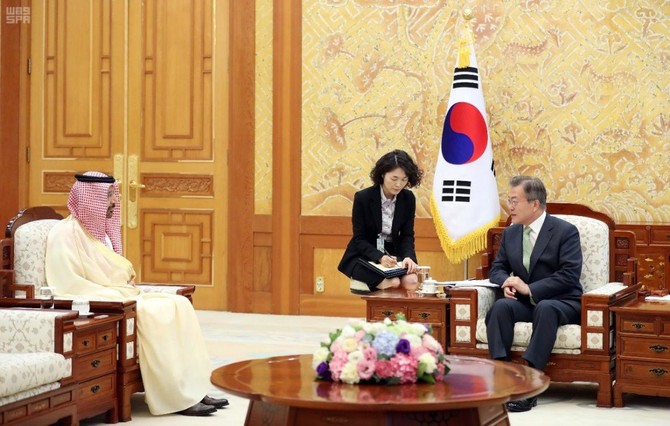
Saudi Arabia, South Korea expand mutual cooperation
- The strong bilateral relationship between Saudi Arabia and Korea began in 1962.
- Saudi Arabia and Korea are working closely on nuclear safety and security and the Kingdom has sent 41 nuclear experts to South Korea for training and learning to design, construct and develop nuclear plants based on System-integrated Modular Advanced Reac


Arab, Islamic youth explore Saudi heritage, holy sites, progress
- Participants in Holy Sites Journey program tour Makkah, Madinah, and Jeddah, witnessing world-class pilgrim services
JEDDAH: The 11th Holy Sites Journey Program recently concluded in Jeddah, with more than 114 youth from 33 Arab and Islamic countries participating.
The 10-day program was organized by the Ministry of Sport, in cooperation with the Organization of Islamic Cooperation and the League of Arab States.
Participants traveled across Makkah, Madinah, and Jeddah, exploring sacred sites, performing Umrah, and witnessing the Kingdom’s exemplary Hajj organizational practices.
They also visited historical landmarks, experienced modern sports facilities, and observed urban development projects, gaining insights into Saudi Arabia’s rich heritage, spirituality, and progress.
At a closing event in Jeddah on Thursday, Ahmed Al-Ghamlas, assistant deputy minister of sports for youth affairs, praised the participants and emphasized the Kingdom’s commitment to hosting programs that empower the next generation.
He also encouraged those taking part to serve, on returning to their home countries, as ambassadors conveying the Kingdom’s advancements in services for pilgrims.
Al-Ghamlas added: “The program aimed to strengthen cultural and youth communication between Arab and Islamic countries, highlight the Kingdom's leading role in serving Islam and Muslims, and empower youth by building their capabilities.”
Ambassador Tarig Ali Bakheet, assistant secretary-general for humanitarian, cultural, and social affairs at the Organization of Islamic Cooperation, praised Saudi Arabia's efforts in organizing the program for young people from Arab and Muslim countries, noting it as a step to promote cultural dialogue among youth from Islamic nations.
Participants expressed their appreciation and gratitude for the opportunity to be part of the journey, witness the Kingdom’s transformative projects and world-class facilities, and pledged to share the knowledge, experiences, and insights they gained with peers in their home countries.
Bilal Jabiro, head of the Syrian Ministry of Youth delegation, told Arab News: “It was a great journey, and I enjoyed every minute of it. We sincerely thank Saudi Arabia for giving us this opportunity to strengthen our ties with youth from other Islamic nations and to see firsthand the great services and facilities the Kingdom offers to visitors and pilgrims.”
Youssef Issa Al-Sharifi, a member of the Supreme Council for Algerian Youth, praised the program’s objectives, saying: “Participation is an opportunity for every Arab Muslim.”
Meanwhile, Hussain Saeed from Oman told Arab News that he was happy to see the expansion of the Two Holy Mosques, adding: “It was a very informative and educational journey.”
Syrian influencer Azam Al-Khaldi said the program combined worship, knowledge, and history.
“It was an amazing journey, and I had the pleasure of showing my followers every step of the 10-day program,” he added.


