


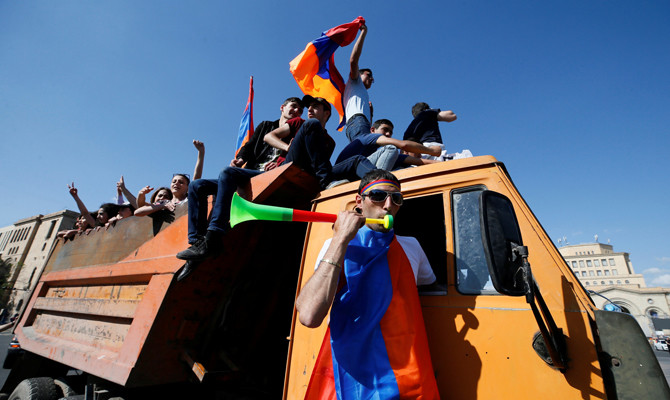
YEREVAN: Tens of thousands of Armenians converged on the capital Wednesday, blocking key transport links and government buildings, as popular anger exploded over the ruling party’s rejection of opposition leader Nikol Pashinyan’s bid to become prime minister.
In an unprecedented show of defiance, protesters including elderly people, pupils and even housewives paralyzed Yerevan, with streets closed to traffic, and the subway and numerous stores shut.
The poor, Moscow-allied nation was plunged into its most serious political crisis in years last month when mass demonstrations led by Pashinyan forced the resignation of longtime leader Serzh Sargsyan.
Crowds of protesters across the city Wednesday waved national flags, blew vuvuzelas and shouted “Free, independent Armenia!,” turning a new day of rallies into a street carnival.
Leading supporters on a march, Pashinyan pledged to ramp up pressure on the authorities.
“Various scenarios are under discussion; under each scenario, the people will win,” said Pashinyan who was wearing his trademark khaki-colored T-shirt and a baseball cap.
Suburban train services were disrupted and the road linking Yerevan with its airport was blocked, forcing travelers to drag their luggage on foot.
The central bank warned Armenians against a run on banks, saying it was capable of ensuring the “stability of the country’s financial system.”
Protesters said they would persist for as long as it takes to oust the ruling elites from power to rid the country of poverty and corruption.
“The people will not give up, protests will not subside,” said Sergey Konsulyan, a 45-year-old businessman.
Student Gayane Amiragyan, 19, added: “We will win because we are united, the whole Armenian people are united.”
On social media, Armenians launched a “name and shame” campaign against lawmakers, forcing the Parliament speaker to ask them to stop harassing MPs.
“I urge a halt to the persecution of lawmakers, stop insulting them on social media, on the streets and public places and publishing their addresses and phone numbers,” said Ara Babloyan.
In Parliament, lawmakers could not convene for a session due to the absence of a quorum, with the Prosperous Armenia party declaring a boycott over “an emergency situation in the country.”
Lawmakers will try to elect a prime minister next Tuesday, Babloyan said. If they fail again, the legislature will be dissolved and early elections called.
In the second city of Gyumri — which hosts a Russian military base — and the smaller town of Maralik, demonstrators burst into the mayor’s offices, demanding the local authorities join the protest movement.
Acting head of government Karen Karapetyan urged talks to end the crisis.
“A prime minister should only be elected in parliament according to the constitution,” he said.
Armenians’ famed good humor and temperament were on full display as they turned the general strike into a colorful spectacle, performing the country’s national dance at the roadblocks and grilling meat.
A photo of a little boy blocking a street with his tiny toy cars went viral, as did a picture of a coffin outside the offices of the ruling party in the small town of Artik.
Pashinyan urged Armenians to launch a general strike after the ruling Republican Party on Tuesday shot down his bid for prime minister following weeks of protests against Sargsyan and Armenia’s corrupt elite.
Parliament voted 45 in favor to 55 against Pashinyan, with Sargsyan’s Republican Party saying he was not a suitable candidate for the top job.
Pashinyan — who was the sole candidate in the running for prime minister— was widely expected to get elected.
But his failure has plunged the Moscow-allied nation into uncertainty, with observers expressing concern that the turmoil could destabilize the country and the wider region.
Pashinyan has ruled out any possibility of clashes between protesters and police but the risk of violence has not been lost on politicians in a country locked in a decades-long territorial dispute with Azerbaijan.
Pashinyan’s protest movement had accused Sargsyan and his party of a power grab, saying the former leader wanted to extend his grip on power by becoming premier after serving as president for a decade, despite failing to tackle a litany of problems.


