Armenian leader resigns, says to protesters: ‘I was wrong’

1 / 4
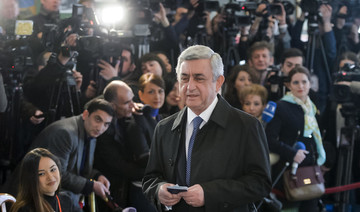
Opposition leader Nikol Pashinyan delivers a speech during a protest against the appointment of ex-president Serzh Sarksyan as the new prime minister, after being released by police in central Yerevan on April 23, 2018. (REUTERS/Hayk Baghdasaryan/Photolure)
2 / 4
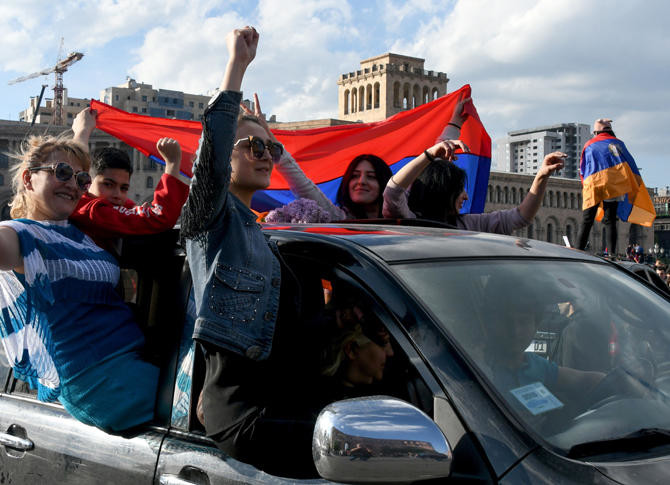
Armenians celebrate prime minister Serzh Sarkisian's resignation in downtown Yerevan on April 23, 2018. (AFP / Vano Shlamov)
3 / 4
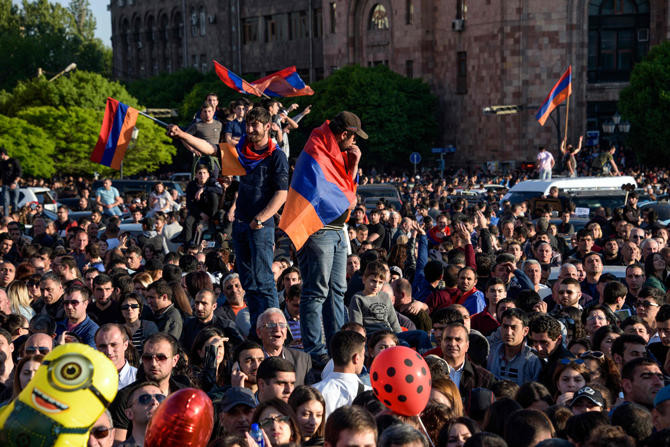
People celebrate Armenian prime minister Serzh Sarkisian's resignation in downtown Yerevan on April 23, 2018. (AFP / KAREN MINASYAN)
4 / 4
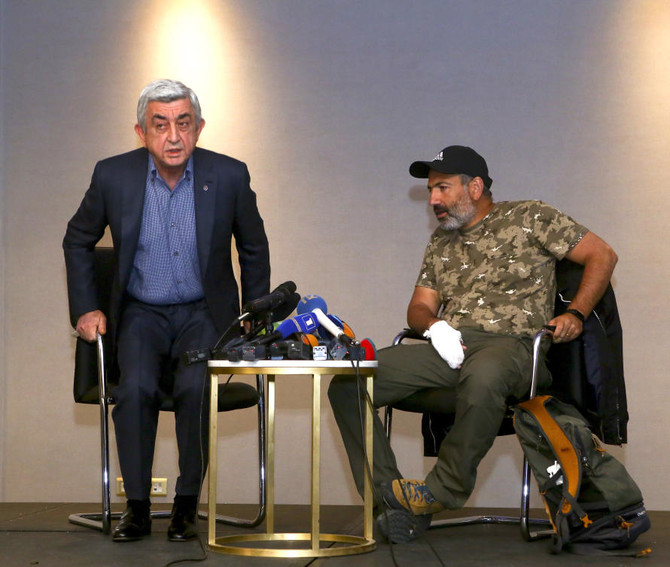
In this photo taken on Sunday, April 22, 2018, former Armenian President Serzh Sargsyan, left, leaves a meeting with protest leader Nikol Pashinian, right, in Yerevan. Armenian Prime Minister Serzh Sargsyan has resigned, according to his website. (Hrant Khachatryan/PAN Photo via AP)
Updated 23 April 2018
Follow

Armenian leader resigns, says to protesters: ‘I was wrong’

  • Armenians have poured out into the streets in protest over Sargsyan's apparent attempt to perpetuate himself in power
  • Former Prime Minister Karen Karapetian was named acting premier and opposition leader Nikol Pashinian was released from detention

YEREVAN: Armenian Prime Minister Serzh Sargsyan resigned unexpectedly Monday to quell massive anti-government protests over what critics feared was his effort to seize power for life.
Residents of the capital, Yerevan, poured out on the streets to celebrate his stunning departure. People hugged and kissed each other, and motorists honked their horns.
Protest leader “Nikol Pashinian was right. I was wrong,” Sargsyan, a former Armenian president, said in a surprise announcement on his website. “The movement on the streets is against my rule. I’m complying with their demands.”
The move plunges the Caucasian Mountains country into uncertainty after 10 days of protests against Sargsyan’s appointment as prime minister.
The appointment was part of a transition to a new governmental system that reduces the powers of the presidency and bolsters those of the premier. Critics saw that as an attempt by 63-year-old Sargsyan, who served as president from 2008 until term limits forced him out in March, to stay in power indefinitely.
It echoes similar tenure-lengthening maneuvers by Russian President Vladimir Putin — Armenia’s closest ally. Leaders of other former Soviet republics from Belarus to Central Asia have also engineered themselves lifetime jobs.
The streets of Yerevan have turned into masses of human anger since anti-government protesters began rallying on April 13, blocking government buildings and facing off with police. Sunday’s rally attracted some 50,000 demonstrators.
Pashinian, the protest leader, was arrested on Sunday after he met the prime minister for talks. Sargsyan abruptly ended the meeting when Pashinian refused to discuss anything besides the prime minister’s resignation. The protest leader was released from custody Monday afternoon.
Sargsyan said Monday that he should not have resisted the demands of the opposition.
Opposition leaders have not yet commented on Sargsyan’s resignation and have called a rally in central Yerevan for Monday evening.
The Armenian government quickly named former Prime Minister Karen Karapetian as acting premier. A Sargsyan ally, Karapetian also served as mayor of Yerevan and worked in Russia for five years as a senior executive of state-controlled gas giant Gazprom.
Alexander Iskanderian, director of the Caucasus Institute in Yerevan, told The Associated Press that the protests drove Sargsyan into a corner:
“The protests in the past couple of days have swelled to a point that you either had to use violence or find another way out,” Iskanderian said.
Russian officials and state television have been cautious in commenting on the unrest in Armenia. In the past, Moscow decried anti-government rallies in neighboring post-Soviet nations as example of hostile Western interference.
In what appeared to be the first official Russian reaction to the resignation of the Armenian premier, Russian Foreign Ministry spokeswoman Maria Zakharova lauded Sargsyan’s decision as a move to unify the nation.
“The people who have the strength to keep respect toward each other despite crucial differences and stay united even in the most difficult moments of its history is a great people,” Zakharova wrote on her Facebook account. “Armenia, Russia is always with you!“
When Sargsyan switched to the prime minister’s job, ally Armen Sarkisian, a former prime minister and ambassador to Britain, was elected president in Sargsyan’s place. Sarkisian was seen as an unofficial Sargsyan appointee.



In show of support, Canada, France open consulates in Greenland

Updated 50 min 11 sec ago
Follow

In show of support, Canada, France open consulates in Greenland

  • Decisions taken in a strong show of support for Greenland government amid threats by US President Trump to seize the island

COPENHAGEN, Denmark: Canada and France, which both adamantly oppose Donald Trump’s wish to control Greenland, will open consulates in the Danish autonomous territory’s capital on Friday, in a strong show of support for the local government.
Since returning to the White House last year, Trump has repeatedly insisted that Washington needs to control the strategic, mineral-rich Arctic island for security reasons.
The US president last month backed off his threats to seize Greenland after saying he had struck a “framework” deal with NATO chief Mark Rutte to ensure greater American influence.
A US-Denmark-Greenland working group has been established to discuss ways to meet Washington’s security concerns in the Arctic, but the details of the talks have not been made public.
While Denmark and Greenland have said they share Trump’s security concerns, they have insisted that sovereignty and territorial integrity are a “red line” in the discussions.
“In a sense, it’s a victory for Greenlanders to see two allies opening diplomatic representations in Nuuk,” said Jeppe Strandsbjerg, a political scientist at the University of Greenland.
“There is great appreciation for the support against what Trump has said.”
French President Emmanuel Macron announced Paris’s plans to open a consulate during a visit to Nuuk in June, where he expressed Europe’s “solidarity” with Greenland and criticized Trump’s ambitions.
The newly-appointed French consul, Jean-Noel Poirier, has previously served as ambassador to Vietnam.
Canada meanwhile announced in late 2024 that it would open a consulate in Greenland to boost cooperation.
The opening of the consulates is “a way of telling Donald Trump that his aggression against Greenland and Denmark is not a question for Greenland and Denmark alone, it’s also a question for European allies and also for Canada as an ally, as a friend of Greenland and the European allies also,” Ulrik Pram Gad, Arctic expert at the Danish Institute of International Studies, told AFP.
“It’s a small step, part of a strategy where we are making this problem European,” said Christine Nissen, security and defense analyst at the Europa think tank.
“The consequences are obviously not just Danish. It’s European and global.”

Recognition

According to Strandsbjerg, the two consulates — which will be attached to the French and Canadian embassies in Copenhagen — will give Greenland an opportunity to “practice” at being independent, as the island has long dreamt of cutting its ties to Denmark one day.
The decision to open diplomatic missions is also a recognition of Greenland’s growing autonomy, laid out in its 2009 Self-Government Act, Nissen said.
“In terms of their own quest for sovereignty, the Greenlandic people will think to have more direct contact with other European countries,” she said.
That would make it possible to reduce Denmark’s role “by diversifying Greenland’s dependence on the outside world, so that it is not solely dependent on Denmark and can have more ties for its economy, trade, investments, politics and so on,” echoed Pram Gad.
Greenland has had diplomatic ties with the European Union since 1992, with Washington since 2014 and with Iceland since 2017.
Iceland opened its consulate in Nuuk in 2013, while the United States, which had a consulate in the Greenlandic capital from 1940 to 1953, reopened its mission in 2020.
The European Commission opened its office in 2024.