YEREVAN: Armenia’s political turmoil deepened with fresh protests set for Thursday after the opposition accused the ruling party of refusing to cede power following the resignation of veteran leader Serzh Sarkisian.
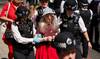
Protesters clapped, whistled, beat drums, banged pots and tooted car horns in demonstrations that underscored the political crisis gripping the impoverished former Soviet republic.
Many raised their hands in the air — a sign that the protest movement led by opposition lawmaker Nikol Pashinyan is peaceful — and robed priests joined the rallies in an apparent attempt to prevent possible clashes.
Led by 42-year-old Pashinyan, thousands of demonstrators earlier in the day marched through Yerevan against the ruling Republican Party’s unwillingness to transfer power after its leader and former president Sarkisian stood down Monday from his new post of prime minister.
Pashinyan sported his trademark khaki-colored T-shirt and clutched a megaphone as protesters chanted “Nikol for prime minister” and “We are the masters of our country.”
Stepan Grigoryan, a political analyst who joined the rallies, said it was a do-or-die situation, describing the current system as “criminal.”
“The head has been chopped off,” he said, referring to Sarkisian’s resignation Monday, “but the body — the Republican Party — remains and it needs to be removed.”
In a surprise move, Sarkisian, who served as president for a decade, stood down as prime minister just a week after being elected by parliament, following days of protests by demonstrators who accused him of a blatant power grab.
Pashinyan, leader of the Civil Contract Party, had been due Wednesday to hold talks with acting government head Karen Karapetyan to discuss a “peaceful” power transfer. But the negotiations were canceled late Tuesday.
Addressing supporters on Wednesday night, he called on Karapetyan to “immediately recognize our revolution’s victory and abandon his ambitions.
“If the Republican Party dares to present a candidate the people will surround the parliament and government buildings,” he said.
Pashinyan has insisted the new premier must be a “people’s candidate” and not a member of Sarkisian’s party, and has said he is willing to lead the impoverished country.
“We need the Republicans to leave, or else nothing will change,” said Varazdat Panoian, 28, who joined the crowds gathered in the capital.
The Yelk opposition bloc said Wednesday it would nominate Pashinyan for prime minister. But a lawmaker from the bloc, Edmon Marukyan of the Bright Armenia party, said Pashinyan was currently 13 votes short of a majority. A candidate would need 53 votes to get elected.
A small member of the current ruling coalition, the Armenian Revolutionary Federation, said it was leaving the coalition on Wednesday evening calling for a new prime minister to be elected to “overcome the political crisis.”
But the move posed no immediate threat to the Republican Party’s rule as it still held 58 seats in parliament.
On Wednesday, Serzh Sarkisian called a meeting with Republican MPs to explain the reasons for his resignation and discuss the party’s future in a statement reported by Armenian media.
“As much as I am determined not to interfere in political processes after my resignation, I now believe that I must do this,” Sarkisian said.
“I invited you to talk about peace and stability,” he said.
Karapetyan, who has accused Pashinyan of promoting his own agenda, proposed holding a snap election so voters themselves could decide on the new leader under a parliamentary system of government.
Armenia’s President Armen Sarkisian, who is no relation to Serzh Sarkisian, and is a ceremonial figurehead, urged compromise.
The Kremlin on Wednesday said Russian president Vladimir Putin spoke to Armen Sarkisian, urging “all political forces in the country to show restraint and responsibility.”
Russia — which has a military base in Armenia — earlier said it was watching the situation “very closely” but reiterated it would not interfere.
Russia hopes that a “stable solution” can be found, said Kremlin spokesman Dmitri Peskov, stressing that it was however an “internal matter” for the country to deal with.
The opposition had accused 63-year-old Serzh Sarkisian of wanting to extend his grip on power under a new parliamentary system, saying he failed to tackle a litany of problems including poverty and corruption.


![]()

Tens of thousands protest as Armenia crisis deepens
Tens of thousands protest as Armenia crisis deepens
- Russia — which has a military base in Armenia — earlier said it was watching the situation “very closely” but reiterated it would not interfere
- Demonstrators marched through Yerevan against the ruling Republican Party’s unwillingness to transfer power after its leader and former president Sarkisian stood down from his new post of prime minister


Latest updates




© 2026 SAUDI RESEARCH & PUBLISHING COMPANY, All Rights Reserved And subject to Terms of Use Agreement.