Saudis remember ‘Year of Hunger’ to curb extravagance

1 / 3
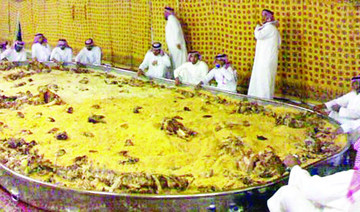
Old Saudis tell heartbreaking stories about how miserable their ancestors’ lives were. They say that some 50 years ago, some families could only have meat on Eid Al-Adha.
2 / 3
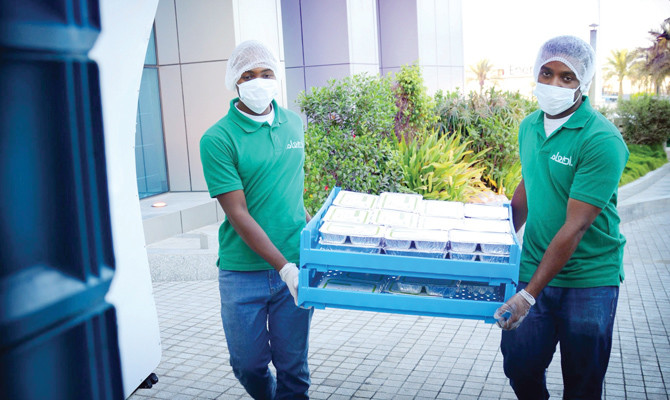
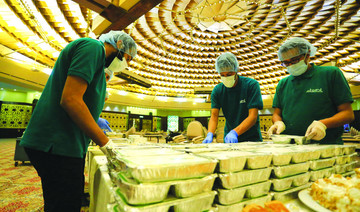
Eta’am volunteers collect food from a hotel for free distribution.
3 / 3
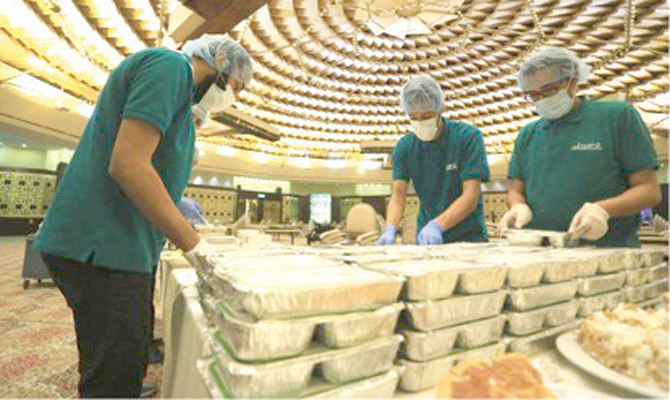
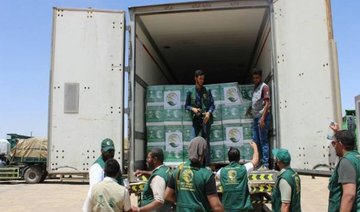
Volunteers busy working at a wedding hall.
Updated 24 April 2018
Follow

Saudis remember ‘Year of Hunger’ to curb extravagance

  • With its natural resources and the wise control of its vast wealth, Saudi Arabia is now a member of the G-20, making it an important player in the management of the global financial system.
  • The Saudi leadership aims to enlighten all segments of the society about the negative practices in dealing with extra amounts of food

JEDDAH: The year 1909 is known by old Saudi people as the “Year of Hunger.” In that year, Saudis suffered to such an extent that some of them perished while searching for a mouthful of food that could keep them alive for a few days.

Old people tell heartbreaking stories about how miserable their ancestors’ lives were. 

“Some 50 years ago, a Saudi family could have meat only on the day of sacrifice, Eid Al-Adha,” Mohammed Mousa, a retired soldier in his eighties, told Arab News.

He added that wheat bread, dates and water made up the daily meals of his family of four. “The family that had a small quantity of sheep milk, ghee and tea was considered rich,” he said.
Khamees Al-Zahrani, a preacher, told an excruciating story about a group of friends who lived in the region some 100 years ago. 

“A group of men agreed to seek food wherever it would be, even if it cost them their lives. A starving woman with a 12-year-old boy approached one of them and begged him to take her only son with them; as he might die of emptiness if he stayed with her,” Al-Zahrani said.

The woman assured the man that she would forgive him if her son died. The merciful man agreed.

“Three days into their quest, they found nothing to eat. So the other men secretly told the man that they should kill the boy and eat his flesh. ‘Otherwise, we will all die’,” the preacher said.

The “trustworthy” man refused, Al-Zahrani added. “While the other men were trying to persuade him, they saw a female dog with six puppies. They rejoiced and forgot about the boy. They then slaughtered the seven animals, started a fire and had their ‘hot dogs’ that helped them complete their trip,” Al-Zahrani said.

Al-Zahrani told another painful story about a woman who asked a man to marry her. 

“He told her that he had no money. The would-be groom was shocked to hear from the woman that all she wanted from him was to assure her daily need of food, and that would be her dowry,” Al-Zahrani said.

Old people have heard heartbreaking stories about their fathers and relatives. They tell these stories to their children to remind them to thank God for all graces He has granted them.

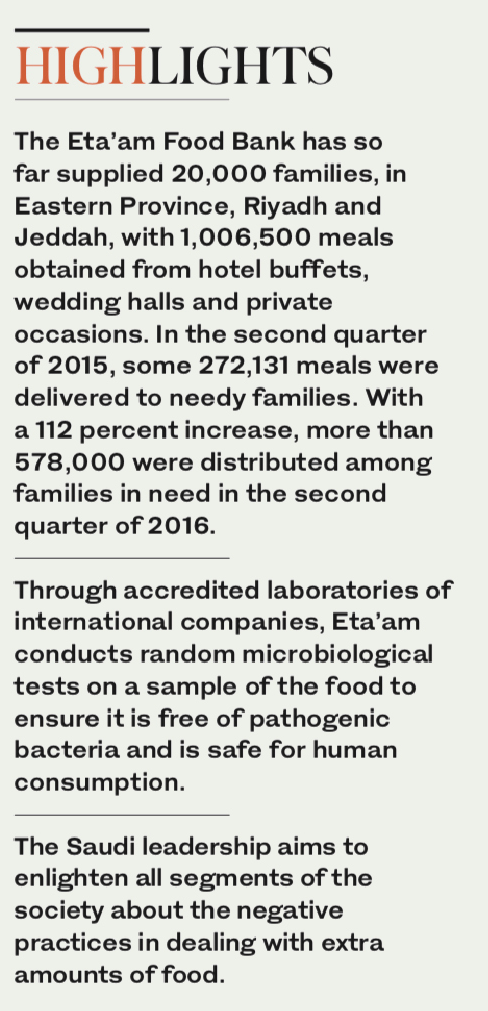
Keeping this in mind, Eta’am Food Bank organized an event on Monday at the King Abdul Aziz Center for National Dialogue to commemorate “the Year of Hunger” to spread awareness of preserving food and making use of leftovers.
Deputy Governor of Riyadh, Prince Mohammed bin Abdurrahman, patronized the event.

Under the slogan “A 100 Years … From Hunger to Extravagance,” the event was also attended by the undersecretary of the Ministry of Labor and Social Development, Abdurrahman Al-Mutairi, and a large number of businessmen. 

Amir bin Abdurrahman Al-Barjas, executive director of Eta’am, said: “More than 100 years ago, we went through very painful events.” 

He said during those days, hunger mercilessly effected the rich and the poor alike. 

“You can’t imagine what happened that year. Because of hunger, people were found dead on the roads,” he said.

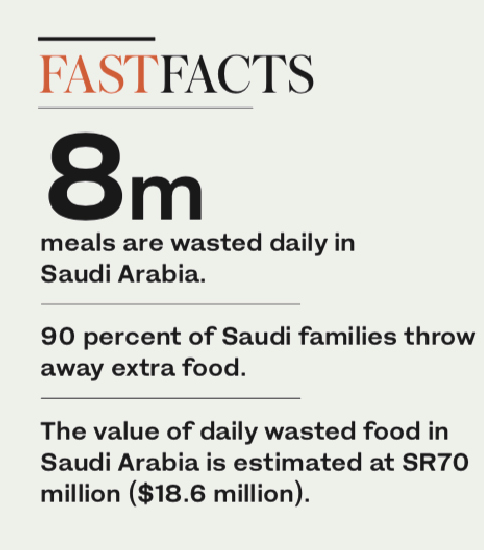
Al-Barjas said that the latest studies have found that Saudi Arabia is among the most food-wasting countries. 

“No wonder as millions of tons of food are thrown in garbage containers without any measures taken against the wrongdoers,” he added.

The event saw signings of memoranda of cooperation between Eta’am and a number of private sector companies, in which these companies assured to support and finance the programs of the Eta’am.

During the event, a documentary highlighting the tough times Saudis went through during those days was also screened.

On the other hand, Ahmed Al-Jaafari, director of administrative development at Eta’am, said the Saudi leadership aims to enlighten all segments of society about the negative practices in dealing with extra amounts of food.

“We at Eta’am introduce the best positive ways to benefit from extra food,” he said. He urged the people to learn a lesson from ‘the Year of Hunger.’

It is hoped that linking that year to the opulence in our lives today will help people change their bad habits about food consumption.
How private Christmas celebrations in Saudi Arabia offer moments of cultural exchange

Christmas celebrations at Vives Compound complete with “amazing” Christmas tree lighting. (Supplied)
Updated 59 min ago
Follow

How private Christmas celebrations in Saudi Arabia offer moments of cultural exchange

  • Christmas spirit in major cities is growing as Saudi Arabia continues to embrace its religious diversity
  • One of Riyadh’s decorations was held privately in a residential compound

RIYADH: As the days get colder and the year comes to an end, people across Saudi Arabia are looking to their families for warmth and their faith for comfort. For the Kingdom’s Christian residents, the holiday cheer has never been louder.

The Christmas spirit in major cities is growing as Saudi Arabia continues to embrace its religious diversity. One of Riyadh’s decorations was held privately in a residential compound.

The compound’s general manager, Jean Noujaim, told Arab News: “Christmas is being celebrated more and more … things that were frowned upon are now becoming less so.”

Guests were wrapped in fake snow while shopping around the Christmas market, admiring the illustrious decorations, enjoying the live choir, and entertaining their children with a host of games and activities.

The event also included a few very special guest stars including elves, the Grinch, and the season’s hero, Santa Claus.

The compound’s largest event thus far, approximately 1,500 residents and 2,000 visitors were in attendance.

“It showed how much people were missing these types of events,” Noujaim said.

Breaking records in “every way,” the event also saw its highest number of Saudi attendees for a Christmas celebration, having hosted similar festivities on an annual basis.

Noujaim wanted those of all faiths to feel welcome, emphasizing that it was a celebration centered around children and joy.

“Everyone who came told me they had goosebumps during the event. They felt it was magical … their children were very happy.”

The Vives Compound Christmas celebration was held on Nov. 20 and will be held annually.

While celebrations in the Kingdom remain low-key and largely private, they are increasingly shaped by a sense of community, cultural exchange, and shared hospitality, often extending to Saudi friends and colleagues. 

For many expats, Christmas in Saudi Arabia is marked by intimate gatherings at home or within residential compounds. Decorations are modest, featuring Christmas trees, lights, and small festive touches that recreate a sense of home far from home. 

Jazmin Soledad Huanca, a Peruvian expatriate working in Saudi Arabia, described Christmas as one of the most anticipated moments of the year for foreigners living in the Kingdom. 

“Christmas represents unity and family,” she said. “The first thing many of us do is decorate our space, whether with a tree, lights, or a small reminder of Christmas. We prepare to visit close friends or family, exchange secret gifts, and share food together.” 

Food, she added, plays a central role in the celebrations, ranging from cookies and hot chocolate to baked turkey served with salads. For many expats who arrived in Saudi Arabia alone, the occasion carries an added emotional weight. 

“Here, many of us came individually, which makes Christmas different but equally beautiful,” Huanca said. “In some compounds, activities are organized for children, families, and single people. On that day, we all become one community.” 

Inviting Saudi friends to join the celebrations has become increasingly common. “Yes, we invite Saudis,” Huanca said. “For us, Christmas is about unity and family. We want them to feel that.” 

She added that hosting Saudi guests brings a special sense of joy. “It feels like having an important guest at home. You want them to feel comfortable, like this is their home too.” 

International schools across Saudi Arabia have also been embracing the festive season with inclusive and joyful Christmas celebrations. 

At the American International School of Jeddah the campus has been filled with holiday cheer through festive bazaars, extensive decorations including seven Christmas trees, daily morning musical performances by students and teachers, and even a surprise visit from Santa Claus.

Superintendent Robert Rinaldo said: “With more than 1,500 students representing 68 nationalities, we see Christmas celebrations as a true reflection of our diverse community. The festive atmosphere on campus, from holiday-themed decorations to daily musical performances, highlights that diversity and helps create an environment where everyone feels a genuine sense of belonging and can come together to share in the joy of the season.”

Raza Ali, headmaster of Jeddah Prep and Grammar School, said: “As a British school overseas, we appropriately acknowledge Christmas during this time of year through school decorations, a winter musical, and references within certain class lessons, while always ensuring that we respect all cultural backgrounds within our community.”

Parents also value this balance. AISJ parent Victoria Joseph said: “Even though we are far from our home in California, my son is able to experience and understand the holiday season just as he would in the United States. It’s wonderful to see how the school embraces the festivities while showing such respect and adaptability toward the celebration in the Kingdom.”

As Saudi Arabia continues to grow as a multicultural society, these understated celebrations reflect a broader story of coexistence, where traditions are preserved, shared, and respectfully experienced across cultures.