Armenian leader resigns, says to protesters: ‘I was wrong’

1 / 4
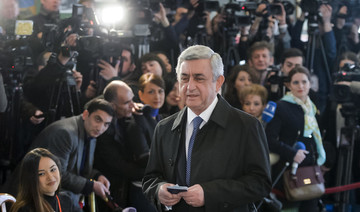
Opposition leader Nikol Pashinyan delivers a speech during a protest against the appointment of ex-president Serzh Sarksyan as the new prime minister, after being released by police in central Yerevan on April 23, 2018. (REUTERS/Hayk Baghdasaryan/Photolure)
2 / 4
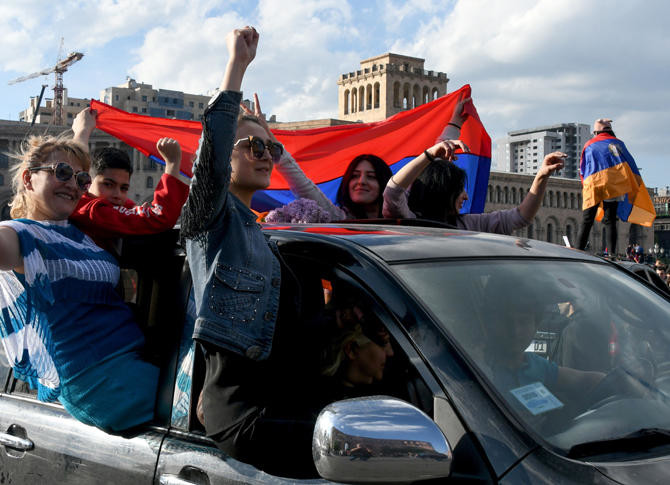
Armenians celebrate prime minister Serzh Sarkisian's resignation in downtown Yerevan on April 23, 2018. (AFP / Vano Shlamov)
3 / 4
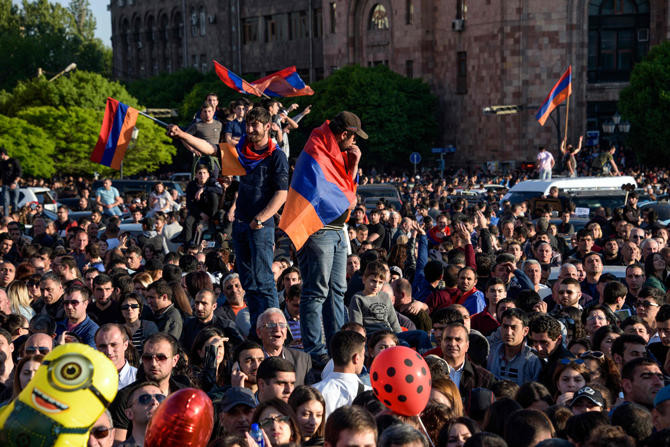
People celebrate Armenian prime minister Serzh Sarkisian's resignation in downtown Yerevan on April 23, 2018. (AFP / KAREN MINASYAN)
4 / 4
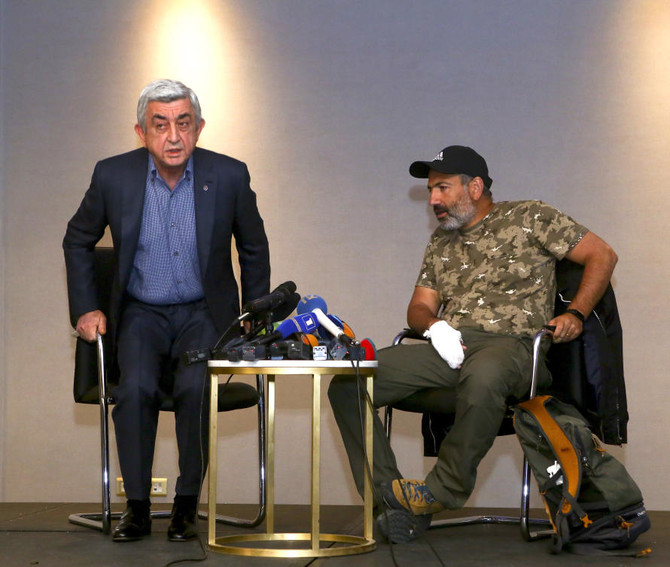
In this photo taken on Sunday, April 22, 2018, former Armenian President Serzh Sargsyan, left, leaves a meeting with protest leader Nikol Pashinian, right, in Yerevan. Armenian Prime Minister Serzh Sargsyan has resigned, according to his website. (Hrant Khachatryan/PAN Photo via AP)
Updated 23 April 2018
Follow

Armenian leader resigns, says to protesters: ‘I was wrong’

  • Armenians have poured out into the streets in protest over Sargsyan's apparent attempt to perpetuate himself in power
  • Former Prime Minister Karen Karapetian was named acting premier and opposition leader Nikol Pashinian was released from detention

YEREVAN: Armenian Prime Minister Serzh Sargsyan resigned unexpectedly Monday to quell massive anti-government protests over what critics feared was his effort to seize power for life.
Residents of the capital, Yerevan, poured out on the streets to celebrate his stunning departure. People hugged and kissed each other, and motorists honked their horns.
Protest leader “Nikol Pashinian was right. I was wrong,” Sargsyan, a former Armenian president, said in a surprise announcement on his website. “The movement on the streets is against my rule. I’m complying with their demands.”
The move plunges the Caucasian Mountains country into uncertainty after 10 days of protests against Sargsyan’s appointment as prime minister.
The appointment was part of a transition to a new governmental system that reduces the powers of the presidency and bolsters those of the premier. Critics saw that as an attempt by 63-year-old Sargsyan, who served as president from 2008 until term limits forced him out in March, to stay in power indefinitely.
It echoes similar tenure-lengthening maneuvers by Russian President Vladimir Putin — Armenia’s closest ally. Leaders of other former Soviet republics from Belarus to Central Asia have also engineered themselves lifetime jobs.
The streets of Yerevan have turned into masses of human anger since anti-government protesters began rallying on April 13, blocking government buildings and facing off with police. Sunday’s rally attracted some 50,000 demonstrators.
Pashinian, the protest leader, was arrested on Sunday after he met the prime minister for talks. Sargsyan abruptly ended the meeting when Pashinian refused to discuss anything besides the prime minister’s resignation. The protest leader was released from custody Monday afternoon.
Sargsyan said Monday that he should not have resisted the demands of the opposition.
Opposition leaders have not yet commented on Sargsyan’s resignation and have called a rally in central Yerevan for Monday evening.
The Armenian government quickly named former Prime Minister Karen Karapetian as acting premier. A Sargsyan ally, Karapetian also served as mayor of Yerevan and worked in Russia for five years as a senior executive of state-controlled gas giant Gazprom.
Alexander Iskanderian, director of the Caucasus Institute in Yerevan, told The Associated Press that the protests drove Sargsyan into a corner:
“The protests in the past couple of days have swelled to a point that you either had to use violence or find another way out,” Iskanderian said.
Russian officials and state television have been cautious in commenting on the unrest in Armenia. In the past, Moscow decried anti-government rallies in neighboring post-Soviet nations as example of hostile Western interference.
In what appeared to be the first official Russian reaction to the resignation of the Armenian premier, Russian Foreign Ministry spokeswoman Maria Zakharova lauded Sargsyan’s decision as a move to unify the nation.
“The people who have the strength to keep respect toward each other despite crucial differences and stay united even in the most difficult moments of its history is a great people,” Zakharova wrote on her Facebook account. “Armenia, Russia is always with you!“
When Sargsyan switched to the prime minister’s job, ally Armen Sarkisian, a former prime minister and ambassador to Britain, was elected president in Sargsyan’s place. Sarkisian was seen as an unofficial Sargsyan appointee.



Italian suspect questioned over Bosnia ‘weekend sniper’ killings

Updated 7 sec ago
Follow

Italian suspect questioned over Bosnia ‘weekend sniper’ killings

  • The octogenarian former truck driver from the Friuli-Venezia Giulia region of northeast Italy, is suspected by Milan prosecutors of “voluntary homicide aggravated by abject motives,” according to Italian news agency ANSA

ROME: An 80-year-old man suspected of being a “weekend sniper” who paid the Bosnian Serb army to shoot civilians during the 1990s siege of Sarajevo was questioned Monday in Milan, media reported.

The octogenarian former truck driver from the Friuli-Venezia Giulia region of northeast Italy, is suspected by Milan prosecutors of “voluntary homicide aggravated by abject motives,” according to Italian news agency ANSA.

Lawyer Giovanni Menegon told journalists that his client had answered questions from prosecutors and police and “reaffirmed his complete innocence.”

In October, prosecutors opened an investigation into what Italian media dubbed “weekend snipers” or “war tourists“: mostly wealthy, gun-loving, far-right sympathizers who allegedly gathered in Trieste and were taken to the hills surrounding Sarajevo where they fired on civilians for sport.

During the nearly four-year siege of Sarajevo that began in April 1992 some 11,541 men, women and children were killed and more than 50,000 people wounded by Bosnian Serb forces, according to official figures.

Il Giornale newspaper reported last year that the would-be snipers paid Bosnian Serb forces up to the equivalent of €100,000 ($115,000) per day to shoot at civilians below them.

The suspect — described by the Italian press as a hunting enthusiast who is nostalgic for Fascism — is said to have boasted publicly about having gone “man hunting.”

Witness statements, particularly from residents of his village, helped investigators to track the suspect, freelance journalist Marianna Maiorino said.

“According to the testimonies, he would tell his friends at the village bar about what he did during the war in the Balkans,” said Maiorino, who researched the allegations and was herself questioned as part of the investigation.

The suspect is “described as a sniper, someone

who enjoyed going to Sarajevo to kill people,” she added.

The suspect told local newspaper Messaggero Veneto Sunday he had been to Bosnia during the war, but “for work, not for hunting.” He added that his public statements had been exaggerated and he was “not worried.”

The investigation opened last year followed a complaint filed by Italian journalist and writer Ezio Gavanezzi, based on allegations revealed in the documentary “Sarajevo Safari” by Slovenian director Miran Zupanic in 2022.

Gavanezzi was contacted in August 2025 by the former mayor of Sarajevo, Benjamina Karic, who filed a complaint in Bosnia in 2022 after the same documentary was broadcast.

The Bosnia and Herzegovina prosecutor’s office confirmed on Friday that a special war crimes department was investigating alleged foreign snipers during the siege of Sarajevo.

Bosnian prosecutors requested information from Italian counterparts at the end of last year, while also contacting the International Residual Mechanism for Criminal Tribunals in The Hague, it said. That body performs some of the functions previously carried out by the International Criminal Tribunal for the former Yugoslavia.

Sarajevo City Council adopted a decision last month authorizing the current mayor, Samir Avdic, to “join the criminal proceedings” before the Italian

courts, in order to support Italian prosecutors.