Armenia vote ‘tainted’ by claims of ‘vote-buying’: Western observers

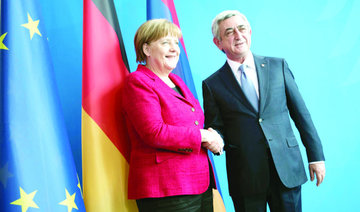
Armenia's President Serzh Sargsyan ruling party won elections on Sunday. (PAN Photo, Davit Hakobyan/Photo via AP)
Updated 04 April 2017
Follow

Armenia vote ‘tainted’ by claims of ‘vote-buying’: Western observers

YEREVAN: European observers said Monday there was “credible information” that Armenia’s parliamentary elections at the weekend were marred by “vote-buying” and pressure on voters.
The elections won by the pro-Russian ruling Republican Party “were tainted by credible information about vote-buying, and pressure on civil servants and employees of private companies,” observers from the OSCE, the Council of Europe, and the European Parliament said in a joint statement following Sunday’s polls.
The observers noted however that the polls “were well administered and fundamental freedoms were generally respected.”
The central electoral commission said on Monday that the Republican Party beat the main opposition coalition, led by wealthy politician Gagik Tsarukyan, by 49.15 percent to 27.37 percent.
Another opposition coalition, Elk, and the Dashnaktsutyun nationalist party received 7.78 percent and 6.58 percent of the vote respectively, and will also enter the parliament.
Turnout was 60.86 percent, the electoral panel said.
The West views Armenia’s election as a key democratic test for the landlocked nation of 2.9 million, which has no history of transferring power to the opposition through the ballot box.
Pro-Russian President Serzh Sarkisian, who heads the Republican Party, has said his government “made enormous efforts so that (the) milestone vote is flawless.”
Violence flared following his election in 2008, with 10 people killed in clashes between police and opposition supporters.
But opposition politicians have reported violations at polling stations after having alleged before the vote that the government was preparing mass electoral fraud.
“We have recorded numerous violations at polling stations — violation of ballots’ secrecy and multiple voting,” Hovsep Khurshudyan, a leader of Ohanyan-Raffi-Oskanyan, an opposition coalition, told AFP on Sunday night.
The polls followed constitutional amendments initiated by Sarkisian in 2015 that his opponents say are designed to perpetuate the rule of the Republican party, which has been in power for the last two decades.
The amendments will shift the country away from a strong presidency to a parliamentary form of government after Sarkisian’s second and final term ends in 2018.
The opposition says the changes were made to allow Sarkisian, 62, to maintain his grip on power by remaining party leader after he steps down as president.
Sarkisian denies that, saying the changes are “part of Armenia’s democratization process.”
Ahead of the vote, Sarkisian told AFP he would remain “active” in politics after he left office by remaining the leader of his party.
“As chairman of the Republican Party, I assume responsibility for my teammates,” he said when asked about his post-2018 future.
Both ruling and opposition parties had campaigned on populist promises such as “jobs, wages, pensions,” Gevorg Poghosyan, a pollster at the Armenian Sociologists’ Association, told AFP.
“That’s what matters to the voters” in a country where about 30 percent of the population live under the official poverty line, he said.
Opposition coalition leader Tsarukyan had built his campaign on lavish promises to cut tariffs on natural gas and electricity and hike public-sector salaries and pensions. He has accused the government of failing to address poverty and endemic corruption.
Five parties and four electoral blocs ran in Sunday’s vote, with 101 parliamentary seats up for grabs under a system of proportional representation.
A party needs to clear a five-percent threshold to be represented in parliament, while an electoral bloc — an entity made up of several parties — needs to garner at least seven percent of the vote.


A macabre dispute has kept the body of Zambia’s former president unburied for months

Updated 3 sec ago
Follow

A macabre dispute has kept the body of Zambia’s former president unburied for months

LUSAKA: More than eight months after his death, former Zambian President Edgar Lungu’s remains are still in a South African funeral home, the subject of a macabre fight between his family and the longtime rival who succeeded him.
A graphic symbol of the dispute: an unfilled, coffin-size hole in a cemetery in Zambia’s capital, Lusaka, where the current president, Hakainde Hichilema, had hoped Lungu would be buried in a state funeral. But Lungu, in his last days, told his family members that Hichilema, even as a mourner, should never go near his body.
The matter has gone to the courts, which have repeatedly sided with Zambian authorities over Lungu’s wishes. Lungu’s family persists in seeking a burial that sidelines Hichilema.
So the body lies frozen in South Africa, where Lungu died, while Zambia endures a scandalous saga that offends traditional beliefs and raises many questions in a country where it is taboo to fail to bury the dead promptly and with dignity.
Behind the impasse is a long-running feud between two political rivals. It also reflects a spiritual contest between Hichilema, who is up for reelection in August, and Lungu, who is said to be fighting back from the dead, according to scholars and religious leaders who spoke to The Associated Press.
A spiritual battle
“It has shifted from the physical, it has shifted from politics, and it is now a spiritual battle,” said Bishop Anthony Kaluba of Life of Christ congregation in Lusaka.
Hichilema’s supporters see Lungu’s will as casting a curse, while they say a state funeral attended by Hichilema would be an act of generosity toward Lungu and his family.
The fight over a corpse can seem bizarre to others, but Lungu’s directive resonates with many Zambians.
Some have barred their enemies from attending their funerals, often blaming them for misfortune. Those quarrels are usually more private, not like the public drama of a former president who, facing death, retaliates against his rival in the harsh language of his ancestors.
Across Africa, last words are a “vital force” to enhance life or block it, said Chammah J. Kaunda, a Zambian professor of African Pentecostal theology who serves as academic dean of the Oxford Center for Mission Studies.
Elders facing death can impose curses or give blessings, and Lungu’s case shows that curses “can acquire a life of their own,” he said.
A vibrant democracy with traditional beliefs
Zambia is a vibrant democracy. Its founding president was the genial, handkerchief-waving Kenneth Kaunda, who was voted out of power in 1991, despite his status as an independence hero.
Like Kaunda, subsequent presidents have been civilians lacking the military strength of various authoritarians elsewhere in Africa, giving Zambia’s presidential hopefuls the opportunity to run on their own merits.
Even so, there’s a perception that some political leaders — like many of their compatriots — worry they might be bewitched. The feeling is widespread in a country where traditional religion thrives alongside Christianity, and a spoken curse is dreaded by many as spiritually enforceable if provoked by injustice.
“It is a weapon,” said Herbert Sinyangwe of WayLife Ministries in Lusaka. “We believe in our culture that curses work.”
In the case of three recent presidents — Michael Sata, Lungu and Hichilema — suspicion was rampant. The official presidential residence is now thought by many to be under a deadly spell because all the six former presidents are now dead. Hichilema works there but sleeps elsewhere.
Sata, who was president from 2011 to 2014, worried that Hichilema, then an opposition figure, was victimizing him even as he asserted that charms from his own region were stronger. Zambian authorities last year had two men convicted and jailed for allegedly plotting to kill the president by magic. Lungu’s family doesn’t trust Hichilema.
An empty tomb
The spot in Lusaka that would be Lungu’s tomb was quickly dug and built before it was known that Lungu’s family had objections, said cemetery caretaker Allen Banda. He warned that a tomb without a corpse was akin to digging “your own grave.”
“If nobody goes there, culturally it’s your body that’s going to go there,” he said.
That Hichilema is willing to risk public anger in opposing Lungu’s family has reinforced the views of those who see a spiritual battle between him and Lungu.
“On the one hand, nearly everything done by the Lungu family so far seems to have been designed to deny Hichilema access to Lungu’s body,” said Sishuwa Sishuwa, a Zambian historian who is a visiting scholar at Harvard. “On the other, Hichilema’s conduct so far suggests that he will do whatever it takes to secure access to Lungu’s corpse, perhaps because the president sees the issue as a matter of life and death.”
Lungu died June 5, 2025, after surgery-related complications. He was 68, and was treated for a narrowing of the esophagus.
A fight in court
To organize a state funeral, Zambian authorities would need to take custody of Lungu’s remains until they were interred. But Lungu’s family resisted Hichilema’s plans during negotiations over funeral proceedings.
They preferred to transport the corpse by private charter and had hoped to keep it at Lungu’s residence at night. They picked three people to look after it during the state funeral that never happened.
When Lungu’s family concluded that their wishes were not likely to be followed, they opted for a private funeral in South Africa. They were moving ahead with that ceremony when they found out that Zambian authorities had blocked it.
A South African court ruled in August that Zambian authorities could take Lungu’s body home for burial.
Bertha Lungu, the former president’s sister, was inconsolable in the courtroom after the ruling, wailing and cursing at Mulilo Kabesha, Zambia’s attorney general, who said it was time to take the corpse home. She asserted that Hichilema wanted the corpse for ritual purposes.
Hichilema denies malice toward Lungu, and has said his Christian faith forbids belief in traditional religion.
A bitter rivalry
Lungu rose to power after Sata’s death in 2014. Sata’s vice president, Guy Scott, was ineligible to seek the presidency in a 2015 vote and Lungu was picked to finish Sata’s term.
His main opponent was Hichilema, a wealthy businessman. It was a close race — Lungu won by under 28,000 votes.
After the 2016 election, won again by Lungu, Hichilema faced treason charges and was jailed for four months for allegedly failing to yield to the presidential motorcade.
Five years later, Lungu lost to Hichilema and said he would retire from politics. He changed his mind in 2023, and Zambian authorities withdrew Lungu’s retirement benefits.
Lungu faced more pressure after his wife and daughter were arrested in 2024 over fraud allegations tied to property acquisition.
When he fell sick, Lungu found it hard to leave Zambia. The government restricted his travels. He managed to slip away to South Africa early in 2025, buying a ticket at the airport counter. The incident was reported by the local press as a security lapse over which an airport manager was fired.
Lungu is “still influencing our politics from the grave,” said Emmanuel Mwamba, a Zambian diplomat who speaks for Lungu’s party. “His issues remain. How he was treated in life and how he was treated in death.”