BEIRUT: The Syrian army bombarded militants in the last area outside government control near Damascus overnight, as President Bashar Assad accelerated his push to retake remaining enclaves.
US, British and French air strikes on Saturday to punish Assad for suspected use of chemical weapons have done nothing to slow the advance of his forces, now in their strongest position since the early months of the seven-year-old war.
Air strikes and shelling hit the Yarmouk Palestinian refugee camp and Al-Hajjar Al-Aswad area, part of a small enclave divided between warring militants and other rebels south of the capital, the Syrian Observatory for Human Rights war monitor said.
Assad is accelerating his campaign to retake the remaining enclaves his forces encircle around Syria, which would leave rebels with only their two major strongholds in the northwest and southwest.
Western countries launched their first coordinated action against Assad on Saturday to punish him for a suspected gas attack they say killed scores of people during an advance that captured the town of Ghouta near the capital.
But the single volley of air strikes, hitting three targets far from any frontline, had no effect on the wider war which has killed 500,000 people and made more than half of Syrians homeless.
International inspectors from the Organization for the Prohibition of Chemical Weapons (OPCW) who arrived in Damascus nearly a week ago were still waiting early on Friday to visit the site of the suspected poison gas attack.
Syria and its ally Russia deny using chemical weapons in the assault on Douma. The Western countries say the Syrian government, which now controls the town, is keeping the inspectors out and may be tampering with evidence, both accusations Damascus and Moscow deny.
Rebels on Thursday began pulling out of Dumayr, an enclave northeast of Damascus, under a surrender deal with the government. Insurgents in another enclave nearby — Eastern Qalamoun — said they had also agreed to withdraw.
Thousands of civilians, including the fighters’ families, are expected to leave with them for northern Syria before the areas come back under Assad’s rule under deals similar to others carried out across the country as Syrian forces advance.
The UN has voiced concern that such “evacuations” involve the displacement of civilians under threat of reprisals or forced conscription, though the government denies that.
“The UN expects further displacements in the near future to northern Syria from other locations controlled by non-state armed groups where negotiations reportedly are happening,” the world body said in a humanitarian note.
Conditions in the opposition-held pocket of northern Syria where the displaced will go are poor.
After the army’s recovery of eastern Ghouta this month in a ferocious battle that began in February, the surrender Dumayr and Qalamoun would leave only the pocket in south Damascus outside government control in the area around the capital.
Yarmouk was the biggest camp for Palestinian refugees in Syria before the war. Although most residents have fled, up to 12,000 remain there and in the neighboring areas under militant or rebel control, said the UN agency that helps them.

Syrian army bombards Yarmouk camp, war monitor says
- Syria and its ally Russia deny using chemical weapons in the assault on Douma
- Conditions in the opposition-held pocket of northern Syria, where the displaced will go, are poor
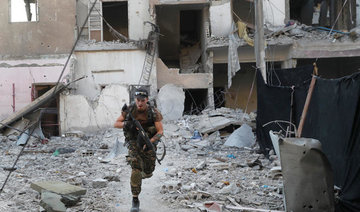
Syria’s Kurdish fighters agree to leave Aleppo after deadly clashes
- Syria’s official SANA news agency reported that “buses carrying the last batch of members of the SDF organization have left the Sheikh Maqsud neighborhood in Aleppo, heading toward northeastern Syria”
ALEPPO: Syria’s Kurdish fighters said Sunday that they agreed under a ceasefire to withdraw from Aleppo after days of fighting government forces in the city.
Hours earlier, Syria’s military said it had finished operations in the Kurdish-held Sheikh Maqsud neighborhood with state television reporting that Kurdish fighters who surrendered were being bused to the north.
The military had already announced its seizure of Aleppo’s other Kurdish-held neighborhood, Ashrafiyeh.
Kurdish forces had controlled pockets of Syria’s second city Aleppo and operate a de facto autonomous administration across swathes of the north and northeast, much of it captured during the 14-year civil war.
The latest clashes erupted after negotiations to integrate the Kurds into the country’s new government stalled.
“We reached an understanding that led to a ceasefire and secured the evacuation of the martyrs, the wounded, the trapped civilians and the fighters from Ashrafiyeh and Sheikh Maqsud neighborhoods to northern and eastern Syria,” the Kurdish-led Syrian Democratic Forces (SDF) wrote in a statement.
Syria’s official SANA news agency reported that “buses carrying the last batch of members of the SDF organization have left the Sheikh Maqsud neighborhood in Aleppo, heading toward northeastern Syria.”
The SDF initially denied its fighters were leaving, describing the bus transfers as forced displacement of civilians.
An AFP correspondent saw at least five buses on Saturday carrying men out of Sheikh Maqsud, but could not independently verify their identities.
According to the SDF statement, the ceasefire was reached “through the mediation of international parties to stop the attacks and violations against our people in Aleppo.”
The United States and European Union both called for the Syrian government and Kurdish authorities to return to political dialogue.
The fighting, some of the most intense since the ousting of long-time ruler Bashar Assad in December 2024, has killed at least 21 civilians, according to figures from both sides, while Aleppo’s governor said 155,000 people fled their homes.
Both sides blamed the other for starting the clashes on Tuesday.
Children ‘still inside’
On the outskirts of Sheikh Maqsud, families who had been trapped by the fighting were leaving, accompanied by Syrian security forces.
An AFP correspondent saw men carrying children on their backs board buses headed to shelters.
Dozens of young men in civilian clothing were separated from the crowd, with security forces making them sit on the ground before transporting them to an unknown destination, according to the correspondent.
A Syrian security official told AFP on condition of anonymity that the young men were “fighters” being “transferred to Syrian detention centers.”
At the entrance to the district, 60-year-old Imad Al-Ahmad was heading in the opposite direction, trying to seek permission to return home.
“I left four days ago...I took refuge at my sister’s house,” he told AFP. “I don’t know if we’ll be able to return today.”
Nahed Mohammad Qassab, a 40-year-old widow also waiting to return, said she left before the fighting to attend a funeral.
“My three children are still inside, at my neighbor’s house. I want to get them out,” she said.
A flight suspension at Aleppo airport was extended until further notice.
‘Return to dialogue’
US envoy Tom Barrack met Syrian President Ahmed Al-Sharaa on Saturday, and afterwards called for a “return to dialogue” with the Kurds in accordance with the integration framework agreed in March.
The deal was meant to be implemented last year, but differences, including Kurdish demands for decentralized rule, stymied progress as Damascus repeatedly rejected the idea.
The fighting in Aleppo raised fears of a regional escalation, with neighboring Turkiye, a close ally of Syria’s new Islamist authorities, saying it was ready to intervene. Israel has sided with the Kurdish forces.
The clashes have also tested the Syrian authorities’ ability to reunify the country after the brutal civil war and commitment to protecting minorities, after sectarian bloodshed rocked the country’s Alawite and Druze communities last year.


