

Arab leaders meet in Saudi Arabia as Syria tensions reach boiling point

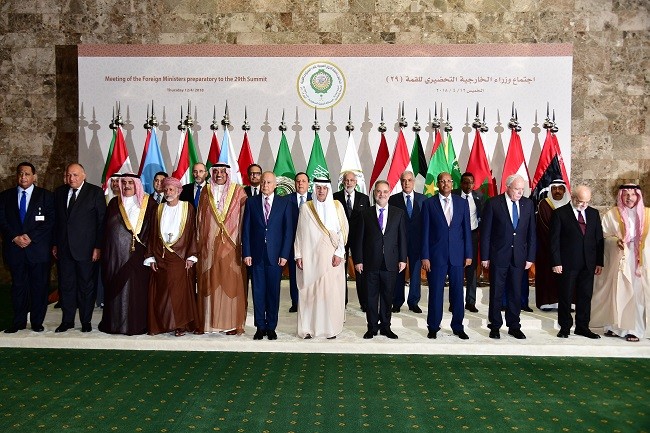
Foreign Ministers pose for a group picture during the preparatory meeting of Arab Foreign Ministers ahead of the 28th Summit of the Arab League in Riyadh on April 12, 2018. (AFP)
Updated 15 April 2018
Follow

Arab leaders meet in Saudi Arabia as Syria tensions reach boiling point

  • The fate of Jerusalem will also be on the agenda as the US prepares to move its embassy there from Tel Aviv after declaring it Israel’s capital
  • Saudi Arabia is likely to seek Arab support to pile the pressure on Iran

RIYADH: Leaders of the 22-nation Arab League, who will meet in the Saudi city of Dhahran on Sunday, are expected to stress continuity in their efforts to find a solution to the Syrian conflict. It follows airstrikes by the US, UK and France against the Assad regime on Saturday. The leaders are likely to seek Arab and international support to increase pressure on the regime to find a solution to the conflict.

Their push for a tough stand against Iran is expected to dominate the Arab League Summit as regional tensions grow over the wars in Syria and Yemen. 
The fate of Jerusalem will also be on the agenda as the US prepares to move its embassy there from Tel Aviv after declaring it Israel’s capital.
“All key regional issues are on the agenda, with Syria, Yemen and Palestine at the top,” Ali Al-Kayed, Jordanian ambassador to Saudi Arabia, told Arab News.
Dr. Ibrahim Al-Qayid, founding member of the National Society for Human Rights (NSHR), said Saturday’s airstrikes are “largely welcomed by Western and Arab nations, which condemn (the regime’s) crimes against humanity by repeatedly using chemical weapons against civilians.”
He added: “There is an urgent need to defuse the crisis in Syria, where more than half of the population has either fled the country or become homeless.”
He asked: “Should the world sit and watch as an arrogant ruler (Syrian President Bashar Assad) commits genocide in his own country?”

Al-Qayid urged Arab leaders to take “stern and decisive action” to resolve the conflict once and for all. 
He commended the US, UK and France for Saturday’s attack, saying when a ruthless regime commits war crimes, the international community has the right to take action and save innocent civilians.
Arab leaders and heads of delegations started arriving in Dhahran on Saturday to take part in the summit, SPA reported.
They were received by Prince Saud bin Naif bin Abdulaziz, governor of Eastern Region; Prince Ahmed bin Fahad bin Salman, deputy governor, Ahmed Aboul-Gheit, secretary general of the Arab League, and a number of officials.

Iran’s interference
Thursday’s preparatory meeting of Arab foreign ministers said there could be “no peace and security in the region as long as Iran continues to interfere in the domestic affairs of Arab states.”
The meeting was led by Saudi Foreign Minister Adel Al-Jubeir, who received the Arab League’s rotating chairmanship from his Jordanian counterpart Ayman Safadi in the presence of the secretary-general.  
Addressing the meeting, Aboul-Gheit said the decline of Arab influence on the situation in Syria had led to the “domination of foreign powers” there, paving the way for the country’s eventual disintegration. “The crisis in Syria can only be resolved through a political solution,” he added.
Saudi Arabia is likely to seek Arab support to pile the pressure on Iran, an analyst told AFP.
“Saudi Arabia is going to push for a much harsher stance on Iran — not necessarily on the nuclear dossier per se, but on Iranian influence in the Arab countries, particularly Iraq, Syria, Lebanon and Yemen,” said Karim Bitar of the Paris-based Institute of International and Strategic Affairs.


Dhahran’s women-led farmers’ market is back

Updated 10 January 2026
Follow

Dhahran’s women-led farmers’ market is back

  • Juthoor unites local producers, farmers, families under winter sky

DHAHRAN: Juthoor is back, bringing together a mix of local artisans, farmers and food vendors. The outdoor market runs until Jan. 18, giving families ample time to browse, shop and linger.

With cool winter breezes, outdoor seating and live music, the market provides an inviting setting to enjoy the fresh air and locally made goods. 

Juthoor was founded by three lifelong friends: Ghsoon Al-Belushi, Noura Al-Dulaijan and Reem Al-Suqair. They set out to recreate the kind of community market they had enjoyed abroad but struggled to find locally.

One of the busiest booths has been Dammam’s Ana Starter Sourdough Factory, where visitors have sampled chocolate sourdough. Founder and CEO Aisha Alomair said Juthoor had played a key role in the brand’s growth.

She told Arab News: “Juthoor is the best market for us. This is our third participation and actually our first year being an official sponsor. With Zadk, the (local) culinary academy, we do a live grilled cheese station. It is soup season — we can’t miss this opportunity!” 

Alomair said markets like Juthoor offered a vital entry point for small businesses, and added: “Not everyone has the high capital to start a factory or to start a restaurant or start a cafe. That’s too expensive, right? Especially coming from an average background, you won’t be able to really get those expenses and really start something that big.”

She now sells 13 kinds of sourdough at Juthoor, including a hawawshi loaf made with local dates, which has proved a favorite. What began as a home business has grown into a family effort, with relatives helping to run the stand while others participate in nearby festivals.

Ana Starter Sourdough Factory started via a passion for creating and fermenting the healthiest bread and introducing it to the Saudi market, said Alomair.

She added: “The breads that were available at the supermarkets or at local bakeries had instant yeast that never really took time to ferment and, therefore, when you consume the average bread, you notice some stiffening, you notice indigestion, you notice bloating and heartburn.”

When she became the “bread winner” she brought her whole family in to share the dough. And they are by her side now.

She said: “Right now, we have the Saudi Date Festival in Al-Ahsa — my mom is actually there with my daughter. I (have) got my son here with me in Juthoor.”

The market’s focus on health, community and local talent stands out. 

“The weather is fantastic. The place is beautiful. The best thing is, if you notice, all the organizers are women,” she added.

Al-Belushi, one of the co-founders of the event, told Arab News about the commitment to continuing the mission to create the change they wished to see when they started Juthoor in 2019.

They still prioritize finding Saudi vendors who create produce they would want to buy themselves.

She said: “We wanted to focus on quality, not quantity, so that’s why we have a very small number of stalls.”

This year there are 10 in the farmers’ market area; 25 in the local market; eight abaya stalls, and around 10 food vendors, along with live cooking classes.

Al-Belushi said: “It’s always been in this location (Prince Saud bin Naif Park). It’s central to everything. I think the beauty of Juthoor is that everyone can have a good time.

“They are all vendors that we would shop from. They’re all local; they’re all great quality. We’re very selective.

“It has to be local — we don’t accept vendors who import products and sell them.”

Most of the farmers come from neighboring places within the Eastern Province.

One such example is farmer Emad Ali Alshawaf who traveled to Juthoor from nearby Jubail to offer his goods, including cucumbers and fresh mint.

Alshawaf told Arab News that he found out about Juthoor from another vendor and decided to give it a chance.

He said: “Last year we decided to participate at our very first farmers’ market and we chose Juthoor. We were very successful and we hope to be this year too.” 

He has one small criticism, however, and added: “The price of the booth is quite high for us. These are organic produce items with no preservatives, so they have a two-day limit. If I don’t sell the tomatoes within that timeframe, for example, we are forced to throw them away.”

Back in Jubail, where his farm is about an hour’s drive away, he can guarantee sale of the goods as he is more familiar with the community and knows how to navigate it. But since these fresh vegetables and other goods are reserved for the booth at Juthoor, he just hopes people will buy them before they spoil.

Among the returning vendors is Shikhah Albuainain, of Crafting, Gifts & Other Stories. She told Arab News: “My first participation ever in any event was at Juthoor in 2019. It was our first time, so it was special — we all learned together.”

Initially a crocheter, she returned to Juthoor in 2020 and added to her products. She now sells iPad bags, scrunchies and toiletry bags, all sewn by hand at her workshop in the Eastern Province.

Albuainain said: “Juthoor really helped me pivot toward items that people can use and buy in person, not just from my online store.”

Al-Dulaijan, one of the co-founders of Juthoor, told Arab News that the Juthoor family was there to help support each other.

She said: “The (participating vendors) all exist with or without us; they exist the entire year without Juthoor. Juthoor is just here as a platform for them to meet people, to get them to try their things, and see it in real life.”

The next step? Growing roots, and blossoming, in Riyadh.

Al-Suqair, its third co-founder, moved to Riyadh at the beginning of 2025 and is setting up roots there.

Al-Dulaijan said: “What happened with our partner (Al-Suqair) moving to Riyadh, it kind of gave us a push, because now we have someone centered there.

“No one knows us there. The difference between here (Dhahran) and there (Riyadh), is the market is saturated with events. We’re not the type of event that happens in Riyadh. We are like earthy, maybe, cozy and simple. And Riyadh? They’re used to humongous events, big budgets, big everything.”

The co-founders are excited about the new challenge and the new rewards — and bringing a taste of Eastern Province to the capital. 

You can catch them between Feb. 5-14, conveniently timed for a week before Ramadan.

Al-Dulaijan said: “We’re happy that the location is … The Cultural House (in Riyadh). Their identity is similar to ours.”

Tickets for the Dhahran event can be purchased online or at the door and cost SR30 ($8) for adults and SR20 (aged 7-13). Children under 6 are admitted free.

Doors are open until 11 p.m., with a 4 p.m. start on Sunday to Thursday or 2 p.m. (Friday and Saturday).