Israel says open-fire rules for Gaza protest unchanged, one Palestinian shot dead

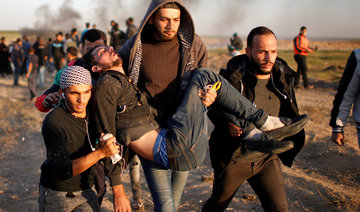
Palestinian demonstrators react to tear gas fired by Israeli troops during clashes at a tent city protest at the Israel-Gaza border, Apr. 5, 2018. (Reuters)
Updated 05 April 2018
Follow

Israel says open-fire rules for Gaza protest unchanged, one Palestinian shot dead

Jerusalem: Israeli fire killed a Palestinian at the Gaza border on Thursday and another died of wounds suffered several days ago, health officials said, 
bringing to 19 the number of Palestinian dead from a week of frontier protests.
The Israeli military said one of its aircraft targeted an armed militant near the security fence along the Gaza Strip.
Earlier, Defence Minister Avigdor Lieberman said that open-fire rules for the Gaza border which saw Israeli forces kill 18 Palestinians last week when a mass protest led to clashes will remain unchanged.
"If there are provocations, there will be a reaction of the harshest kind like last week," Lieberman said on the eve of fresh protests expected on the Gaza-Israel border.
"We do not intend to change the rules of engagement," the minister told public radio.
Tens of thousands of Palestinians are holding a six-week-long protest in tent encampments along the fenced border of the Israeli-blockaded Gaza Strip, an enclave of two million ruled by the militant Hamas group.
The demonstrators are pressing for a right of return for refugees and their descendants to what is now Israel.
The latest deaths are likely to add to international concerns over the violence, which human rights groups have said involved live fire against demonstrators posing no immediate threat to life.
UN Secretary-General Antonio Guterres has called for an independent investigation into the deaths on the first day of the protest last Friday, and B’Tselem, an Israeli rights group, urged Israeli soldiers to “refuse to open fire on unarmed demonstrators.” Orders to do so were “manifestly illegal,” it said.
Sixteen Palestinians died after being shot by Israeli troops on the first day of the demonstrations, Palestinian medical officials said, and another was killed on Tuesday.
A 33-year-old man, hit by Israeli fire a few days ago near one of the tent cities, died on Thursday, the officials said.
Israel says it is doing what is necessary to defend its border. The military said that its troops had used live fire only against people trying to sabotage the border fence or rolling burning tires and throwing rocks.
On Thursday Brig.-General Ronen Manelis, Israel’s chief military spokesman, cautioned that Israel might attack deeper inside Gaza if the demonstrations did not stop.
“We have information that tomorrow, under a smoke screen and civilian cover, Hamas intends to carry out terrorist attacks against our civilians and troops, and cross the fence,” he said.
“We have no interest in harming women and children who are protesting. They are not our enemies. We have one intention, not to allow terrorist attacks against our civilians and troops on the other side of the fence.”
LETHAL FORCE
Many of the demonstrators who turned out for the first wave of protests along the border returned to their homes and jobs over the week. But organizers expect large crowds again on Friday, the Muslim sabbath.
Protesters on Thursday were bringing more tents and thousands of tires to burn, in what has become known as “The Friday of Tyres.” They say they intend to use mirrors and laser pointers to distract Israeli sharpshooters.
“Friday is going to be a special day, they will see that we are not afraid,” said one Palestinian youth as he delivered tires to the area. But Ahmed Ali, a 55-year-old teacher, said that while he wanted his family to see the tent camp, but would not come back on Friday.
“I taught my children one day we will be returning to Jaffa, our home, but I can’t allow them to throw stones because the Israelis won’t hesitate to kill them,” he said.
Hamas said on Thursday it would pay $3,000 to the family of anyone killed in the protests, $500 for critically injuries and $200 for more minor injuries. Israeli leaders say that such payments serve to instigate violence.
Visiting the frontier this week, Israeli Defense Minister Avigdor Lieberman warned protesters that “every person who comes close to the fence is endangering their lives.”
The protest action is set to wind up on May 15, when Palestinians mark the “Naqba,” or “Catastrophe,” when hundreds of thousands fled or were driven out of their homes during violence that culminated in war in May 1948 between the newly created state of Israel and its Arab neighbors.
Israel has long ruled out any right of return, fearing it would lose its Jewish majority. 


White House names some leaders with roles in next steps in Gaza, while Palestinian committee meets

Updated 14 sec ago
Follow

White House names some leaders with roles in next steps in Gaza, while Palestinian committee meets

  • Blair is a controversial choice in the Middle East because of his role in the 2003 invasion of Iraq, and Trump himself said last year that he wanted to make sure he was an “acceptable choice to everybody”
  • The plan’s second phase is now underway, though clouded by allegations of aid shortages and violence

CAIRO: The White House released the names of some of the leaders who will play a role in overseeing next steps in Gaza after the Palestinian committee set to govern the territory under US supervision met for the first time Friday in Cairo.
The committee’s leader, Ali Shaath, an engineer and former Palestinian Authority official from Gaza, pledged to get to work quickly to improve conditions. He expects reconstruction and recovery to take about three years and plans to focus first on immediate needs, including shelter.
“The Palestinian people were looking forward to this committee, its establishment and its work to rescue them,” Shaath said after the meeting, in a television interview with Egypt’s state-owned Al-Qahera News.
US President Donald Trump supports the group’s efforts to govern Gaza after the two-year war between Israel and Hamas. Israeli troops withdrew from parts of Gaza after the ceasefire took effect on Oct. 10, while thousands of displaced Palestinians have returned to what is left of their homes.
Now, there will be a number of huge challenges going forward, including the deployment of an international security force to supervise the ceasefire deal and the difficult process of disarming Hamas.
Under Trump’s plan, Shaath’s technocratic committee will run day-to-day affairs in Gaza under the oversight of a Trump-led “Board of Peace,” whose members have not yet been named.
White House names some officials to oversight boards
The White House said an executive board will work to carry out the vision of the Board of Peace.
The executive board’s members include US Secretary of State Marco Rubio, Trump envoy Steve Witkoff, Trump’s son-in-law Jared Kushner, former British Prime Minister Tony Blair, Apollo Global Management CEO Marc Rowan, World Bank President Ajay Banga, and Trump’s deputy national security adviser Robert Gabriel.
Nickolay Mladenov, a former Bulgarian politician and UN Mideast envoy, is to serve as the executive board’s representative overseeing day-to-day matters.
The White House also announced the members of another board, the “Gaza Executive Board,” which will work with Mladenov, the technocratic committee and the international stabilization force.
Witkoff, Kushner, Blair, Rowan and Mladenov will also sit on that board. Additional members include: Turkish Foreign Minister Hakan Fidan; Qatari diplomat Ali Al-Thawadi; Hassan Rashad, director of Egypt’s General Intelligence Agency; Emirati minister Reem Al-Hashimy; Israeli businessman Yakir Gabay; and Sigrid Kaag, the Netherlands’ former deputy prime minister and a Mideast expert.
Death of boy mourned in the West Bank
In the West Bank, friends and relatives gathered Friday to mourn the death of a 14-year-old Palestinian boy killed by Israeli forces.
The Palestinian Health Ministry, which confirmed his death, said Mohammad Na’san was the first child killed by the army in the occupied West Bank in 2026.
Residents said Israeli forces fired stun grenades and tear gas in an unprovoked attack. Israel’s military said in a statement that the incursion came after Palestinians had hurled rocks at Israelis and set tires aflame.
“There was gunfire directed at citizens and farmers, the most dangerous of which occurred during the storming of the village as people were leaving the mosques. The streets were crowded with the elderly, children, women, and elders, and they began firing relentlessly,” said Ameen Abu Aliya, head of the Al-Mughayyir village council.
The death was the latest episode of violence to hit Al-Mughayyir, a village east of Ramallah that has become a flashpoint in the West Bank. Much of the community’s agricultural land falls under Israeli military control.
Early this year, settlers and Israeli military bulldozers destroyed olive groves in the area, saying they were searching for Palestinian gunmen. A children’s park in Al-Mughayyir was also demolished.
In 2025, 240 Palestinians — including 55 children — were killed by Israeli forces or settlers in the West Bank, while Palestinians killed 17 Israelis — including one child — in the region, according to the United Nations.
Meanwhile, two children were killed Friday in Gaza, a 7-year-old girl and a 16-year-old boy. They were killed in Beith Lahiya, near the Yellow Line, and their bodies taken to Al-Shifa Hospital, the hospital said. No further details were immediately available.