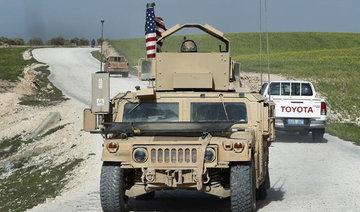
HALAWANJI, Syria: Perched on a green hilltop, Kurdish and Arab fighters face a tense front line separating them from Turkish-backed forces in this part of northern Syria. Behind them, American troops drive up and down the roads. Their aim: Make their presence known to prevent bursts of gunfire from spiraling into a battle.
Down the hill and across a stream are the rival forces: Syrian opposition fighters. They have taken positions on a crossroads in the village of Halawanji and on rooftops with views up to the hill. Beyond them, on another hill, Turkish troops have a base, ready to back up their allies if needed.
This front line threatens to ignite at any time, with the militaries of two NATO members on opposing sides. The crowded terrain has become more combustible as Turkey ever more loudly threatens to push through these lines to attack the nearby Kurdish-Arab town of Manbij and other Kurdish-run towns further east. The presence of the Americans is a main obstacle preventing them from doing so.
Further hiking tensions, a roadside bomb in Manbij late Thursday killed two coalition personnel, an American and a Briton. Kurdish officials accuse Turkey and its allies of carrying out acts of violence in the town to sow instability, including several recent smaller bombings, protests and an attempted assassination attempt on a Kurdish official — although there is also the possibility Daesh group militants are behind the violence.
Manbij is highly strategic: the main town on westernmost edge of the stretch of Syrian territory held by the US-backed Syrian Kurds, running along the border with Turkey. Mixed Kurdish-Arab Syrian forces liberated Manbij from the rule of the Daesh group in 2016 with help from the US-led coalition. But Kurdish control of the town infuriated Turkey, which views the main US Kurdish ally, the YPG militia, as “terrorists” linked to Kurdish insurgents on its own soil.
US troops first deployed in the area about 16 months ago, after Turkish-backed Syrian forces advanced on areas near Manbij, in a race for control of territories as IS militants collapsed. The deployment prevented repeated clashes between the two rival forces.
The U.S-backed Syrian fighters at Halwanji say their Turkish-backed rivals downhill increasingly open fire on them, trying to provoke a fight and create a pretext for an incursion. One commander said it happens as often as three times a week. Another said the “provocations” increased after Turkish troops and their allies successfully captured another town further west, Afrin, from the YPG. The commanders say their forces do not respond to the fire.
On Thursday, one commander, Abu Ali Nejm, said US troops have increased their presence “in a noticeable way” in the area in recent days to prevent an eruption of violence, following the capture of Afrin, Turkey’s threats and a recent build-up of Turkish troops and their allies.
“They have become part of the front line to reassure the people in Manbij and the military forces and to raise morale,” said Abu Ali, who uses his nom de guerre and is a leading member of the Manbij Military Council, the joint Kurdish-Arab body leading the US-allied forces here.
US Col. Ryan Dillon, of the U.S-led coalition, said there were no new US bases in the area. “Our patrols move around. They are not static,” he said. “The purpose of our forces is to prevent the reemergence of (IS militants)” and prevent “any type of incursion from any other group in the area.”
Turkey and the United States have held talks aimed at defusing the standoff, with a round set for Friday in Washington. But a solution remains unclear: Turkey says the YPG power across northern Syria is a threat, and President Recep Tayyip Erdogan has vowed to roll back the Kurdish fighters, starting from Manbij all the way to the Iraqi border. On Friday, Erdogan angrily lashed out at French President Emmanuel Macron for meeting with Kurdish officials and offering to mediate. Erdogan said he would not negotiate with “terrorists” and brusquely said Macron was “over his head.”
Meanwhile, at Halwanji, Abu Ali said the Turkish-backed fighters fired on his forces Thursday, using heavy machine guns and small arms. His troops did not respond, in accordance with orders, and instead reported the incident to US troops nearby, he said.
“We inform, and they come to the front and see for themselves. They have their own contacts or coordination with the Turkish forces, something they don’t have to tell us about,” he said, adding that when the rival side sees the Americans they don’t fire.
A team of Associated Press reporters arrived to the scene soon after the incident. A convoy of UStroops was seen on the road. All was quiet and all sides returned to their positions. But as the AP team drove away, new shooting rang out in the distance.


![]()

At volatile Syrian front line, US, Turkey on opposing sides
At volatile Syrian front line, US, Turkey on opposing sides
Latest updates


© 2026 SAUDI RESEARCH & PUBLISHING COMPANY, All Rights Reserved And subject to Terms of Use Agreement.