JEDDAH: US President Donald Trump has told advisers he wants an early exit of US troops from Syria, two senior administration officials said on Friday — a stance that may put him at odds with top US officials.
During a speech in Richfield, Ohio, the US leader revealed his aim to withdraw American forces from Syria and turn over security to regional countries.
Trump said that following allied victories against Daesh militants, “we’ll be coming out of Syria, like, very soon.”
“Let the other people take care of it now. Very soon, very soon, we’re coming out,” he said. “We’re going to get back to our country, where we belong, where we want to be.”
However, a Syrian opposition spokesman, Yahya Al-Aridi, told Arab News that the region’s strategic importance meant it was unlikely the US would act on the president’s demand.
The US presidency is not the only entity that decides strategic matters, he said. “It is not like any other country where the president speaks and everybody follows like a herd.”
Al-Aridi said the Middle East is of high strategic importance to the US because the region, especially Syria, is linked to America’s national security.
“The US has established many bases in Syria. There is Russia, Iran, Turkey and the allied forces. The US could play a more important role at the political level to find out a political solution to the Syrian crisis. This requires seriousness and standing up to Russian belligerence and its militarization of the whole conflict,” Al-Aridi said.
Syrians hope that no foreign power remains in the country after the conflict, he said.
Asked if a US withdrawal would help Daesh, Al-Aridi said: “(Barack) Obama said he needed 15 years to get rid of Daesh. Four months ago, from Hmeimim, (Vladimir) Putin declared that he defeated Daesh. We don’t know whether the terror group has been defeated. There are some spots where Daesh is being mobilized and we consider it a company everybody contributes to and uses as a pretext.”
Daesh is “a gun for hire,” he said. “It was mainly used by the (Bashar) Assad regime in order to justify the military action against Syrian people.”
The radical terror group is being used by these powers and “the losers in all of this are the Syrian people,” Al-Aridi said.
He highlighted the “cunning of Iran and its coordination” and cited the example of buses that carried Daesh terrorists from western Syria to eastern Syria “under the protection of the Assad regime and Tehran.”
The Daesh factor is being manipulated to serve their interests, Al-Aridi said.
Two members of the US-led anti-jihadist coalition, an American and a Briton, were killed by an improvised explosive device in the northern Syrian city of Manbij, US and British officials said on Friday.
Five other coalition service personnel were wounded, the Pentagon said.


![]()
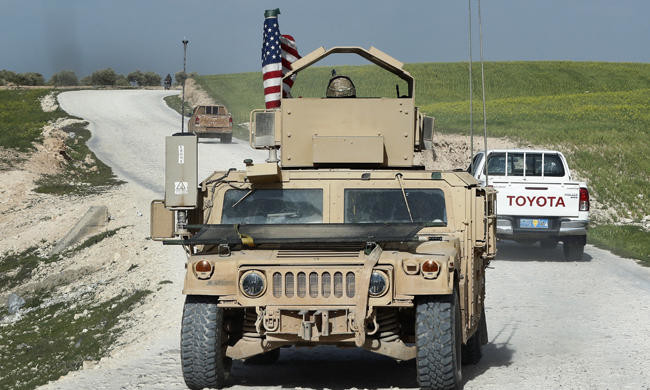
Syrian opposition casts doubt on Trump threat to pull out troops
Syrian opposition casts doubt on Trump threat to pull out troops
Latest updates




© 2026 SAUDI RESEARCH & PUBLISHING COMPANY, All Rights Reserved And subject to Terms of Use Agreement.