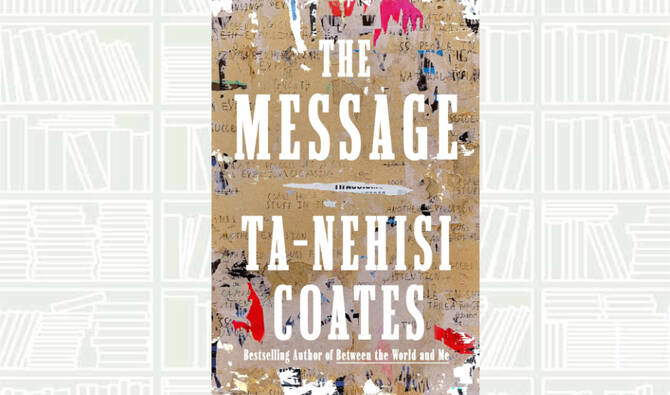

Author: Ta‑Nehisi Coates
Ta‑Nehisi Coates’s “The Message” is a work of nonfiction that uses travel and personal reflection to examine race, education, and power. Built as a series of essays, the book opens with Coates addressing the students he taught at Howard University.
According to students he once taught, it moves between new experiences and past events from Coates’s life.
Three major sections take place in Dakar, Senegal, Columbia, South Carolina, and the West Bank of Palestine. Each location becomes a backdrop for broader themes.
In Dakar, Coates describes his first trip to Africa and reflects on the complicated relationship between ancestry, distance, and belonging.
He visits Goree Island, which he frames as a kind of pilgrimage. He then spends time with friends, including writers and activists, as he tries to understand the differences between himself, a descendant of enslaved Africans, and Senegalese friends whose families lived under colonial government.
Columbia shifts the focus to a local fight over the school curriculum and the pressure placed on teachers when books about race become targets. The final section, set in the West Bank, is the most severe in tone.
Coates follows a literary trip through Palestinian cities Ramallah and Hebron in the West Bank and Jerusalem, describing what he sees and situating it within a broader historical narrative about the region.
Once he arrives at the Palestine Festival of Literature, held on an estate outside Ramallah, he says he enjoys his time among other writers and artists. He also calls for more work by Palestinian writers to reach wider audiences.
There’s no neutral gear here. Coates writes with a clear stance, and the essays often move toward moral conclusions rather than extended debate. That directness will work for some readers and alienate others.
At times the writing is also dense, moving quickly from scene to history to commentary, and it assumes a reader willing to keep track of the larger themes as they accumulate. Even when it feels heavy, it is rarely casual.