Efforts to form caretaker setup under way as Pakistan gears up for polls

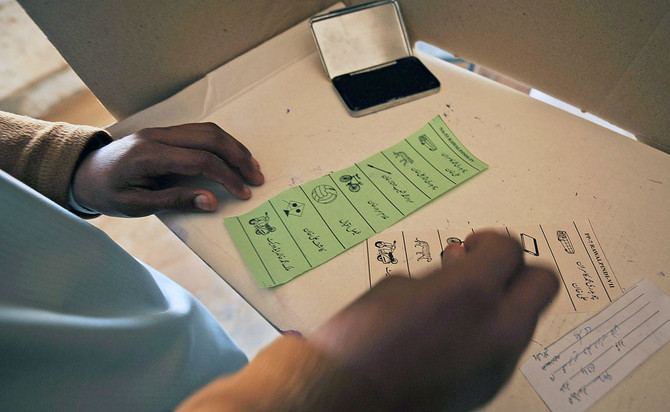
In this file photo, a Pakistani man stamps his ballot papers as he cast his vote at a polling station in Chakri, some 40 km from Islamabad, on Feb. 18, 2008. (AFP)
Updated 24 March 2018
Follow

Efforts to form caretaker setup under way as Pakistan gears up for polls

ISLAMABAD: Political parties in Pakistan are preparing for the 2018 general elections in August as the assemblies come to end their constitutional terms in the last week of May, according to Election Commission of Pakistan (ECP).
The five-year constitutional term of the National Assembly and the Punjab Assembly is ending on May 31, while those of the Sindh, Khyber Pakhtunkhwa and Balochistan assemblies are finishing three days earlier, i.e, on May 28.
The National Assembly is expected to complete its constitutional tenure on June 5, requiring elections to be held within 60 days of its dissolution.
Pakistan’s constitution requires the president to nominate the caretaker prime minister after consultation with the prime minister and leader of the opposition.
“As per Article 224A (1), in case the Prime Minister and the Leader of the Opposition in the outgoing National Assembly do not agree on any person to be appointed as the caretaker Prime Minister, within three days of the dissolution of the National Assembly, they shall forward two nominees each to a Committee to be immediately constituted by the Speaker of the National Assembly,” ECP official Haroon Khan told Arab News.
He said the parliamentary committee comprises eight members of the outgoing National Assembly, or the Senate, or both, having equal representation from the Treasury and the Opposition, to be nominated by the prime minister and the leader of the opposition respectively.
“The Committee constituted under clause (1) or (2) [of Article 224] shall finalize the name of the caretaker prime minister or caretaker chief minister, as the case may be, within three days of the referral of the matter to it,” said Haroon.
In case of the Committee’s inability to decide the matter in these three days, “the names of the nominees shall be referred to the Election Commission of Pakistan for a final decision within two days,” he added.
On Friday, Prime Minister Shahid Khaqan Abbasi said efforts were being made to install a consensus caretaker setup after the incumbent government completes its tenure, but if the efforts failed the matter would go to the ECP.
However, he feared that given the role of Pakistan People’s Party in the recent elections of the chairman and deputy chairman of Senate, there can be some problems in reaching consensus over the caretaker setup.
“The incumbent prime minister and the chief ministers shall continue to hold office till appointment of the caretaker prime minister and the respective caretaker provincial chief ministers, as the case may be,” Haroon said.


Pakistan says ‘national security is non-negotiable’ after Afghanistan strikes

Updated 58 min 52 sec ago
Follow

Pakistan says ‘national security is non-negotiable’ after Afghanistan strikes

  • Islamabad says recent cross-border strikes targeted Afghanistan-based militants behind recent attacks
  • Kabul has condemned strikes, accused Pakistan of violating territorial sovereignty and killing civilians

ISLAMABAD: Pakistan’s Parliamentary Secretary for Information and Broadcasting Danyal Chaudhry said on Monday “national security is non-negotiable,” defending Islamabad’s recent cross-border strikes inside Afghanistan following a number of recent militant attacks.

The remarks come after Pakistan said it launched “intelligence-based selective targeting” of seven militant camps along the Afghan border in response to a mosque bombing in Islamabad and violence in the northwestern border districts of Bajaur and Bannu, among other attacks. Authorities say many of the assaults have been carried out by the Tehreek-e-Taliban Pakistan (TTP) and allied groups that Islamabad alleges are operating from sanctuaries in Afghanistan, whose government denies this.

Kabul has condemned Sunday’s strikes as a violation of its sovereignty and claimed civilians were killed. Pakistan has not responded to that allegation.

Tensions between the two neighbors have escalated sharply despite a fragile ceasefire agreed after deadly clashes in October. 

“Pakistan has always chosen the path of dialogue and peaceful coexistence. But when Afghan soil continues to be used for proxy attacks, we have no choice but to defend our homeland. National security is non-negotiable,” Chaudhry said in a statement.

He said the recent operation had “successfully neutralized militants involved in attacks on Pakistani soil,” adding that “every precaution was taken to protect innocent lives.”

Pakistan has repeatedly accused Afghanistan’s Taliban rulers of allowing TTP militants and fighters linked to the Islamic State Khorasan Province (ISKP), the regional affiliate of the Daesh group, to operate from Afghan territory, claims Kabul denies.

Chaudhry referred to a recent United Nations report, saying militants from 21 countries were now operating from Afghan territory and posed a threat to regional stability.

Afghanistan’s defense ministry earlier condemned what it called a breach of international law and vowed a “measured response at a suitable time.” Its foreign ministry summoned Pakistan’s ambassador over what it described as violations of Afghan airspace.

Islamabad has also accused neighboring India of backing anti-Pakistan militant groups, a charge New Delhi has consistently denied.

The latest exchange has raised concerns of renewed instability along the 2,600-kilometer frontier, where repeated border closures have disrupted trade and strained diplomatic ties. Analysts say the escalation risks undoing recent efforts at de-escalation, including the Saudi-mediated release of three Pakistani soldiers earlier this month.