Exit polls suggest Vladimir Putin easily wins re-election

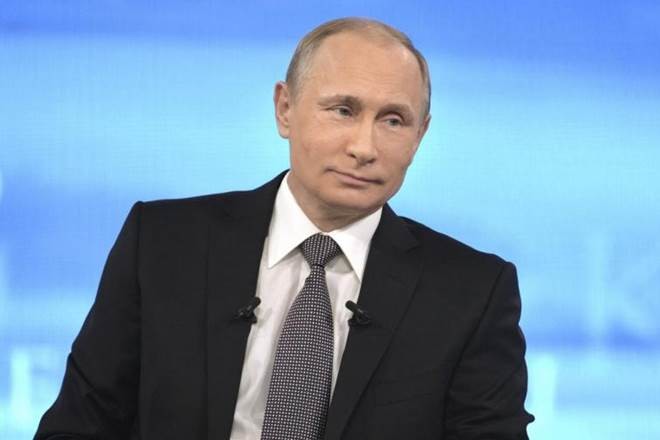
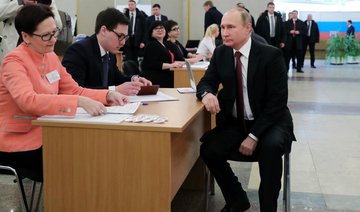
Russian President Vladimir Putin won a landslide re-election victory on Sunday. (REUTERS)
Updated 18 March 2018
Follow

Exit polls suggest Vladimir Putin easily wins re-election

MOSCOW: Russian President Vladimir Putin won a landslide re-election victory on Sunday, extending his rule over the world's largest country for another six years at a time when his ties with the West are on a hostile trajectory.
Putin's victory will extend his total time in office to nearly a quarter of a century, until 2024, by which time he will be 71. Only Soviet dictator Josef Stalin ruled for longer. Putin has promised to use his new term to beef up Russia's defences against the West and to raise living standards.
In a widely expected outcome, an exit poll by pollster VTsIOM showed Putin, who has dominated the political landscape for the last 18 years, had won 73.9 percent of the vote. The Central Election Commission, speaking after almost a third of the votes had been counted, put Putin on 73 percent.
Backed by state TV, the ruling party, and credited with an approval rating around 80 percent, his victory was never in doubt. His nearest challenger, Communist Party candidate Pavel Grudinin, got just over 11 percent, according to exit polls, while nationalist Vladimir Zhirinovsky got around 6 percent.
None of the seven candidates who ran against him posed a threat, and opposition leader Alexei Navalny was barred from running. Critics alleged that officials had compelled people to come to the polls to ensure that voter boredom at the one-sided contest did not lead to a low turnout.
Russia's Central Election Commission recognised that there were some irregularities, but was likely to dismiss wider criticism and declare the overall result legitimate.
Putin loyalists said the result was a vindication of his tough stance towards the West.
"I think that in the United States and Britain they've understood they cannot influence our elections," Senator Igor Morozov said on state television.
Valentina Matviyenko, a close Putin ally and speaker of the upper house of parliament, hailed the victory as a moral one over the West.
"Our elections have proved once again ... that it's not possible to manipulate our people," she said. "People came together. No other country in the world has such open and transparent elections."
The immediate question is if and when opponents like Navalny organise protests, citing fraud, and how large and sustained those protests will be. A senior opposition politician has warned they could descend into street clashes if police crack down too hard on demonstrators.
The longer-term question is whether Putin will soften his anti-Western rhetoric now the election is won.


Trump calls for one year cap on credit card interest rates at 10 percent

Updated 6 sec ago
Follow

Trump calls for one year cap on credit card interest rates at 10 percent

  • Trump says Americans have been ‘ripped off’ by credit card companies
  • Lawmakers from both parties have raised concerns about rates

WASHINGTON: US President Donald Trump said on Friday he was ​calling for a one-year cap on credit card interest rates at 10 percent starting on January 20 but he did not provide details on how his plan will come to fruition or how he planned to make companies comply.
Trump also made the pledge during the campaign for the 2024 election that he won but analysts dismissed it at the time saying that such a step required congressional approval.
Lawmakers from both the Democratic and Republican Parties have raised concerns about high rates and have called for those to be addressed. Republicans currently hold a narrow majority in both the Senate ‌and the House ‌of Representatives.
There have been some legislative efforts in Congress ‌to pursue ⁠such ​a proposal ‌but they are yet to become law and in his post Trump did not offer explicit support to any specific bill.
Opposition lawmakers have criticized Trump, a Republican, for not having delivered on his campaign pledge.
“Effective January 20, 2026, I, as President of the United States, am calling for a one year cap on Credit Card Interest Rates of 10 percent,” Trump wrote on Truth Social, without providing more details.
“Please be informed that we will no longer let the American Public be ‘ripped off’ by Credit Card Companies,” Trump added.
The ⁠White House did not immediately respond to a request for comment on details of the call from Trump, but said on ‌social media without elaborating that the president was capping the rates.
Some ‍major US banks and credit card issuers ‍like American Express, Capital One Financial Corp, JPMorgan , Citigroup and Bank of America did not immediately respond ‍to a request for comment.
US Senator Bernie Sanders, a fierce Trump critic, and Senator Josh Hawley, who belongs to Trump’s Republican Party, have previously introduced bipartisan legislation aimed at capping credit card interest rates at 10 percent for five years. This bill explicitly directs credit card companies to limit rates ​as part of broader consumer relief legislation.
Democratic US Representative Alexandria Ocasio-Cortez and Republican Congresswoman Anna Paulina Luna have also introduced a House of Representatives bill to cap credit card ⁠interest rates at 10 percent, reflecting cross-aisle interest in addressing high rates.
Billionaire fund manager Bill Ackman, who endorsed Trump in the last elections, said the US president’s call was a “mistake.”
“This is a mistake,” Ackman wrote on X.
“Without being able to charge rates adequate enough to cover losses and earn an adequate return on equity, credit card lenders will cancel cards for millions of consumers who will have to turn to loan sharks for credit at rates higher than and on terms inferior to what they previously paid.”
Last year, the Trump administration moved to scrap a credit card late fee rule from the era of former President Joe Biden.
The Trump administration had asked a federal court to throw out a regulation capping credit card late fees at $8, saying it agreed with business and banking groups that alleged the rule was ‌illegal. A federal judge subsequently threw out the rule.