Putin on track for commanding win as Russians troop to polls

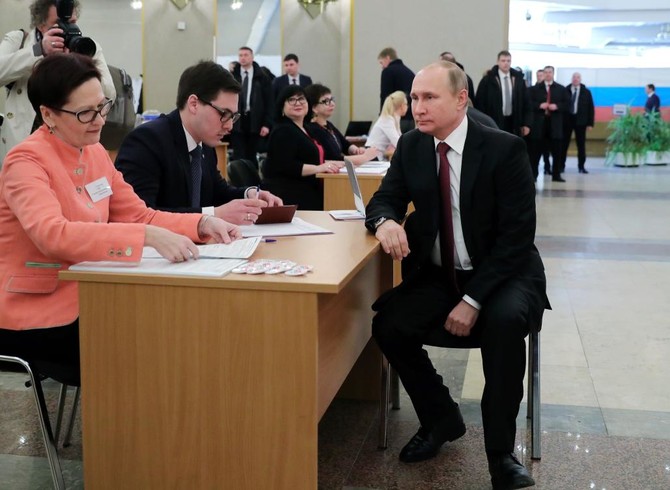
Russian President and Presidential candidate Vladimir Putin waits to get his ballot as he arrives to vote at a polling station during Russia’s presidential election in Moscow on Sunday. (AP)
Updated 19 March 2018
Follow

Putin on track for commanding win as Russians troop to polls

UST-DJEGUTA, Russia: Russians voted in a presidential election on Sunday that was expected to give Vladimir Putin an easy victory, but his opponents alleged officials were compelling people to come to the polls so that a low turnout does not tarnish the win.
Opinion polls give Putin, the incumbent, support of around 70 percent, or nearly 10 times the backing of his nearest challenger.
Another term will take him to nearly a quarter century in power — a longevity among Kremlin leaders second only to Soviet dictator Josef Stalin.
Many voters credit Putin, a 65-year-old former KGB spy, with standing up for Russia’s interests in what they view as a hostile outside world.
Russia’s annexation of Ukraine’s Crimea region, alleged Kremlin meddling in the US presidential election, and Moscow’s bombing campaign in Syria, have been condemned in the West. But for most people at home, they have only burnished Putin’s reputation as a strong leader.
A row with Britain over allegations the Kremlin used a nerve toxin to poison a Russian double agent in a sleepy English city — denied by Moscow — has not dented Putin’s standing.
“I voted for Putin,” said Lyubov Kachan, a teacher in the settlement of Ust-Djeguta, in southern Russia.
“If anything is not going our way right now, that’s thanks to the world which treats us so negatively, while he is trying to stand up to that,” she said.
The only real headache for Putin’s campaign was the possibility many voters, including Putin supporters, would not bother to come to the polls because they felt the outcome was already a foregone conclusion.
Putin opponents alleged employers with close ties to the state were ordering staff to go and vote, and send back evidence.
Reuters reporters witnessed multiple people in different locations voting in groups, and then taking photos of themselves in front of the ballot boxes on their phones. Some arrived at polling stations on board private-hire buses.
In polling station 1515 in Zelenodolsk, 800 km (500 miles) east of Moscow, five people photographed themselves voting. Asked by a Reuters reporter why, one of the group, a young woman, said: “What do you mean why? It’s a photographic report for our bosses.”
At polling station No. 216 in Ust-Djeguta, Marina Kostina was supervising two teenage girls who were photographing voters. Asked why one woman was photographed, Kostina said: “Her work asked her to report back.”
Turnout nationwide was at 51.9 percent by 1400 GMT, official data showed. A low turnout would diminish Putin’s authority within the ruling elite, which is founded in large part on his ability to mobilize the public behind him.
Nina Bostanova, a pensioner in Ust-Djeguta, said she decided not to vote. “What’s the point? They’ll get elected anyway. Why go and vote?” she said.
The first politician in years to challenge the Kremlin’s grip on power, Alexei Navalny, is barred from the race because of a corruption conviction he says was fabricated. He is calling for a boycott of the election, saying it is an undemocratic farce.
Navalny’s headquarters said activists sent out to monitor the vote reported people being bussed to polling stations by their employers.
“They need turnout,” Navalny told a briefing. “Across the country people are being driven to the polling stations.” He said he would decide later on Sunday whether to call supporters out into the streets in protest.
Previous demonstrations organized by Navalny have attracted several thousand people, and led to clashes with police, but they have been successfully contained by the authorities.
A day of voting across Russia’s 11 time zones began at 2000 GMT on Saturday on Russia’s eastern edge, in the Pacific coast city of Petropavlovsk-Kamchatsky. Voting will run until polls close at the westernmost point of Russia, the Kaliningrad region on the Baltic Sea, at 1800 GMT on Sunday.
The majority of voters see no viable alternative to Putin: He has total dominance of the political scene and state-run television, where most people get their news, gives lavish coverage of Putin and little airtime to his rivals.
Many Russians believe he has restored stability after the chaos that ensued after the Soviet Union collapsed.
A March 9 survey by state-run pollster VTsIOM gave Putin, who was first elected president in 2000, support of 69 percent. His nearest rival Pavel Grudinin, the Communist Party’s candidate, was on just 7 percent.
Ella Pamfilova, head of the commission organizing the vote nationwide, has said any fraud will be stamped out.
She said those already alleging the election was rigged were biased and peddling “Russophobia,” echoing a line used by the Kremlin to describe Western criticism of Russia.


Democrats say White House offer on ICE is ‘insufficient’ as Homeland Security funding set to expire

Updated 3 sec ago
Follow

Democrats say White House offer on ICE is ‘insufficient’ as Homeland Security funding set to expire

  • Many Democrats who are furious about ICE’s aggressive crackdown have said they won’t vote for another penny of Homeland Security funding until enforcement is radically scaled back

WASHINGTON: Democratic leaders say a proposal from the White House is “incomplete and insufficient” as they are demanding new restrictions on President Donald Trump’s immigration crackdown and threatening a shutdown of the Homeland Security Department.
Senate Democratic leader Chuck Schumer and House Democratic leader Hakeem Jeffries said in a statement late Monday that a White House counterproposal to the list of demands they transmitted over the weekend “included neither details nor legislative text” and does not address “the concerns Americans have about ICE’s lawless conduct.” The White House proposal was not released publicly.
The Democrats’ statement comes as time is running short, with another partial government shutdown threatening to begin Saturday. Among the Democrats’ demands are a requirement for judicial warrants, better identification of DHS officers, new use-of-force standards and a stop to racial profiling. They say such changes are necessary after two protesters were fatally shot by federal agents in Minneapolis last month.
Earlier Monday, Senate Majority Leader John Thune, R-S.D., had expressed optimism about the rare negotiations between Democrats and the White House, saying there was “forward progress.”
Thune said it was a good sign that the two sides were trading papers, and “hopefully they can find some common ground here.”
But coming to an agreement on the charged issue of immigration enforcement will be difficult, especially as rank-and-file lawmakers in both parties were skeptical about finding common ground.
Republicans have balked at the Democrats’ requests and some have demands of their own, including the addition of legislation that would require proof of citizenship before Americans register to vote and restrictions on cities that they say do not do enough to crack down on illegal immigration.
And many Democrats who are furious about Immigration and Customs Enforcement’s aggressive crackdown have said they won’t vote for another penny of Homeland Security funding until enforcement is radically scaled back.
“Dramatic changes are needed at the Department of Homeland Security before a DHS funding bill moves forward,” Jeffries said earlier Monday. “Period. Full stop.”

Trump deals with Democrats
Congress is trying to renegotiate the DHS spending bill after Trump agreed to a Democratic request that it be separated out from a larger spending measure that became law last week. That package extended Homeland Security funding at current levels only through Feb. 13, creating a brief window for action as the two parties discuss new restrictions on ICE and other federal officers.
Democrats made the demands for new restrictions on ICE and other federal law enforcement after ICU nurse Alex Pretti was shot and killed by a US Border Patrol officer in Minneapolis on Jan. 24, and some Republicans suggested that new restrictions were necessary. Renee Good was shot by ICE agents on Jan. 7.
While he agreed to separate the funding, Trump has not publicly responded to the Democrats’ specific demands.
White House press secretary Karoline Leavitt said late last week that the Trump administration is willing to discuss some items on the Democrats’ list, but “others don’t seem like they are grounded in any common sense, and they are nonstarters for this administration.”

Democratic demands
Schumer and Jeffries have said they want immigration officers to remove their masks, to show identification and to better coordinate with local authorities. They have also demanded a stricter use-of-force policy for the federal officers, legal safeguards at detention centers and a prohibition on tracking protesters with body-worn cameras.
Among other demands, Democrats say Congress should end indiscriminate arrests, “improve warrant procedures and standards,” ensure the law is clear that officers cannot enter private property without a judicial warrant and require that before a person can be detained, it’s verified that the person is not a US citizen.
Republicans have said they support the requirement for DHS officers to have body-worn cameras — language that was in the original DHS bill — but have balked at many of the other Democratic asks.
“Taking the masks off ICE officers and agents, the reason we can’t do that is that it would subject them to great harm, their families at great risk because people are doxing them and targeting them,” said House Speaker Mike Johnson, R-Louisiana, on Monday. “We’ve got to talk about things that are reasonable and achievable.”
Tennessee Sen. Bill Hagerty said on “Fox News Sunday” that Democrats are ”trying to motivate a radical left base.”
“The left has gone completely overboard, and they’re threatening the safety and security of our agents so they cannot do their job,” Hagerty said.

Consequences of a shutdown
In addition to ICE and US Customs and Border Protection, the homeland security bill includes funding for the Federal Emergency Management Agency and the Transportation Security Administration. If DHS shuts down, Thune said last week, “there’s a very good chance we could see more travel problems” similar to the 43-day government closure last year.
Lawmakers in both parties have suggested they could separate out funding for ICE and Border Patrol and pass the rest of it by Friday. But Thune has been cool to that idea, saying instead that Congress should pass another short-term extension for all of DHS while they negotiate the possible new restrictions.
“If there’s additional time that’s needed, then hopefully Democrats would be amenable to another extension,” Thune said.
Many Democrats are unlikely to vote for another extension. But Republicans could potentially win enough votes in both chambers from Democrats if they feel hopeful about negotiations.
“The ball is in the Republicans’ court,” Jeffries said Monday.