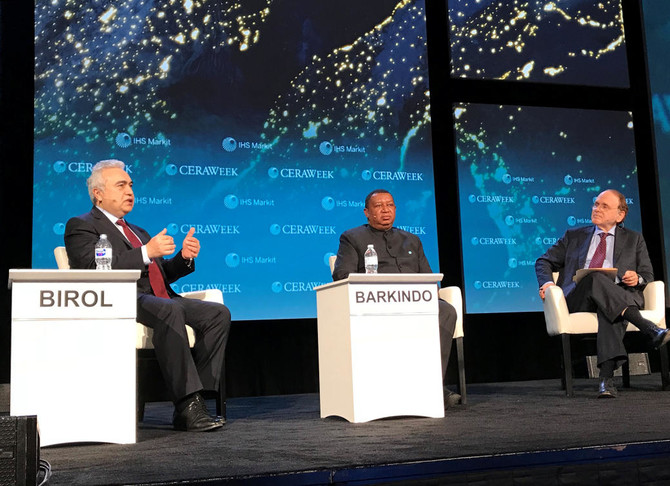
HOUSTON: Energy industry leaders were virtually unanimous in their commitment to raise gas production as a percentage of their overall portfolio. It is seen as the most environmentally sound form of fossil fuel at a time when most big corporations are finally realizing they have to do something about pollution and climate change.
Ben van Beurden, chief executive of Royal Dutch Shell, is looking to increase his company’s gas production to three times that of oil as part of the pledge to cut carbon emissions by 50 percent over the next three decades.
“Over time, this net carbon footprint ambition will transform our company’s product mix,” van Beurden said.
America is the world’s biggest gas producer, and once again the US industry’s ambitions are set high, reflecting the new-found confidence of the American energy industry. The country’s shale fields have already revolutionized the global oil industry, and now look set to do the same for gas.
Houston-based Cheniere Energy, is one of the biggest US gas producers. Its chief executive, Jack Fusco, told the conference that demand for liquefied natural gas (LNG), rose 40 percent over the past year, and would continue to be strong thanks to a new appetite for gas in China and other parts of Asia. “They want — they need — cleaner air, and we see that shift longer term,” he said. China wants to increase gas to around 10 percent of total energy consumption over the next two years, and imported LNG is crucial to meeting that target.
And it is not just China. During the conference Cheniere announced that it was to begin LNG shipments for the first time to India, which is also waking up to its air quality issues.
Saudi Aramco, the world’s biggest oil company, is also aware of the new global appetite for gas, and is moving to increase its output significantly.
Virtually the whole of the Kingdom’s gas production used to be flared, because there was no obvious use for the product, seen essentially as a byproduct from oil production. That practice was stopped some years ago, and the Kingdom is now the fifth-largest gas producer in the world.
But it is looking to go further. Ahmad Al-Khowaiter, Aramco’s chief technical officer, said on the sidelines of the conference that Aramco was looking to significantly increase the proportion of its supplies to the domestic market and for export.
That was echoed by Aramco chief executive Amin Nasser, who said that gas was a “very significant growth area,” and that Aramco was looking to double gas production in the Kingdom over the next 10 years to 23 billion cubic feet per day.
“There should be a global priority on improving the efficiency and lowering carbon emissions,” he added. The Saudi Arabian company might also be sitting on its very own equivalent of the gas-bearing shale of Texas. It emerged that Aramco is to begin exploiting a big shale gas deposit at its South Ghawar and Jafurah basins, which executives believe could be as big as some of the Texas fields.
Could the new-found Saudi enthusiasm for gas lead it to partner US companies in the Texas gas fields and elsewhere? There was much speculation at CERAWeek that there had been preliminary conversations between Aramco and American counterparts over such a deal.
Nasser left the door open to the possibility with a statement that the company was “trying to capture growth areas in different parts of the world.”
New facilities for processing and transporting gas are expensive, and in the US at least face challenges from environmentalists who do not like pipelines that criss-cross virgin countryside.
But that new infrastructure is what the gas industry needs if it is to sustain its push.
Meg Gentle, chief executive of LNG company Tellurian, said that some $200 billion of investment was needed in US gas to meet growth in both supply and demand.
Nasser put the required total global investment in energy at $20 trillion over the next 25 years to meet growth in demand. Gas will be a big part of that spend, for Aramco as for the rest of the world.


![]()
Gas was king at CERAweek as Asia demands cleaner air
Gas was king at CERAweek as Asia demands cleaner air

Latest updates


© 2026 SAUDI RESEARCH & PUBLISHING COMPANY, All Rights Reserved And subject to Terms of Use Agreement.