

Aid reaches Syria’s Ghouta as strikes hit rebel enclave

An aid convoy from the International Committee of the Red Cross makes its way to Rastan, a besieged town in Homs province, on April 21, 2016 (AFP)
Updated 09 March 2018
Follow

Aid reaches Syria’s Ghouta as strikes hit rebel enclave

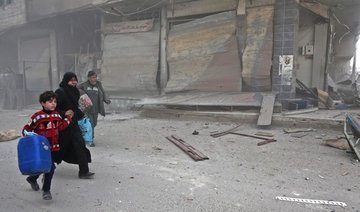
DOUMA, Syria: An aid convoy managed to deliver food to hunger-stricken Eastern Ghouta on Friday despite renewed bombardment by Syrian regime forces who have seized more than half of the besieged rebel enclave.
Nearly 950 civilians have been killed since Russia-backed government forces launched a blistering assault on the last opposition bastion near Damascus on February 18.
Fresh air strikes killed six civilians in the area of Jisreen, a war monitor said, even as the regime and businessmen held talks about the possible evacuation of residents from parts of the enclave.
The Doctors Without Borders charity called for desperately needed medical supplies to be allowed into the enclave, where exhausted doctors have been struggling to treat hundreds of wounded.
Air strikes hit the areas of Jisreen and Harasta after stopping briefly in the early morning, the Britain-based Syrian Observatory for Human Rights monitoring group said.
Earlier, 13 trucks loaded with 2,400 food parcels crossed into Eastern Ghouta, the International Committee of the Red Cross said, entering what UN chief Antonio Guterres has called “hell on earth.”

But renewed bombardment near the main town of Douma soon threatened the joint ICRC, Syrian Arab Red Crescent and United Nations convoy.
“Shelling in proximity of Douma, east Ghouta today, is putting the UN/ICRC/SARC convoy at risk, despite assurances of safety from parties including the Russian Federation,” the UN humanitarian coordinator in Syria, Ali Al-Zaatari, said.
The aid was delivered with helicopters hovering overhead and warplanes targeting areas outside Douma, a correspondent in the town said.
There were no medical supplies on board Friday’s convoy, which was carrying food that aid workers were unable to distribute on Monday.
The enclave’s 400,000 inhabitants have been living under government siege since 2013, with food and medicines in very short supply even before the latest assault.
The renewed artillery fire came as representatives of Damascus and businessmen pressed negotiations on a solution that would allow civilians or fighters to leave the enclave, the Observatory said.
Syrian state news agency SANA said dozens of civilians were expected to leave Eastern Ghouta on Friday.
In the town of Hammuriyeh, dozens of people took part in a protest calling for an end to the bloodshed, the Observatory said.
“Enough destruction and death! We want to save our children and all those who have not died,” said Abu Riyadh, a 47-year-old man in the town.
A negotiator from the town said a “civilian delegation” was “to negotiate with the regime toward a solution to end the fighting” in the area.
A tribal leader said more than 300 civilians from the areas of Kafr Batna, Saqba and Hammuriyeh wanted to leave.
He told journalists there had been discussions for “500 fighters to hand over their weapons to the army.”
Ambulances and green buses — usually used to evacuate people from areas retaken by the regime — waited near a key checkpoint out of the enclave, an AFP reporter there said, as national songs blared on loudspeakers.
The air and ground assault has left medical staff exhausted.
Doctors and nurses in the enclave have run out of several life-saving items, Doctors Without Borders (MSF) said Friday.
“The need for a massive medical re-supply, without life-saving items being removed, is increasingly urgent with each passing hour,” MSF said in a statement.
The Paris-based charity urged the warring parties to pause the bombardment to allow for the evacuation of critically ill or wounded patients.
More than a week ago, the United Nations said those already numbered more than 700.
The charity said 15 of the 20 medical facilities it supports in Eastern Ghouta have been hit by air strikes or shelling.
Regime forces have advanced rapidly through farmland in the enclave since last week, the Observatory says, taking control of more than half of the territory from the armed opposition.
On Monday, 46 trucks entered the area in the first aid provision since February 18 — but had to cut their deliveries short due to bombardment.
The United Nations said Syrian authorities removed some medical supplies from the trucks.
More than 340,000 people have been killed since Syria’s war started in 2011 with the brutal repression of anti-government protests.
UN High Commissioner for Refugees Filippo Grandi on Friday called the conflict a “colossal human tragedy.”
“The conditions faced by civilians inside Syria are worse than ever, with 69 percent languishing in extreme poverty,” he said.
UN-backed peace talks have failed to end the war, and a nationwide cease-fire called for by the UN Security Council last month has not been implemented.
In northern Syria, Turkey-led rebels have been pressing an assault on the Kurdish enclave of Afrin since January 20.
Turkish President Recep Tayyip Erdogan said on Friday that his forces and allied rebels could enter the center of Afrin town “at any moment,” a day after they seized another key town in the area.

Iran envoy: Saudi Arabia a pivotal partner, relations ‘fortified’

Updated 5 sec ago
Follow

Iran envoy: Saudi Arabia a pivotal partner, relations ‘fortified’

  • ‘Our contacts continue at all levels,’ Ambassador Alireza Enayati tells Asharq Al-Awsat
  • Alireza Enayati: Iran and the Kingdom are keen on the security and stability of the region

RIYADH: A senior Iranian official said that relations with Saudi Arabia are “fortified” and cannot be undermined, highlighting both nations’ shared commitment to regional security and stability. 

Alireza Enayati, Iran’s ambassador to Saudi Arabia, said in an exclusive interview with Asharq Al-Awsat that both countries are committed to preventing escalation and avoiding actions that could destabilize the region. 

He added that contacts and coordination between the two countries are taking place at various levels, including visits, meetings and private discussions.

Enayati said: “We must recognize the sensitivity of the current situation amid repeated threats facing the region and the risk of sliding into unprecedented escalation.

“In Iran, we believe that regional stability serves the interests of all countries in the region, and we have repeatedly sensed this affirmation during our meetings and encounters with Saudi officials.”

A senior Saudi official had told Asharq Al-Awsat on Saturday that reports circulated by some media outlets about a change in the Kingdom’s position regarding escalation in the region were inaccurate.

The source said that Saudi Arabia supports efforts aimed at reaching a peaceful solution to all disputed issues between the US and Iran through dialogue and diplomatic means, stressing the Kingdom’s rejection of the use of its airspace or territory for any military actions against Iran.

Enayati pointed to the existence of “ongoing contacts and exchanges between the two countries at various levels, including visits and meetings — some of which are public, while others are held away from the media.”

The Iranian diplomat said that Tehran “considers Saudi Arabia a pivotal and influential state in the region,” adding that cooperation between the two countries on issues of mutual interest “contributes to strengthening the region’s security and stability.”

He said: “Iran and the Kingdom are keen on the security and stability of the region, and emphasize the need to avoid escalation and steer clear of anything that could disturb regional calm.” 

Consultations are taking place between the two sides “stemming from a strategic conviction that has crystallized for both parties and serves their interests as well as those of the region as a whole,” Enayati added.

“The Kingdom views Iran as a reliable partner, while Iran regards Saudi Arabia as an important and effective state in the region, and their cooperation on issues of mutual interest helps consolidate regional security and stability.”

The ambassador said: “These relations are fortified and cannot be undermined, thanks to the leadership of both countries and their understanding of the inevitability of these relations, ensuring their continuity and growth, and the reflection of their positive effects on all.”

Enayati recalled the Saudi position in support of Tehran during its recent war with Israel, saying: “Iran welcomed the Saudi position supporting it during the war imposed on it, as Saudi Arabia strongly condemned the Israeli aggression against Iran, and we received a phone call that morning from the Saudi foreign minister. This stance was not surprising from our Saudi brothers, who stood by us during that phase.”

He added: “Second, any harm to Iran affects the security of the entire region, and this was clearly reflected in constructive positions, including that of the Kingdom. Third, the attack on Iran comes within a series of Israeli attacks that have targeted countries across the region, and no state is immune from these aggressions.”

Regarding talk of a negotiating framework taking shape between Iran and the US, Enayati said that Iran “entered the negotiations in 2015 and 2025 with full seriousness, but the US withdrew from them and dealt with them in a contradictory manner.”

He added: “If the US is serious about an equal dialogue without preconditions, Iran welcomes that, and Iranian officials have repeatedly affirmed this position.

“We recently heard statements indicating that the two sides are working to establish a framework for negotiations; however, negotiations cannot begin with predetermined outcomes. Rather, their results must emerge from the negotiating process itself, not be imposed on it in advance.”

Crown Prince Mohammed bin Salman, during a phone call he received from Iranian President Masoud Pezeshkian last week, highlighted the Kingdom’s support for any efforts aimed at resolving disputes through dialogue in a manner that enhances regional security and stability.

During the call, the Saudi crown prince stressed Riyadh’s position on respecting Iran’s sovereignty and the Kingdom’s refusal to allow the use of its airspace or territory for any military actions against Iran, or for attacks by any party, regardless of their direction.

Pezeshkian expressed his gratitude to Saudi Arabia for its respect of Iran’s sovereignty and territorial integrity, and his appreciation for the crown prince’s efforts and initiatives to achieve regional security and stability.