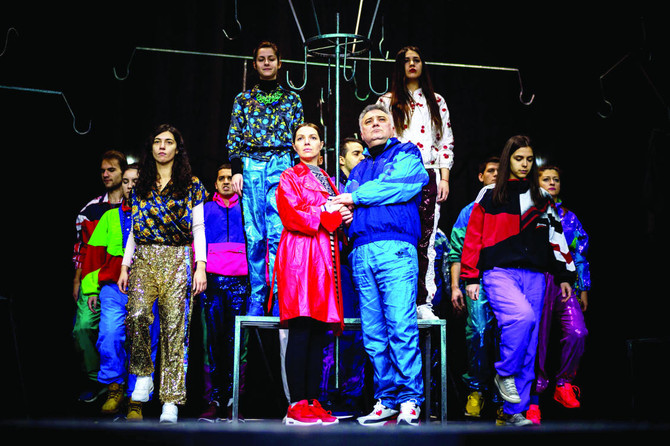
GRACANICA, Kosovo: Twelve years after he died during his trial for war crimes, Slobodan Milosevic, the one-time Serbian strongman, divided his audience again, this time as a character in a musical that made its debut on Tuesday.
“The Lift — The Slobodan Show,” written by Belgrade-based writer Jelena Bogavac, focuses more on Milosevic’s personal relationship with his powerful wife Mirjana, his daughter Marija and his son Marko than on the politics that made him infamous.
Milosevic rode a wave of nationalism to power in Belgrade in 1989 as communism was collapsing across eastern Europe. He then led Serbia through a decade of wars in Bosnia, Croatia and Kosovo. Hailed by Serbian nationalists as their champion against Catholic Croats and Bosnian and Kosovar Albanian Muslims, Milosevic was seen as a brutal dictator by the West.
Around 200 Kosovo Serbs attended the show at a theater in Gracanica, a Serb enclave just outside Kosovo’s capital Pristina. They expressed mixed feelings about it.
“There’s nothing there, it’s simply a great manipulation... a political theater which actually tricked us,” said Zivojin Rakocevic, a former journalist from Gracanica.
In one scene Milosevic comforts his daughter over the poor financial state of her radio station. In another he tells Marko not to overheat the water in the family swimming pool.
Milosevic lost power after a NATO bombing campaign in 1999 and popular unrest in October 2000.
The play ends with his war crimes trial in the Hague, where he died of a heart attack in 2006.
“I’m delighted ... the point of the whole show is in one sentence, when a young man says ‘Sloba (Milosevic) didn’t get under my skin’,” said Viktorija Zivkovic, who works in a local school.
“We tried to show through their personalities what happened both in Kosovo ... and in Serbia of the 1990s,” Belgrade-based actress Tamara Tomanovic said.
The play frustrated ethnic Albanians who form the majority in Kosovo, which declared independence from Belgrade in 2008 in a move still not recognized by Serbia and Kosovo Serbs.

Milosevic — the musical — plays in Kosovo
Arts festival’s decision to exclude Palestinian author spurs boycott
- A Macquarie University academic who researches Islamophobia and Palestine, Abdel-Fattah responded saying it was “a blatant and shameless act of anti-Palestinian racism and censorship,” with her lawyers issuing a letter to the festival
SYDENY: A top Australian arts festival has seen the withdrawal of dozens of writers in a backlash against its decision to bar an Australian Palestinian author after the Bondi Beach mass shooting, as moves to curb antisemitism spur free speech concerns.
The shooting which killed 15 people at a Jewish Hanukkah celebration at Sydney’s Bondi Beach on Dec. 14 sparked nationwide calls to tackle antisemitism. Police say the alleged gunmen were inspired by Daesh.
The Adelaide Festival board said last Thursday it would disinvite Randa Abdel-Fattah from February’s Writers Week in the state of South Australia because “it would not be culturally sensitive to continue to program her at this unprecedented time so soon after Bondi.”
FASTFACTS
• Abdel-Fattah responded, saying it was ‘a blatant and shameless act of anti-Palestinian racism and censorship.’
• Around 50 authors have since withdrawn from the festival in protest, leaving it in doubt, local media reported.
A Macquarie University academic who researches Islamophobia and Palestine, Abdel-Fattah responded saying it was “a blatant and shameless act of anti-Palestinian racism and censorship,” with her lawyers issuing a letter to the festival.
Around 50 authors have since withdrawn from the festival in protest, leaving it in doubt, local media reported.
Among the boycotting authors, Kathy Lette wrote on social media the decision to bar Abdel-Fattah “sends a divisive and plainly discriminatory message that platforming Australian Palestinians is ‘culturally insensitive.'”
The Adelaide Festival said in a statement on Monday that three board members and the chairperson had resigned. The festival’s executive director, Julian Hobba, said the arts body was “navigating a complex moment.”
a complex and unprecedented moment” after the “significant community response” to the board decision.
In the days after the Bondi Beach attack, Jewish community groups and the Israeli government criticized Prime Minister Anthony Albanese for failing to act on a rise in antisemitic attacks and criticized protest marches against Israel’s war in Gaza held since 2023.
Albanese said last week a Royal Commission will consider the events of the shooting as well as antisemitism and social cohesion in Australia. Albanese said on Monday he would recall parliament next week to pass tougher hate speech laws.
On Monday, New South Wales state premier Chris Minns announced new rules that would allow local councils to cut off power and water to illegally operating prayer halls.
Minns said the new rules were prompted by the difficulty in closing a prayer hall in Sydney linked to a cleric found by a court to have made statements intimidating Jewish Australians.
The mayor of the western Sydney suburb of Fairfield said the rules were ill-considered and councils should not be responsible for determining hate speech.
“Freedom of speech is something that should always be allowed, as long as it is done in a peaceful way,” Mayor Frank Carbone told Reuters.