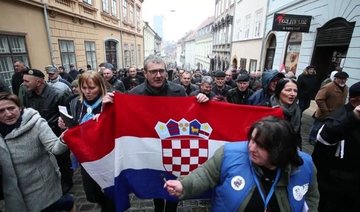
PRISTINA: Kosovo expects to resolve outstanding issues with Serbia this year by reaching an “historic” agreement that would pave the way for the Balkan country to get a seat at the United Nations, President Hashim Thaci said on Tuesday.
Kosovo seceded a decade ago from Serbia, but its independence has not been recognized by Belgrade, which together with its traditional allies Moscow and Beijing has blocked Pristina’s bid for a UN seat.
As Belgrade moves closer to membership in the European Union, Serbian authorities are under pressure to resolve relations with neighbors including Kosovo.
“The deal between Kosovo and Serbia, which I believe will happen in 2018, will be a historic, a comprehensive agreement which will result in Kosovo’s membership in United Nations,” Thaci told Reuters in an interview.
Serbia lost control over Kosovo in 1999 when NATO waged a bombing campaign to halt killings of ethnic Albanians in a two-year counter-insurgency war. Nearly a decade later, in 2008, Kosovo declared independence, backed by the United States and most of the Western European states.
Kosovo’s independence has been recognized by 115 states so far.
Thaci said the agreement with Serbia would bring full normalization of relations between the former foes, although they may not be required to recognize each other as independent states.
Kosovo’s relations with Western countries was soured by an initiative to scrap a law that established a war crimes court. The initiative was shelved under pressure by Western embassies in Pristina, and the court was set up in 2015, although it has yet to hear a case.
The Specialist Chamber, which has the authority to try ex-Kosovo Liberation Army (KLA) guerrillas for alleged atrocities in the war that led to independence from Serbia, is part of Kosovo’s legal system but based in The Hague to minimize the risks of witness intimidation and judicial corruption.
Kosovo’s media have reported that some of the leading Kosovo politicians, including Thaci, who was commander of the KLA, could be indicted by the court or called to testify.
“This was a historic injustice but for the sake of keeping the strategic partnership with the US, EU and NATO we created that (the court),” Thaci said. “Kosovo has nothing to hide.”
Asked what he would do if called to testify as a witness or defendant by the court, he said: “The president or any other citizen of this country has no reason to be afraid.”
“We never violated Kosovo law or international laws. We have fought against a dictator, against a man who committed genocide,” he said, referring to former Yugoslav and Serbian president Slobodan Milosevic, who died in 2006 while on trial for war crimes.
The 1.8 million-strong country is preparing for a big celebration on Saturday to commemorate the 10th anniversary of its declaration of independence. Kosovo-born British singer Rita Ora is due to hold a big concert in Pristina.

Kosovo president expects to reach ‘historic’ deal with Serbia this year
Villagers massacred in South Sudan food aid trap
- Civilians killed after being lured from homes with promise of aid, witnesses say
NAIROBI: More than a dozen civilians were killed after being lured from their homes by fighters allied to South Sudan’s government under the pretense of being registered for humanitarian food aid, according to two people who survived the attack.
The killings took place on Saturday morning in the village of Pankor, in Ayod county, in the conflict-hit Jonglei state, about 400km north of the capital, Juba.
Women and children were among the victims.
HIGHLIGHTS
• The two survivors said that 22 people were killed and several more were injured. • Photos showed bodies of women and young men, some with their hands bound behind their backs, who appear to have been shot at close range.
Several dozen fighters arrived in pickup trucks and announced over a loudspeaker that they had come to register residents for food assistance, said the two survivors.
“They gathered them in a luak,” said one witness, referring to a traditional mud hut used to house cattle.
“People were thinking they would get aid or some help.”
The fighters then bound the hands of several men and opened fire on the group.
The two survivors said that 22 people were killed and several more were injured.
The government-appointed county commissioner said 16 people were killed.
Photos showed bodies of women and young men, some with their hands bound behind their backs, who appear to have been shot at close range.
The images, which were shared with AP by an opposition representative, are too graphic to publish.
Makuach Muot, 34, traveled to Pankor on Sunday for the funerals of eight relatives.
Most of the village’s residents had fled fighting months earlier, he said, leaving behind mainly elderly people and young children.
Army spokesman Maj. Gen. Lul Ruai Koang could not be reached for comment.
James Chuol Jiek, the government-appointed county commissioner of Ayod, confirmed that more than a dozen people, mostly women and children, had been killed in the attack.
He said the gunmen belonged to the Agwelek militia, a force drawn from the Shilluk ethnic group that has not been fully integrated into the national army but that has been deeply involved in recent military operations.
Jiek said the fighters had left their barracks overnight without their commander’s knowledge.
He said they told him the killings were revenge for attacks by a Nuer militia on Shilluk villages in 2022, during which hundreds of civilians were killed or abducted.
The government county commissioner condemned the killings and said that several officers had been arrested and that the army had disarmed 150 fighters from the battalion involved.
He disputed that people had been lured out for an aid registration. “This is an opposition lie,” he said.
In January, Agwelek militia commander Lt. Gen. Johnson Olony was filmed ordering his forces to kill civilians during military operations in Jonglei state. “Spare no lives,” he said.
“When we arrive there, don’t spare an elderly, don’t spare a chicken, don’t spare a house or anything.”
His remarks drew widespread rebuke from the UN and others. Olony has since apologized.
Armed clashes, aerial bombardments, and years of extreme flooding have left more than half of Ayod county’s population facing severe food insecurity.
Ayod county lies in northern Jonglei state, an opposition stronghold and a flashpoint in renewed fighting that the UN estimates displaced 280,000people since December.
Aid groups have warned that access restrictions to opposition-held parts of the state were endangering civilian lives.
Residents of northern Jonglei are overwhelmingly from the Nuer ethnic group of suspended vice president and opposition leader Riek Machar.
Opposition officials have repeatedly called the government’s actions in Nuer areas of the country “genocidal.”
Reath Tang Muoch, a senior official in the SPLM-IO, called Olony’s remarks “an early indicator of genocidal intent.”