Mosque, shops attacked in anti-Muslim riots in Sri Lanka

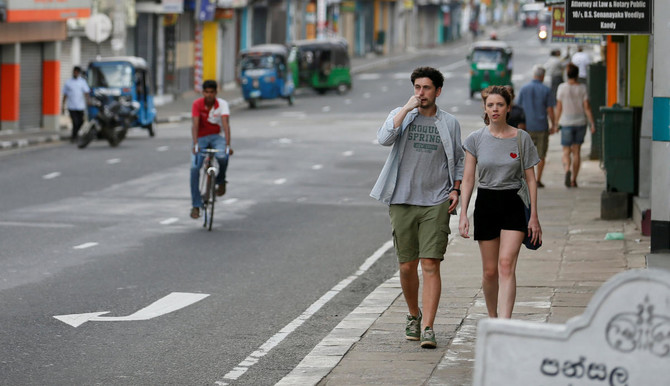
Tourists walk along a street with closed shops after clashes between the Buddhist and Muslim communities in Kandy, Sri Lanka. (Reuters)
Updated 08 March 2018
Follow

Mosque, shops attacked in anti-Muslim riots in Sri Lanka

COLOMBO: Sri Lankan police said petrol bombs were hurled at a mosque on Thursday as hundreds of troops patrolled a troubled central district where anti-Muslim violence has left three people dead.
Muslim-owned businesses were set on fire and vandalized in several parts of Sri Lanka, police said, days after an island-wide state of emergency was imposed to curb riots in Kandy.
Police announced 85 people had been arrested for rioting in the hill district, including the leader of a radical Sinhalese Buddhist group known for agitating against Muslims.
“We have arrested 10 key suspects, including Amith Weerasinghe, who orchestrated and led these attacks,” police spokesman Ruwan Gunasekera told reporters in Colombo, adding that another 75 were detained.
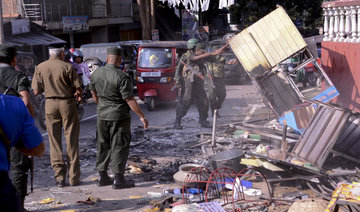
Armored vehicles and heavily-armed troops guarded Kandy, the epicenter of the violence where Internet services remain suspended and an evening curfew is in place.
The government ordered the Internet blackout after police discovered mobs of Sinhalese rioters were using social media to coordinate attacks on Muslim establishments.
More than 200 homes, businesses and vehicles have been torched in three days of violence by mobs from the mainly Buddhist Sinhalese majority.
A 24-hour curfew was imposed on Wednesday afternoon after a hand grenade exploded in the hands of an attacker, killing him and wounding 11 others, officials said.
The day-time curfew was eased following a calm night but schools were shuttered as tensions remain high in the tourist hotspot.
In Kuruvita, 125 kilometers (78 miles) south of Kandy, police said petrol bombs were lobbed at a mosque. Little damage was inflicted and three suspects are being pursued.
In Weligama, 240 kilometers south of Kandy, a Muslim-owned business was attacked, police said, while Muslim establishments were pelted with stones in at least two other locations outside Kandy.
Sri Lanka’s telecoms regulator asked Internet providers to block access to Facebook and other social media platforms to prevent the spread of anti-Muslim hate speech.
Police have already identified anti-Muslim messages being shared on social networks, including a video posted by a hard-line Buddhist monk urging violence against Muslims.
Muslims in Kandy complained that security forces and police — equipped with special powers to detain under the emergency provision — were slow to react as the violence unfolded.
“The main junction is going up in flames. At the same time, the authorities are folding their arms and watching,” said Muslim businessman M. Jaffer, as quoted in Thursday’s DailyFT newspaper.
Former Sri Lankan cricket captain Kumar Sangakkara alluded to the island’s history of ethnic violence in urging his countrymen “to say no to racism.”
“We have to make sure that in Sri Lanka anyone and everyone feels safe, loved and accepted regardless of ethnicity or religion,” he said in a video posted to Twitter.
President Maithripala Sirisena toured Kandy on Wednesday and ordered security forces to use the full force of the law against troublemakers.
Military officials said more reinforcements were sent to the area on Wednesday night to assist police who resorted to teargas to disperse rioters the previous evening.
The United Nations has condemned the violence and urged Colombo “to ensure that appropriate measures are swiftly taken to restore normalcy in affected areas.”
The Kandy region, 115 kilometers (72 miles) east of the capital Colombo, is popular with tourists as well as Buddhist pilgrims.
“Shops are opening, and more people can be seen on the roads since the curfew was lifted,” a police official in the area said by telephone.
Holidaymakers have been urged to avoid the hill resort, which is home to Sri Lanka’s holiest Buddhist shrine, the Temple of the Tooth Relic.
The chief custodian of the UNESCO-listed temple, Pradeep Nilanga Dela, said foreign tourists and pilgrims were flocking to the shrine despite the tensions.
The unrest began Monday after a Sinhalese man died following injuries sustained at the hands of a Muslim mob last week. Conflict escalated when a Muslim man was found dead in a burnt building on Tuesday.
Sinhalese Buddhists are the majority ethnic group in Sri Lanka, making up 75 percent of its 21 million people. Muslims make up 10 percent of the population.
Parliament on Tuesday issued an apology to the island’s Muslim minority for the latest violence targeting them in the Indian Ocean island.
Mobs also set fire to Muslim-owned businesses and attacked a mosque in the east of the country last week. Last November riots in the south of the island left one man dead and homes and vehicles damaged.
In June 2014 riots between Buddhists, led by radical monks, and Muslims left four dead.


Proposals on immigration enforcement flood into state legislatures, heightened by Minnesota action

Updated 11 sec ago
Follow

Proposals on immigration enforcement flood into state legislatures, heightened by Minnesota action

  • Oregon Democrats plan to introduce a bill to allow residents to sue federal officers for violating their Fourth Amendment rights against unlawful search and seizure

NASHVILLE, Tennessee: As Democrats across the country propose state law changes to restrict federal immigration officers after the shooting death of a protester in Minneapolis, Tennessee Republicans introduced a package of bills Thursday backed by the White House that would enlist the full force of the state to support President Donald Trump’s immigration crackdown.
Momentum in Democratic-led states for the measures, some of them proposed for years, is growing as legislatures return to work following the killing of Renee Good by an Immigration and Customs Enforcement officer. But Republicans are pushing back, blaming protesters for impeding the enforcement of immigration laws.

Democratic bills seek to limit ICE

Democratic Gov. Kathy Hochul wants New York to allow people to sue federal officers alleging violations of their constitutional rights. Another measure aims to keep immigration officers lacking judicial warrants out of schools, hospitals and houses of worship.
Oregon Democrats plan to introduce a bill to allow residents to sue federal officers for violating their Fourth Amendment rights against unlawful search and seizure.
New Jersey’s Democrat-led Legislature passed three bills Monday that immigrant rights groups have long pushed for, including a measure prohibiting state law enforcement officers from cooperating with federal immigration enforcement. Democratic Gov. Phil Murphy has until his last day in office Tuesday to sign or veto them.
California lawmakers are proposing to ban local and state law enforcement from taking second jobs with the Department of Homeland Security and make it a violation of state law when ICE officers make “indiscriminate” arrests around court appearances. Other measures are pending.
“Where you have government actions with no accountability, that is not true democracy,” Democratic state Sen. Scott Wiener of San Francisco said at a news conference.
Democrats also push bills in red states
Democrats in Georgia introduced four Senate bills designed to limit immigration enforcement — a package unlikely to become law because Georgia’s conservative upper chamber is led by Lt. Gov. Burt Jones, a close Trump ally. Democrats said it is still important to take a stand.
“Donald Trump has unleashed brutal aggression on our families and our communities across our country,” said state Sen. Sheikh Rahman, an immigrant from Bangladesh whose district in suburban Atlanta’s Gwinnett County is home to many immigrants.
Democrats in New Hampshire have proposed numerous measures seeking to limit federal immigration enforcement, but the state’s Republican majorities passed a new law taking effect this month that bans “sanctuary cities.”
Tennessee GOP works with White House on a response
The bills Tennessee Republicans are introducing appear to require government agencies to check the legal status of all residents before they can obtain public benefits; secure licenses for teaching, nursing and other professions; and get driver’s licenses or register their cars.
They also would include verifying K-12 students’ legal status, which appears to conflict with a US Supreme Court precedent. And they propose criminalizing illegal entry as a misdemeanor, a measure similar to several other states’ requirements, some of which are blocked in court.
“We’re going to do what we can to make sure that if you’re here illegally, we will have the data, we’ll have the transparency, and we’re not spending taxpayer dollars on you unless you’re in jail,” House Speaker Cameron Sexton said at a news conference Thursday.
Trump administration sues to stop laws
The Trump administration has opposed any effort to blunt ICE, including suing local governments whose “sanctuary” policies limit police interactions with federal officers.
States have broad power to regulate within their borders unless the US Constitution bars it, but many of these laws raise novel issues that courts will have to sort out, said Harrison Stark, senior counsel with the State Democracy Research Initiative at the University of Wisconsin Law School.
“There’s not a super clear, concrete legal answer to a lot of these questions,” he said. “It’s almost guaranteed there will be federal litigation over a lot of these policies.”
That is already happening.
California in September was the first to ban most law enforcement officers, including federal immigration officers, from covering their faces on duty. The Justice Department said its officers won’t comply and sued California, arguing that the laws threaten the safety of officers who are facing “unprecedented” harassment, doxing and violence.
The Justice Department also sued Illinois last month, challenging a law that bars federal civil arrests near courthouses, protects medical records and regulates how universities and day care centers manage information about immigration status. The Justice Department claims the law is unconstitutional and threatens federal officers’ safety.
Targeted states push back
Minnesota and Illinois, joined by their largest cities, sued the Trump administration this week. Minneapolis and Minnesota accuse the Republican administration of violating free speech rights by punishing a progressive state that favors Democrats and welcomes immigrants. Illinois and Chicago claim “Operation Midway Blitz” made residents afraid to leave their homes.
Homeland Security spokesperson Tricia McLaughlin accused Minnesota officials of ignoring public safety and called the Illinois lawsuit “baseless.”