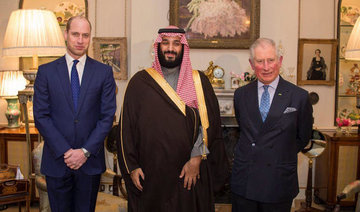
LONDON: In a packed schedule, Crown Prince Mohammed bin Salman met political and religious leaders yesterday on the second full day of his landmark visit to Britain.
Following on from his first day, in which he had lunch with Queen Elizabeth II and met with Prime Minister Theresa May, the crown prince met with MPs and ministers as business leaders gathered from the two countries in the capital.
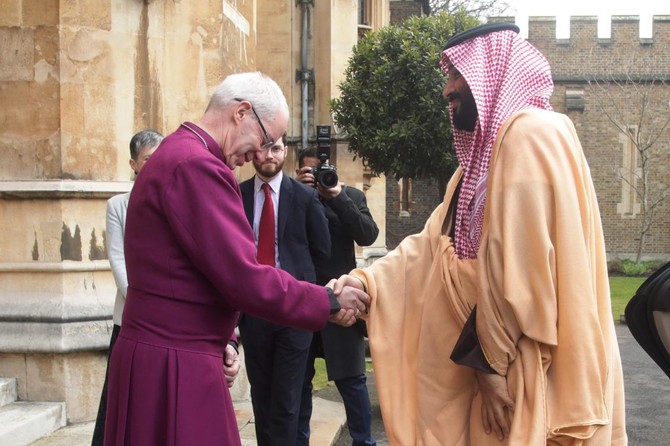
Archbishop of Canterbury Justin Welby, spiritual leader of the Anglican Communion of millions of Christians globally, received the crown prince at Lambeth Palace in central London, where the two talked for an hour.
“The crown prince made a strong commitment to promote the flourishing of those of different faith traditions, and to interfaith dialogue within the Kingdom and beyond,” a statement from Lambeth Palace said.
He also extended an invitation to the Archbishop to visit Saudi Arabia, senior sources at both the Saudi Embassy in the United Kingdom and the Ministry of Foreign Affairs told Arab News.
Earlier this week, Crown Prince Mohammed met Coptic Pope Tawadros II at Cairo’s largest cathedral, and invited Egypt’s Christians to visit Saudi Arabia.
He has said in interviews that he wants to return Saudi Arabia to “moderate Islam” that is open to the world and tolerant of other faiths.
Crown Prince Mohammed and the Archbishop viewed a selection of early texts from the Christian, Muslim and Jewish faiths, including fragments of a Qur’an manuscript found in a Birmingham University library in 2015, which are thought to be among the world’s oldest, Reuters reported.
“The Archbishop shared his concern about limits placed on Christian worship in the Kingdom of Saudi Arabia, and highlighted the importance for leaders of all faiths to support freedom of religion or belief, drawing on the experience of the UK,” the statement said.
Welby also “voiced his distress” at the humanitarian situation in Yemen, where Iran-backed Houthi militias overthrew the internationally recognized government in 2014 sparking the conflict.
Saudi Arabia leads an Arab coalition supporting forces loyal to the president against the militias and their allies.
On Wednesday night, British Foreign Secretary Boris Johnson said: “Iran is playing a destructive and dangerous role in Yemen and destabilizing the region.”
Speaking at a news conference with the Saudi Foreign Minister Adel Al-Jubeir he said there had been “a British-Saudi agreement to control shipping lines in preparation for the opening of Yemeni ports.”
Al-Jubeir said that Saudi Arabia agreed with Britain “on the need to deter Iran and stop its support for terrorism.”
“We support the transitional process and the political dialogue in Yemen,” he added, stressing that “the war there was imposed on us.”
He pointed out that “the Houthis have rebuffed all attempts to reach a political solution in Yemen.”
The Saudi foreign minister affirmed the Kingdom’s continued humanitarian assistance to Yemen after the war.
Yesterday, the crown prince also met with Philip Hammond the treasury secretary and they discussed ways to improve economic cooperation between the two countries as well as opportunities that may arise from the implementation of the Vision 2030 plan to move the Saudi economy away from oil.
He also held talks with MPs from all parties and the heads heads of parliamentary committees for the armed forces, foreign affairs and intelligence.


![]()
![]()

Saudi crown prince meets with MPs and religious leaders
Saudi crown prince meets with MPs and religious leaders
Related
Update


Latest updates


© 2026 SAUDI RESEARCH & PUBLISHING COMPANY, All Rights Reserved And subject to Terms of Use Agreement.