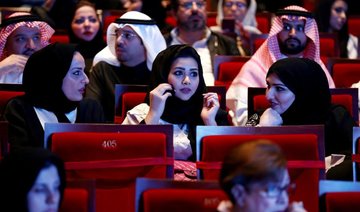
LONDON: Saudi Arabia’s decision to lift the 35-year ban on cinemas last December has opened up opportunities for UK companies to help the Kingdom develop its entertainment industry.
“This is a very exciting time for both Saudi Arabia and the cinema industry and we see huge potential for the development of entertainment centers with the big-screen experience across the country,” said a spokesperson for Vue International. The cinema chain, which has its headquarters in the UK, was one of the first operators to move into the new sector.
The company signed a deal with local partner Abdulmohsin Al Hokair Holding Group on Feb. 12 and plans to open up to 30 multiplexes within three years. It was the was only operator invited to the Future Investment Initiative, held in Riyadh, last October and talks on a deal have been ongoing ever since.
US cinema chain AMC Entertainment signed a deal at the end of last year to form a joint venture with Saudi Arabia’s Public Investment Fund to open cinemas in the Kingdom.
Other UK cinema chains are likely to monitor developments closely. “This is not something everyone can provide but there is bound to be interest from a number of entertainment companies were entering the Saudi market is appropriate to their strategies and international intentions,” said Vue’s spokesperson.
Chris Innes-Hopkins, executive director at the Saudi British Joint Business Council UK, told Arab News he has seen renewed interest from UK cinema chains.
“We have received a number of enquires for cinema operators. We are also working with the UK’s Department of International Trade on plans to promote the opportunities,” he said.
UK companies will have to compete with regional operators, and Vox Cinemas, part of the Dubai-based Majid Al-Futtaim group, who are keen to expand into Saudi Arabia. Novo Cinemas, with 152 screens in the UAE and Bahrain, has also expressed interest.
The revival of commercial cinemas comes as Saudi Crown Prince Mohammed bin Salman — who is currently visiting the UK — spearheads efforts to return the Kingdom to a more “moderate Islam.”
Last September, a decree was issued to lift the ban on women driving, while this January women were allowed to attend football matches for the first time.
Cinema visiting is expected to boost the Kingdom’s economy, helping to realize Vision 2030 plans to move beyond relying on oil.
The government’s economic strategy set out to increase household spending on cultural and entertainment activities from 2.9 percent to 6 percent.
The plan will also support cultural events and the creation of cultural venues such as libraries and museums, another sector where UK companies could find work.
There are “considerable opportunities” in the cultural heritage sectors, said Innes-Hopkins. “A number of UK companies, such as Cultural Innovations, have already worked with the Saudi Commission for Tourism and National Heritage on museum development and restoration of historical sites,” he added.
Cultural Innovations is a London-based consultancy that has delivered museum and heritage projects across the Middle East, including Saudi Arabia.
“No doubt there will also be considerable interest in plans for theme parks and tourism development. Virgin Group have already shown an interest,” he added.
Richard Branson, head of the UK’s Virgin Group, was enthusiastic about tourism options at the Future Investment Initiative conference in Riyadh last year, where he signed a $1 billion (SR 3.8 billion) deal with Saudi’s Public Investment Fund to invest in the Red Sea Resort project to develop a number of islands into luxury resorts.
UK-based firm Paragon Creative is another company that has worked on museums and theme parks in the region, and is eager to explore further opportunities in Saudi Arabia.
The company designs, builds and installs museum exhibits and theme park sets and has recently been working in Dubai on creating props and scenery for the new Hollywood movie-themed Motiongate theme park within Dubai Park and Resorts. The company works closely with Dubai-based partner PCME.
It is currently active working on the interiors of the “Life Gallery” at King Salman Science Oasis in Riyadh for Sabic (Saudi Basic Industries Corporation).
“I believe that the UAE is becoming a saturated market for attractions and leisure and Saudi Arabia is the next destination UK companies should focus on,” said Mark Pyrah, the company’s development director and founder.
“We have seen a 300 percent increase in opportunities over the past 12 months, but there has been a 50 percent fall in the UAE market,” he said.