Aramco IPO preparations ‘progressing well’ but final decision lies with shareholder

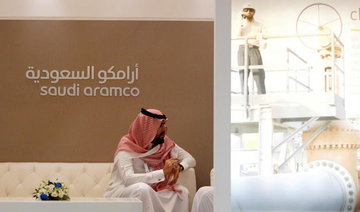
Saudi Aramco's CEO Amin Nasser told a gathering of energy industry peers in Houston: ‘The IPO is progressing well. We became a joint stock company at the beginning of this year, so it is all progressing.’ (Reuters)
Updated 06 March 2018
Follow

Aramco IPO preparations ‘progressing well’ but final decision lies with shareholder

HOUSTON: Preparations for the initial public offering (IPO) of Saudi Aramco are going well but final decisions on timing of the share sale and the venue for any listing other than the Tadawul in Riyadh have yet to be taken, according to the government-owned energy giant’s CEO.
Amin Nasser told a gathering of energy industry peers at the CERAWeek by IHS Markit conference in Houston: “The IPO is progressing well. We became a joint stock company at the beginning of this year, so it is all progressing.
“But the big questions that are being asked — where and when will we list in addition to the Tadawul — are decisions for the shareholder and it is up to the shareholder to decide those questions.”
The conference was shown a copy of the telegram sent 80 years ago this week to announced that oil had been discovered at Aramco’s original well in Dhahran, which marks the origin of the company.
Daniel Yergin, founder of CERA, said that within six months Saudi Arabia became the 26th biggest oil producer in the world. Today Aramco is the biggest oil exporter and has the biggest reserves of any oil company.
Nasser said Aramco regards gas as a “very significant growth area” and he was trying to “capture growth areas in different parts of the world.” There has been speculation Aramco might do gas deals with Russian and even that it would but shale assets in the US.
In his speech from the podium, Nasser said that the original geologists in 1938 “always seemed to know where to go next, and what it would take to get there,” adding that he was also clear about the future of the oil industry.
He said that global oil demand continued to remain healthy, and that major producers were continuing to “show restraint” in supplying oil. He added that there were “multiple downside geopolitical risks to supply.”
But he added: “I am not unduly concerned about the recent volatility and expect the market to strengthen once the seasonal factors begin to fade.”
On the future of the industry, which some analysts say is in long-term decline because of the development of alternative energy sources, he said: “I am not losing any sleep over ‘peak oil demand’ or ‘stranded resources’.”
Nasser also warned that the oil market faces “multiple downside political risks,” and needs $20 trillion of investment over the next 25 years — the size of the American economy.
“Today I want to be clear about what really lies ahead for our industry, and the actions we must take to secure that future,” he said.
“We must leave people in no doubt that misplaced notions of ‘peak oil demandʼ and ‘stranded resourcesʼ are direct threats to an orderly energy transition and energy security,” he said, adding: “Oil and gas will continue to play a major role in a world where all energy sources will be required for the foreseeable future.”
Nasser pointed to flaws in all the various alternatives that have been advocated as future energy sources.
“The hot topic in energy transition is the future role of oil in transport. At the heart of it is the light duty road passenger vehicles segment (cars) that accounts for about 20 percent of global oil demand today. Many wrongly believe that it is a simple matter of electric vehicles quickly and smoothly replacing the internal combustion engine,” he said.
The future for alternatives to the motor car and internal combustion engine was “far more complex,” he said.


Rafal to develop 4 hotels in Riyadh, Tilal Khuzam units accessible from $1,867 monthly, CEO says

Updated 11 sec ago
Follow

Rafal to develop 4 hotels in Riyadh, Tilal Khuzam units accessible from $1,867 monthly, CEO says

RIYADH: Rafal Real Estate Development Co, a Saudi developer, plans to advance its expansion strategy, with investments in Riyadh reaching about SR6.5 billion ($1.73 billion) by 2025.

The company aims to strengthen its presence outside the capital starting next year, Elias Abuo Samra, CEO of Rafal, told Al Eqtisadiah in an exclusive interview.

Abuo Samra said the firm has begun investing in the hospitality sector through a partnership with the hotel brand Rove to develop four new hotel projects ready to serve Expo Riyadh 2030.

He added that the company is also presenting a $1 billion initiative to “tokenize” a real estate portfolio, aimed at bringing small investors into the sector, underscoring that the undeveloped land fee decision has had a significant positive impact by increasing development opportunities and reducing market monopolies.

How much has Rafal invested in Saudi Arabia to date?

The company has been operating in the market for 18 years. Our investments in Riyadh in 2025 total about SR6.5 billion, divided across three main areas: revenue-generating projects; the Tilal Khuzam project in northern Riyadh, in partnership with the National Housing Co.; and a newly established urban services division that includes surface parking, storage projects, and others.

Are your investments limited to Riyadh?

Currently, our focus is on Riyadh. Starting next year, we plan to expand through exclusive brands we work with to develop four premium hotels in the city, and from there we will extend to other regions in Saudi Arabia.

What monthly income does an individual need to own property in Rafal projects?

An individual can start ownership with support from the Ministry of Housing with a monthly income of SR7,000. This allows ownership in Tilal Khuzam, where units start from SR500,000, with an area of 60 to 70 sq. meters, overlooking Khuzam Park, the second-largest park in Riyadh.

Tell us about your key upcoming projects.

Our flagship initiative is an exclusive partnership with Rove Hotels, which owns around 14,000 rooms in Dubai. Through this partnership, we have launched four hotel projects with more than 1,000 rooms across central, northern, and eastern Riyadh.

Two of these projects began in the fourth quarter of 2025, while the other two will start in the first quarter of 2026. All four are scheduled to open in 2027 in time for the Saudi Expo.

Are there plans to list Rafal on the Saudi market?

We are focused on achieving sustainable returns from our projects, especially as the real estate market experiences fluctuations.

Our plan is to achieve this sustainability within two to three years, whether through returns from the Rove project or our five residential developments near Riyadh metro stations. Once these projects reach operational sustainability, we will be ready for a local market listing.

You said you focus on innovation and urban living in your projects, what does that mean?

Innovation and urban living mean addressing Riyadh’s urban challenges. We monitor the city’s social, demographic, and economic evolution to launch projects that meet the expectations of youth and visitors.

For example, we have projects designed to support public transportation, with 1,200 hotel rooms located within five minutes of metro stations. This provides functional housing solutions for young people, helps address traffic issues, and creates a high-quality urban lifestyle. 

We also focus on hotels in strategic locations to ensure visitors can stay at an average rate of no more than SR500 per night throughout the year, in prime locations close to services and the metro.

You launched a tokenization initiative for your portfolio in Riyadh. What is your objective?

Yes, we launched a $1 billion tokenization initiative. This approach, common globally, converts real estate into units that can be traded and owned by small investors, under the supervision of regulatory bodies like the Capital Market Authority.

The main aim is to involve Saudi youth in real estate investment, limit speculation, distribute wealth more broadly, and enable foreign investors to participate, starting from $1,000 to $ 50,000.

Tell us about your financing collaborations with banks.

We rely on smart financing closely linked to our projects. We work with strategic financiers focused on areas such as green finance, housing finance, or technology-driven funding. This approach gives us better terms and incentives to complete projects efficiently.

How has the Tilal Khuzam project performed?

Tilal Khuzam was our first collaboration with NHC. It includes 385,000 residential units, some of which will become revenue-generating rental apartments.

The project has more than 50 six-story buildings, targeting annual returns of 8 percent. Unit prices range from SR500,000 to SR1.5 million.

The project is divided into four phases, originally planned to be sold over four years. By the end of last November, around 1,500 apartments had been sold, representing approximately 45 percent of the first phase.

You have announced projects worth SR4bn. Can you tell us about them?

Yes, these investments are distributed across key areas: SR1.5 billion is allocated to hospitality projects, around SR2 billion for the new phase of the Tilal Khuzam project, and in the coming weeks, we will announce a new logistics project in the heart of Riyadh.

How did the fee decision on undeveloped lands affect your projects in Riyadh?

We do not engage in land hoarding or resale; instead, we acquire land and develop it immediately to improve and accelerate returns.

Two-thirds of our revenues come from development services, not land trading. Therefore, the decision had a very positive impact on us, increasing our development opportunities fivefold compared with before.

This demonstrates that the decision stimulated the market, reduced monopolies, and we expect a significant increase in supply over the next two years, which will benefit both Saudi families and foreign investors.

What are your market expectations for the next phase?

The real estate market cannot be assessed in isolation from the flow of life; it is not like gold, iron, rice, or other commodities. It is an integral part of every person’s life, and location, price, and product are influenced by various supply and demand factors.

Speaking of the residential sector, the numbers are clear: Riyadh will need 300,000 housing units annually over the next five years due to the significant migration from other cities and provinces to the capital.

The economic reality is that the more job opportunities there are in Riyadh, the stronger the demand. The market cannot be evaluated without considering the successful attraction of global company headquarters. Today, Riyadh hosts more than 500 international companies, and we see their impact on demand for office spaces and educational services.

We have also noticed changes in our projects: we have sold four residential units to executives from four global Chinese companies that relocated their offices to Riyadh, and we are increasingly seeing purchases by residents of various nationalities living in Saudi Arabia.