

Inside Chernobyl, Ukraine scrambles to repair radiation shield

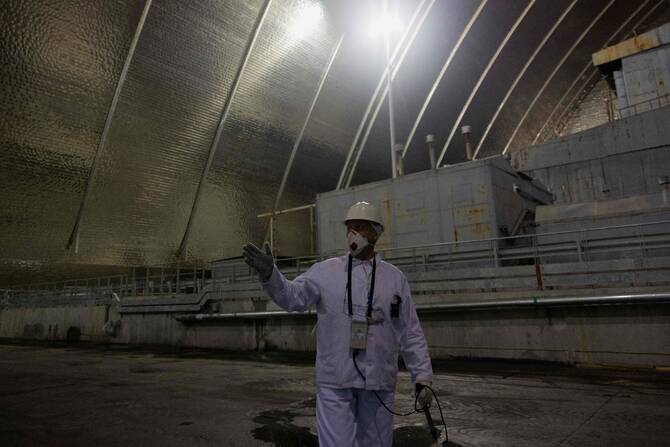
A station employee stands inside the containment vessel that was damaged following a drone attack in February, on the New Safe Confinement which contains the radiation from the remains of reactor 4 of the former Chernobyl Nuclear Power Plant, in Ukraine. (AFP)
Short Url
Updated 26 December 2025
Follow

Inside Chernobyl, Ukraine scrambles to repair radiation shield

  • In February, a Russian drone hit and left a large hole in the New Safe Confinement (NSC), the outer of two radiation shells covering the remnants of the nuclear power plant

CHERNOBYL NUCLEAR POWER PLANT: Inside an abandoned control room at Ukraine’s Chernobyl nuclear power plant, a worker in an orange hardhat gazed at a grey wall of seemingly endless dials, screens and gauges that were supposed to prevent disaster.
The 1986 meltdown at the site was the world’s worst ever nuclear incident. Since Russia invaded in 2022, Kyiv fears another disaster could be just a matter of time.
In February, a Russian drone hit and left a large hole in the New Safe Confinement (NSC), the outer of two radiation shells covering the remnants of the nuclear power plant.
It functions as a modern high-tech replacement for an inner steel-and-concrete structure — known as the Sarcophagus, a defensive layer built hastily after the 1986 incident.
Ten months later, repair work is still ongoing, and it could take another three to four years before the outer dome regains its primary safety functions, plant director Sergiy Tarakanov told AFP in an interview from Kyiv.
“It does not perform the function of retaining radioactive substances inside,” Tarakanov said, echoing concerns raised by the International Atomic Energy Agency.
The strike had also left it unclear if the shell would last the 100 years it was designed to.
The gaping crater in the structure, which AFP journalists saw this summer, has been covered over with a protective screen, but 300 smaller holes made by firefighters when battling the blaze still need to be filled in.
Scaffolding engulfs the inside of the giant multi-billion-dollar structure, rising all the way up to the 100-meter-high ceiling.
Charred debris from the drone strike that hit the NSC still lay on the floor of the plant, AFP journalists saw on a visit to the site in December.

- ‘Main threat’ -

Russia’s army captured the plant on the first day of its 2022 invasion, before withdrawing a few weeks later.
Ukraine has repeatedly accused Moscow of targeting Chernobyl and its other nuclear power plants, saying Moscow’s strikes risk triggering a potentially catastrophic disaster.
Ukraine regularly reduces power at its nuclear plants following Russian strikes on its energy grid.
In October, a Russian strike on a substation near Chernobyl cut power flowing to the confinement structure.
Tarakanov told AFP that radiation levels at the site had remained “stable and within normal limits.”
Inside a modern control room, engineer Ivan Tykhonenko was keeping track of 19 sensors and detection units, constantly monitoring the state of the site.
Part of the 190 tons of uranium that were on site in 1986 “melted, sank down into the reactor unit, the sub-reactor room, and still exists,” he told AFP.
Worries over the fate of the site — and what could happen — run high.
Another Russian hit — or even a powerful nearby strike — could see the inner radiation shell collapse, director Tarakanov told AFP.
“If a missile or drone hits it directly, or even falls somewhere nearby ... it will cause a mini-earthquake in the area,” he said.
“No one can guarantee that the shelter facility will remain standing after that. That is the main threat,” he added.


New Zealand mosque shooter seeks to discard his guilty pleas, saying prison made him irrational

Updated 2 sec ago
Follow

New Zealand mosque shooter seeks to discard his guilty pleas, saying prison made him irrational

WELLINGTON: The man who killed 51 Muslim worshipers at two mosques in New Zealand’s deadliest mass shooting told an appeals court Monday that he felt forced to admit to the crimes because of “irrationality” due to harsh prison conditions, as he sought to have his guilty pleas discarded.
A panel of three judges at the Court of Appeal in Wellington will hear five days of evidence about Brenton Tarrant’s claim that he was not fit to plead to the terrorism, murder and attempted murder charges he faced after the 2019 attack in the city of Christchurch. If his bid is successful, his case would return to court for a trial, which was averted in March 2020 when he admitted to the hate-fueled shooting.
He is also seeking to appeal his sentence of life without the chance of parole, which had never been imposed in New Zealand before. Tarrant’s evidence Monday about his mental state when he pleaded guilty was the first time he had spoken substantively in a public setting since he livestreamed the 2019 massacre on Facebook.
Shooter says he suffered “nervous exhaustion”
The Australian man, a self-declared white supremacist, migrated to New Zealand with a view to committing the massacre, which he planned in detail. He amassed a cache of semiautomatic weapons, took steps to avoid detection and wrote a lengthy manifesto before he drove from Dunedin to Christchurch in March 2019 and opened fire at two mosques.
Along with 51 people killed, the youngest a 3-year-old boy, dozens of others were severely wounded. The attack was considered one of New Zealand’s darkest days and institutions have sought to curb the spread of Tarrant’s message through legal orders and a ban on possession of his manifesto or video of the attack.
Monday’s hearing took place under tight security constraints that severely limited who could view Tarrant’s evidence, which included some reporters and those hurt or bereaved in the massacre. Tarrant, who wore a white button-down shirt and black-rimmed glasses and had a shaved head, spoke on video from a white-walled room at Auckland Prison.
Answering questions from a Crown lawyer and from lawyers representing him, Tarrant, 35, said his mental health had deteriorated due to conditions in prison, where he was held in solitary confinement with limited reading material or contact with other prisoners.
By the time he pleaded guilty, Tarrant said he was suffering from “nervous exhaustion” and uncertainty about his identity and beliefs. He had admitted to the crimes a few months before his trial was due to begin because there was “little else I could do,” he told the court.
Crown lawyers say no evidence of serious mental illness
Crown lawyer Barnaby Hawes suggested to Tarrant during questioning that the Australian man had other options. He could have requested a delay in his trial date on mental health grounds or could have proceeded to trial and defended himself, Hawes said.
Hawes also put to Tarrant that there was little evidence in the documentation of his behavior by mental health experts and prison staff that he was in any kind of serious mental crisis. Tarrant suggested that signs of mental illness he displayed hadn’t been recorded and that at times he had sought to mask them.
“I was definitely doing everything possible to come across as confident, assured, mentally well,” he told the court. Tarrant’s behavior “reflected the political movement I’m a part of,” he added. “So I always wanted to put on the best front possible.”
He agreed that he had had access to legal advice throughout the court process. Tarrant’s current lawyers have been granted name suppression because they feared representing him would make them unsafe.
The appeal outcome is due later
Bids to appeal convictions or sentences in New Zealand must be made within 20 working days. Tarrant was about two years late in seeking an appeal, filing documents with the court in September 2022.
He told the court Monday that his bid had been late because he hadn’t had access to the information required to make it.
The hearing is due to run for the rest of the week but the judges are expected to release their decision at a later date. If they reject Tarrant’s attempt to have his guilty pleas discarded, a later hearing will focus on his bid to appeal his sentence.