HOUSTON: The traditional way to check the health of the global oil business is to look up the price of a barrel of Brent crude on international markets; the other way is to check out the flight from Dubai to Houston in Texas.
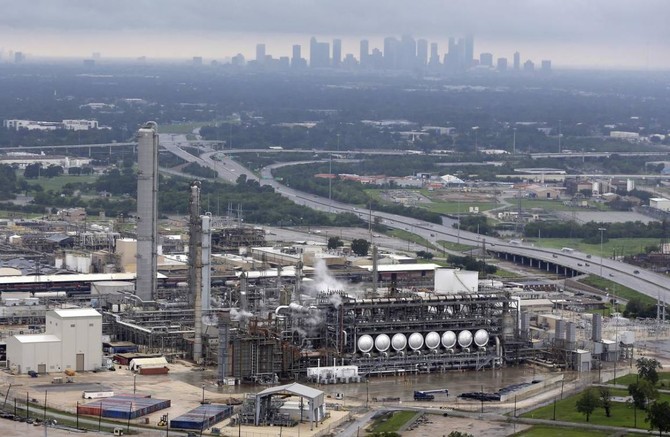
The Bayou City is the capital of the American oil business, some would say the global energy industry. It first grew out of a need to get Texas oil to global markets, providing the right kind of port facilities on the Texas coast to ship crude to the rest of the US and beyond.
It had another boost when the port at nearby Galveston was destroyed by the 1900 hurricane, still the biggest killer hurricane in American history. Hurricanes are a fact of life in these parts, as the world was reminded of by the devastation of Hurricane Harvey last year.
Houston received yet more business when technology allowed offshore oil to be recovered from the Gulf of Mexico, and since the turn of the century it has been mission control for the US shale business, which has revolutionized the global oil industry.
The city is close to the Eagle Ford shale oil field in west Texas, one of the original areas where fracking techniques were perfected to allow oil to be driven from previously unexploitable rocks. Now Houston serves as operational and financial headquarters for the whole of the US shale industry, even those operations much further north in Nebraska and North Dakota. These fields have enabled the US to overtake Saudi Arabia to become the second-largest oil producer, with the biggest, Russia, in its sights sometime in the next two years.
Houston’s central place in the oil business persuaded Emirates Airline in late 2014 that it was a suitable case for the A380 treatment, and the Dubai airline began a daily flight with the double-decker plane late that year, flying more than 500 passengers on the 16-hour trip.
By summer of 2016, the oil price decline had continued, affecting the whole of the global business but hitting US shale men especially hard. Emirates decided to scale back to Boeing 777s, which carry about 150 fewer passengers.
The slow but steady recovery in the oil price last year, and booming prospects for shale in particular, has now persuaded Emirates to reinstate the A380. The airline announced last month it would be resuming A380 flights to George Bush Intercontinental Airport from next June.
The bigger plane is certainly needed, if a recent flight is anything to go by. Last Sunday’s EK211 was packed to the aisles. Economy class was further proof of the appeal of Emirate’s strategy as a connector hub between south Asia and north America, and also evidence of the American airlines’ short-sightedness in virtually deserting this market.
First and business class were also 100-percent full, mainly with oil industry executives and financiers heading to the CERAWeek by IHS Markit meeting, even in Houston the “oil man’s Davos.” With Emirates providing the only direct link between the Arabian Gulf and Houston, the airline looks set to clean up — as long as the oil price stays roughly where it is.


![]()
As oil rises and shale booms, Emirates is going back to Houston with the A380
As oil rises and shale booms, Emirates is going back to Houston with the A380


Latest updates


© 2026 SAUDI RESEARCH & PUBLISHING COMPANY, All Rights Reserved And subject to Terms of Use Agreement.