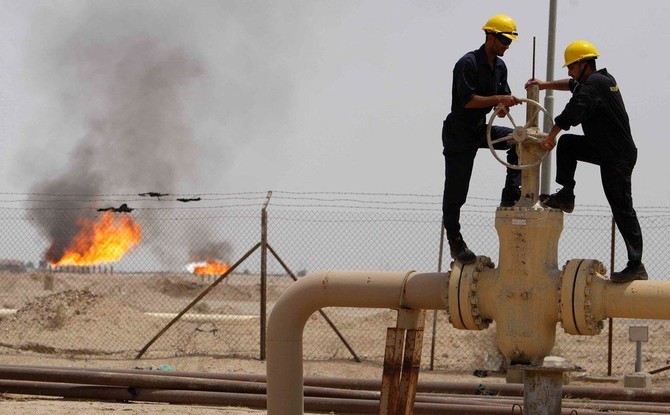
LONDON: China is ramping up its role in Iraqi reconstruction, reflecting its growing reliance on oil from the war-ravaged country, but geopolitical factors are also at play, according to a new report.
A paper compiled by consultancy BMI Research, and released first to Arab News, said: “On the one hand, China will look to direct investment into infrastructure assets associated with Iraq’s oil industry, which has emerged as an increasingly important export partner over the past decade. On the other, China will aim to garner geopolitical influence by participating in broader reconstruction efforts in a country lying along a key artery of its Belt and Road initiative.”
The burgeoning Iraq-China partnership was said to be anchored by a dramatic increase in oil trade. Iraqi oil exports to China rose from zero in 2007 to 270 million barrels annually by 2017, second behind only Saudi Arabia in the Middle East and accounting for roughly 8.8 percent of total Chinese oil imports.
China’s growing investment role in Iraq’s oil sector was highlighted in January when Iraq disclosed that it intended to construct an oil refinery at the port of Fao on the Gulf with two Chinese companies. Iraq’s ministry of oil named the firms as Power China and Nerco Chinese. The ministry said that the refinery would have a capacity of 300,000 barrels per day. Similarly, Baghdad has awarded a contract to China-based Zhenhua Oil to further develop the East Baghdad oilfield.
“Given the growing importance of China as an oil export market vis-a-vis traditional export destinations like the United States, Baghdad will remain keen on deepening partnerships with Chinese companies as bilateral interests align,” BMI said.
The geopolitical research consultancy added that China would also gain indirect exposure to Iraq’s infrastructure sector by extending bilateral loans aimed at rebuilding Iraq’s economy.
In February, international donors pledged $30 billion to reconstruction efforts in Iraq, and while individual country contributions have not been divulged, reports indicated that China had been a key donor with billions committed by Chinese state-controlled enterprises over recent years.
BMI said China’s motives were also driven by its wider geopolitical ambitions. “Iraq lies along a key route of the China-backed Belt and Road initiative, which seeks to foster growing East-West overland trade by promoting greater logistical connectivity.”
BMI also highlighted the planned Basra-Aqaba oil pipeline, where the China Petroleum Pipeline Bureau is slated to play a construction role.
Yu Jie, head of China Foresight at the London School of Economics, told Arab News that “China is the world’s biggest importer of oil and the Middle East is a region for market access.” She flagged media reports that Chinese state-owned oil company Sinopec could acquire a shareholding in Saudi Aramco following the planned IPO later this year.
A recent report by the International Energy Agency said that the Middle East, which accounts for about $200 billion worth of trade, makes the region China’s fourth largest trading partner after the US, Japan and South Korea.
That said, getting the funds needed to rebuild Iraq is no easy task. At the close of an international donor conference in Kuwait last month, Iraq secured only about a third of the $100 billion that Iraq said the country needed, and much of the money pledged was in the form of investment loans (not direct aid).
Last month, the Iraqi Ministry of Defense released a video depicting Chinese-made CH-4B armed drones for use against terrorist targets. That appeared to make good on a statement following a visit by the Iraqi prime minister to Beijing two years ago when the Chinese pledged to expand its military and defense cooperation with Iraq. “We are ready to respond to support Iraq in these areas, as well as economic cooperation,” said Chinese President Xi Jinping at the time.
In an article last month on the website of China Global Television Network, professor Zhou Rong from the Chongyang Institute for Financial Studies at Renmin University of China, wrote that Chinese state-owned enterprises are the biggest oil investors in Iraq, “especially the modernization and development of Iraq’s oil infrastructure.”
About 60 percent of the electricity in the Iraqi capital Baghdad is produced by Chinese companies, he said.
“Sino-Iraqi relations benefit from the backdrop of the Belt and Road Initiative. Iraq thinks that the initiative is important for Iraq because it is historically located on the Al-Hareer Road,” Rong said.
Al-Hareer was a 12,000 kilometer land and sea road linking Asia, the Middle East and Europe hundreds of years ago that facilitated the exchange of goods and products such as silk, perfumes, incense, and spices, he said.


![]()
China pushes for bigger role in Iraqi reconstruction
China pushes for bigger role in Iraqi reconstruction

Latest updates


© 2026 SAUDI RESEARCH & PUBLISHING COMPANY, All Rights Reserved And subject to Terms of Use Agreement.