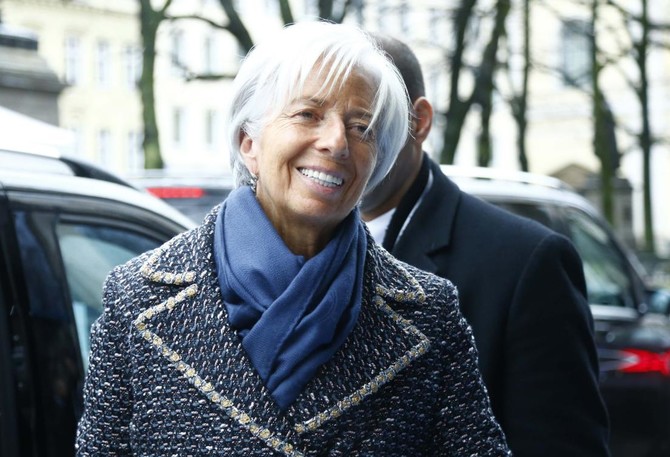
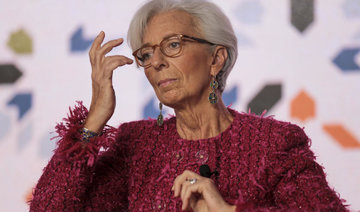
JAKARTA: International Monetary Fund Managing Director Christine Lagarde said on Tuesday the global economy was showing broad-based growth, but the landscape was shifting with heightened risks of trade disputes, monetary policy normalization and technological change.
Lagarde, speaking to an IMF conference in Jakarta in preparation for the Fund’s annual meetings in Bali in October, said the IMF was expecting global growth to reach 3.9 percent in 2018 and 2019. This is unchanged from the IMF’s forecast in January and up from 3.7 percent in 2017.
She said ASEAN countries were preparing for higher interest rates in advanced economies such as the US and Europe, but cautioned that policymakers need to stay vigilant about its effect on financial stability and volatile capital flows.
“We know this will have spillover effects across the world. We have known for some time that it’s coming,” Lagarde said. “It remains uncertain how this transition is going to affect other countries, companies, jobs, incomes.”
ASEAN countries need to embrace new growth models that put a greater emphasis on domestic demand, regional trade and economic diversification and prepare for technological changes such as increased factory automation, artificial intelligence, biotechnology, new financial technologies and digital currencies.
While these could eliminate some jobs, it was important for countries to boost efforts to educate workers to better prepare them to take advantage of new technologies.
“Many jobs will be affected one way or another. Some of them will disappear, but many more will be affected because of automation. So we need to think about the future of work,” Lagarde said, adding that there was no single approach, and many countries will forge their own path.
She highlighted Go-Jek, the fast-growing motorcycle hailing and delivery service in Indonesia as an example of a country-specific technology innovation targeted to the country’s needs and workforce.

IMF chief says global economic growth strong but countries must prepare for change
Acwa signs key terms to develop 5GW of renewable energy capacity in Turkiye
JEDDAH: Saudi utility giant Acwa has signed key investment agreements with Turkiye’s Ministry of Energy and Natural Resources to develop up to 5 gigawatts of renewable energy capacity, starting with 2GW of solar power across two plants in Sivas and Taseli.
Under the investment agreement, Acwa will develop, finance, and construct, as well as commission and operate both facilities, according to a press release.
The program builds on the company’s first investment in Turkiye, the 927-megawatt Kirikkale Independent Power Plant, valued at $930 million, which offsets approximately 1.8 million tonnes of carbon dioxide annually, the statement added.
A separate power purchase agreement has been concluded with Elektrik Uretim Anonim Sirketi for the sale of electricity generated by each facility.
Turkiye aims to boost solar and wind capacity to 120GW by 2035, supported by around $80 billion in investment, while recent projects have already helped prevent 12.5 million tonnes of CO2 emissions and reduced reliance on imported natural gas.
Turkiye’s energy sector has undergone a rapid transformation in recent years, with renewable power emerging as a central pillar of its strategy.
Raad Al-Saady, vice chairman and managing director of ACWA, said: “The signing of the IA (implementation agreement) and PPA key terms marks a pivotal moment in Acwa’s partnership with Turkiye, reflecting the country’s strong potential as a clean energy leader and manufacturing powerhouse.”
He added: “Building on our long-standing presence, including the 927MW Kirikkale Power Plant commissioned in 2017, this step elevates our partnership to a new level,” Al-Saady said.
In its statement, Acwa said the 5GW renewable energy program will deliver electricity at fixed prices, enhancing predictability for grid planning and supporting long-term industrial investment.
By replacing imported fossil fuels with domestically generated clean energy, the initiative is expected to reduce Turkiye’s exposure to global energy market volatility, strengthening energy security and lowering long-term power costs.
The company added that the economic impact will extend beyond the anticipated investment of up to $5 billion in foreign direct investment, with thousands of jobs expected during the construction phase and hundreds of high-skilled roles created during operations.
The energy firm concluded that its existing progress in Turkiye reflects a strong appreciation for Turkish engineering, construction, and manufacturing capacity, adding that localization has been a strategic priority, and it has already achieved 100 percent local employment at its developments in the country.