IMF's Christine Lagarde calls for ‘urgent action’ to create jobs in Arab world

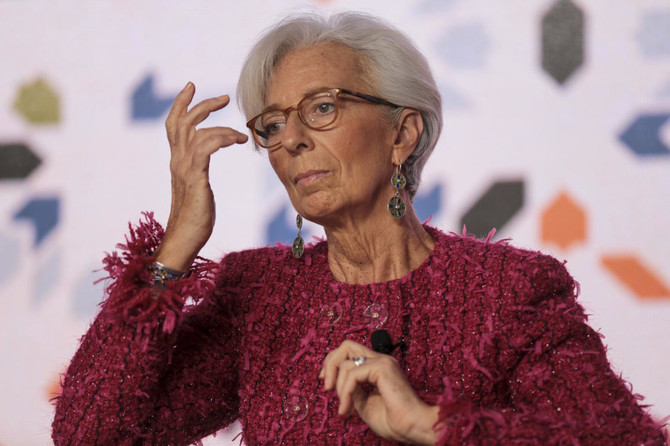
Christine Lagarde, Managing Director of International Monetary Fund IMF attends the opening session of the Opportunities For All economic conference in Marrakech, Morocco, Tuesday, Jan. 30, 2018. (AP)
Updated 30 January 2018
Follow

IMF's Christine Lagarde calls for ‘urgent action’ to create jobs in Arab world

LONDON: Arab countries need to do more to create private sector jobs and bolster inclusive growth amid growing youth unemployment and regional dissatisfaction, said Christine Lagarde, managing director of the International Monetary Fund (IMF), said on Tuesday.
Speaking at an IMF conference in Marrakesh, Morocco, she said 27 million young people would join the workforce in Arab countries in the next five years in a region that has the highest rate of youth unemployment in the world at 25 percent.
Although Arab states are progressing with reforms, they must move away from being “state employers” and focus on improving social safety nets, Lagarde said.
During the two-day conference on inclusive growth, Lagarde said the public dissatisfaction that is “bubbling up” in several countries is a reminder that even more ‘urgent action’ is needed.
In Tunisia, violent demonstrations broke out again this month as anger mounts over IMF-backed measures that include subsidy cuts and tax increases.
Chris Doyle, director of the Council for Arab-British Understanding (CABU), told Arab News: “Frustrations across the Arab world are growing.”
Doyle said: “The region must urgently deploy more resources to tackle youth unemployment and these resources must be deployed far more effectively.”
The director said Middle Eastern governments must take action to end its “many conflicts and crises” to unlock the region’s potential.
Doyle urged the region to look at redesigning its education system to ensure it provides the right skills for a twenty first century jobs market.
“The region needs to look at skilling up for the digital economy,” he said. “However, be under no illusion, it’s a massive challenge.”
The Cabu expert said that Egypt represents a particularly pressing challenge due to its central location and large and growing population.
“[Joblessness] will have an immediate impact on the country and it’s not rosy,” he warned.
“We may well witness more protests and discontent. Governments really should be really aware that [protests] represent genuine economic weaknesses and reflect the levels of corruption in the region.”
Wes Schwalje, COO of GCC research firm Tahseen Consulting, agreed that regional education systems are struggling to produce national workforces with the skills that meet “the needs of knowledge-based economic development and the Fourth Industrial Revolution.”
Schwalje told Arab News: ” A youthful, growing labor market can be beneficial to economic development if it is accompanied by job creation. Without job creation, the counterfactual is youth becoming unemployed, discouraged, or entering the informal economy.
“Discontent among youth is particularly significant since there is a strong link between youth bulges experiencing economic hardship and political violence. If the public sector is unable to create sufficient jobs for Arab youth, the only other option is private sector job creation.”
High levels of public sector employment in the Arab World have been criticized as “perpetuating low productivity, lack of economic diversification, and high public sector wage bills, Schwalje said.
The COO added: “Market reforms will need to reorient Arab youth toward private sector jobs… A number of Arab countries are piloting ambitious labor market reforms, such as unemployment benefits, minimum wages, fees on foreign workers, and increased mobility of foreign workers, but their success is far from certain.”


First EU–Saudi roundtable on critical raw materials reflects shared policy commitment

Updated 16 January 2026
Follow

First EU–Saudi roundtable on critical raw materials reflects shared policy commitment

RIYADH: The EU–Saudi Arabia Business and Investment Dialogue on Advancing Critical Raw Materials Value Chains, held in Riyadh as part of the Future Minerals Forum, brought together senior policymakers, industry leaders, and investors to advance strategic cooperation across critical raw materials value chains.

Organized under a Team Europe approach by the EU–GCC Cooperation on Green Transition Project, in coordination with the EU Delegation to Saudi Arabia, the European Chamber of Commerce in the Kingdom and in close cooperation with FMF, the dialogue provided a high-level platform to explore European actions under the EU Critical Raw Materials Act and ResourceEU alongside the Kingdom’s aspirations for minerals, industrial, and investment priorities.

This is in line with Saudi Vision 2030 and broader regional ambitions across the GCC, MENA, and Africa.

ResourceEU is the EU’s new strategic action plan, launched in late 2025, to secure a reliable supply of critical raw materials like lithium, rare earths, and cobalt, reducing dependency on single suppliers, such as China, by boosting domestic extraction, processing, recycling, stockpiling, and strategic partnerships with resource-rich nations.

The first ever EU–Saudi roundtable on critical raw materials was opened by the bloc’s Ambassador to the Kingdom, Christophe Farnaud, together with Saudi Deputy Minister for Mining Development Turki Al-Babtain, turning policy alignment into concrete cooperation.

Farnaud underlined the central role of international cooperation in the implementation of the EU’s critical raw materials policy framework.

“As the European Union advances the implementation of its Critical Raw Materials policy, international cooperation is indispensable to building secure, diversified, and sustainable value chains. Saudi Arabia is a key partner in this effort. This dialogue reflects our shared commitment to translate policy alignment into concrete business and investment cooperation that supports the green and digital transitions,” said the ambassador.

Discussions focused on strengthening resilient, diversified, and responsible CRM supply chains that are essential to the green and digital transitions.

Participants explored concrete opportunities for EU–Saudi cooperation across the full value chain, including exploration, mining, and processing and refining, as well as recycling, downstream manufacturing, and the mobilization of private investment and sustainable finance, underpinned by high environmental, social, and governance standards.

From the Saudi side, the dialogue was framed as a key contribution to the Kingdom’s industrial transformation and long-term economic diversification agenda under Vision 2030, with a strong focus on responsible resource development and global market integration.

“Developing globally competitive mineral hubs and sustainable value chains is a central pillar of Saudi Vision 2030 and the Kingdom’s industrial transformation. Our engagement with the European Union through this dialogue to strengthen upstream and downstream integration, attract high-quality investment, and advance responsible mining and processing. Enhanced cooperation with the EU, capitalizing on the demand dynamics of the EU Critical Raw Materials Act, will be key to delivering long-term value for both sides,” said Al-Babtain.

Valere Moutarlier, deputy director-general for European industry decarbonization, and directorate-general for the internal market, industry, entrepreneurship and SMEs at European Commission, said the EU Critical Raw Materials Act and ResourceEU provided a clear framework to strengthen Europe’s resilience while deepening its cooperation with international partners.

“Cooperation with Saudi Arabia is essential to advancing secure, sustainable, and diversified critical raw materials value chains. Dialogues such as this play a key role in translating policy ambitions into concrete industrial and investment cooperation,” she added.