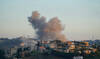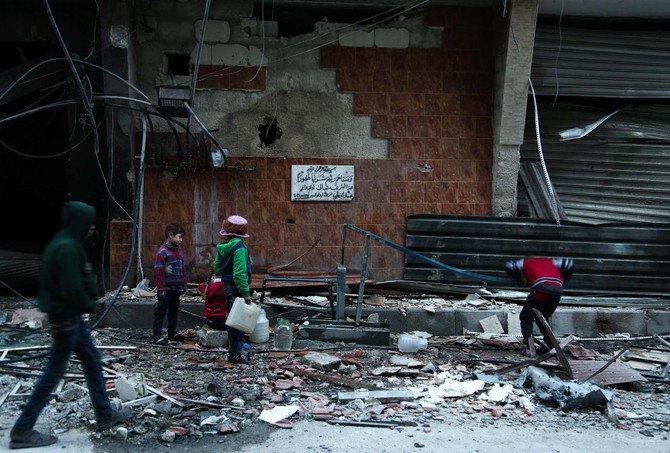
DOUMA, Syria: Fresh strikes on Syria's Ghouta enclave killed 10 civilians on Monday, according to the Syrian Observatory for Human Rights.
Desperate civilians trapped in one of the most ferocious assaults of Syria’s civil war awaited aid and medical help Monday after regime air strikes pounded rebel-held Eastern Ghouta despite UN cease-fire demands.
UN secretary-general Antonio Guterres demanded that a Security Council resolution for a 30-day ceasefire in war-ravaged Syria be "immediately implemented and sustained."
The UN chief hailed the adoption of the resolution last Saturday after days of drawn-out debate, but stressed that "Security Council resolutions are only meaningful if they are effectively implemented, and that is why I expect the resolution to be immediately implemented and sustained."
More than 500 people have been killed in a major bombing campaign by President Bashar Assad’s forces that has hammered the enclave on the edge of Damascus for over a week.
After days of diplomatic wrangling, the United Nations Security Council on Saturday adopted a resolution calling for a 30-day cease-fire in Syria “without delay” to allow for aid deliveries and medical evacuations.
The resolution raised hopes of stemming the bloodshed, but after clashes continued on Sunday it was unclear when or how broadly the cease-fire would be implemented.
Russia is a key ally of Assad’s regime. In a phone call on Sunday, German Chancellor Angela Merkel and French President Emmanuel Macron urged President Vladimir Putin to use his influence to reach a truce.
They called on Russia “to exercise maximum pressure on the Syrian regime to achieve an immediate suspension of air raids and fighting,” Merkel’s office said.
In Douma, the main town in Eastern Ghouta, fresh air raids and artillery strikes could be heard Sunday, an AFP correspondent said.
At least 14 civilians including three children were killed in strikes on Sunday, said the Syrian Observatory for Human Rights monitor, bringing the total number of dead in the week to 530, among them over 130 children.
A child died and at least 13 other people suffered breathing difficulties after a suspected chemical attack on Sunday in a Syrian rebel enclave under intense regime bombardment, said the Observatory and a medic who treated those affected.
The Syrian American Medical Society, which supports a hospital in the besieged area, posted pictures on Twitter of small children using breathing apparatus.
“We confirm that 16 patients, including 6 children & 4 women, suffering from symptoms indicative to exposure to chemical compounds were treated” at the facility, it said.
Russia’s defense ministry said “leaders of armed groups are preparing a provocation to use toxic substances to accuse the regime of using chemical weapons,” in a statement that also said the situation in Eastern Ghouta “continued to worsen.”
An aid worker in Douma, quoted by British charity Save the Children, said a brief pause in bombing had prompted people to emerge after a week sheltering in basements.
“Some people had no food to eat for two or three days,” the unnamed aid worker said.
Observatory chief Rami Abdel Rahman said there appeared be fewer air strikes but that fighting had intensified on the ground.
Heavy clashes erupted in southern areas of Eastern Ghouta, killing at least 13 members of pro-regime forces and six fighters from the Jaish Al-Islam rebel group, he said.
The Britain-based group uses a network of sources across Syria to monitor the country’s conflict.
Mohamed Alloush, a key figure in Jaish Al-Islam, tweeted that the rebels were “resisting” bids by regime forces to enter the region.
Eastern Ghouta, home to some 400,000 people, is surrounded by government-controlled territory and its residents are unwilling or unable to flee.
The two main rebel groups controlling the enclave — Jaish Al-Islam and Faylaq Al-Rahman — welcomed the Security Council demand, but vowed to fight back if there were renewed attacks.
UN diplomats say the resolution was watered down to ensure it was not vetoed by Russia, which has provided diplomatic and military support to Assad’s regime.
Language specifying that the cease-fire would start 72 hours after adoption was scrapped and the term “immediate” was dropped in reference to aid deliveries and evacuations.
In another concession, the cease-fire would not apply to operations against the Daesh group or Al-Qaeda, along with “individuals, groups, undertakings and entities” associated with the groups.
Syria’s former Al-Qaeda affiliate is present in Eastern Ghouta.
The head of the army in Iran, another key Assad ally, said the Syrian military would continue to target “terrorist groups” in Eastern Ghouta.
Assad’s regime and its allies routinely describe all opposition forces as “terrorists.”
“The zones on the periphery of Damascus ... are not covered by the cease-fire and the offensives and clearing operations by the Syrian army will continue,” said Mohammad Bagheri, according to the official IRNA news agency.
UN chief Antonio Guterres, who has described Eastern Ghouta under the bombardment as “hell on Earth,” said the cease-fire must be “immediately” implemented.
In the enclave, news of the UN vote made little impact.
“I don’t think this decision will be implemented. It will be respected neither by the regime nor Russia,” said Douma resident Abu Mazen.
“We can’t trust Russia or the regime. We are used to their betrayals.”
Rebels in Eastern Ghouta have also been firing into Damascus.
Around 20 people have been killed in eastern districts of the capital since February 18, according to state media.
A total of more than 340,000 people have been killed and millions driven from the homes in Syria’s war, which next month enters its eighth year with no diplomatic solution in sight.