Rescuers say cannot keep up with airstrikes battering Eastern Ghouta

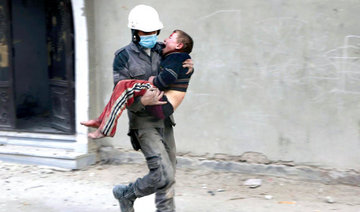
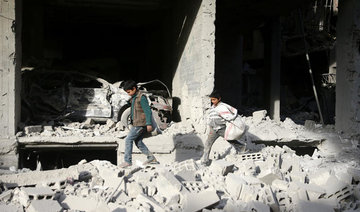
As the bombs rain down, rescuers struggling to pull people from the rubble in Eastern Ghouta, Syria. (Reuters)
Updated 24 February 2018
Follow

Rescuers say cannot keep up with airstrikes battering Eastern Ghouta

BEIRUT: Rescuers in Syria’s Eastern Ghouta said the bombing would not let up long enough for them to count the bodies, in one of the bloodiest air assaults of the seven-year war.
Warplanes pounded the opposition enclave on Saturday, the seventh day in a row of a fierce escalation by Damascus and its allies, an emergency service, a witness and a monitoring group said.
Residents holed up in basements and medical charities decried attacks on a dozen hospitals, as the UN pleaded for a truce in Ghouta, the only big rebel bastion near the capital.
The Damascus regime and Russia, its key ally, say they only target militants. They have said they seek to stop mortar attacks injuring dozens in the capital, and have accused insurgents in Ghouta of holding people as human shields.
There was no immediate comment from the Syrian military.
A total of 127 children figure among the 510 dead in the bombing campaign that the regime launched last Sunday on the enclave just outside Damascus, the Syrian Observatory for Human Rights said. The Britain-based monitor of the war said at least 32 civilians were killed in Saturday’s strikes, including eight children. A night of heavy bombardment sparked fires in residential districts, it said.
First responders searched for survivors after strikes on Kafr Batna, Douma and Harasta, the Civil Defense in Eastern Ghouta said. The rescue service, which operates in opposition territory, said it had documented at least 350 deaths in four days earlier this week.
“Maybe there are many more,” said Siraj Mahmoud, a civil defense spokesman in the suburbs. “We weren’t able to count the martyrs because the warplanes are touring the skies.”
As the bombs rain down, some hitting emergency centers and vehicles, workers have struggled to pull people from the rubble, Mahmoud said. “But if we have to go out running on our legs and dig with our hands to rescue the people, we will still be here.”
A witness in Douma said he woke up in the early hours on Saturday to the sound of a squadron of jets bombing nearby. The streets have mostly remained empty.
The UN says nearly 400,000 people live in Eastern Ghouta, a pocket of satellite towns and farms under regime siege since 2013, without enough food or medicine.
The local opposition council said it was setting up emergency volunteer teams in several districts to reinforce shelters with sandbags and try to link them through tunnels.
“Every day we say God willing tomorrow will be better ... Today, the main sight in the Ghouta is limbs, blood,” Mahmoud said.
“There is no need to dig graves, we will be buried under our houses.”
The UN Security Council was set to vote on Saturday on a draft resolution which demands a 30-day cease-fire across Syria to allow aid access and medical evacuations.
The 15-member council postponed voting on the text, which Sweden and Kuwait drafted. The delay followed a flurry of last-minute talks after Russia, a veto-holding ally of Syrian President Bashar Assad, proposed new amendments.
The truce does not cover militants from Daesh, Al-Qaeda, and the Nusra Front.
Several previous cease-fire attempts have quickly unraveled during the multi-sided conflict, which has killed hundreds of thousands and forced 11 million people out of their homes.
The Syrian regime’s media claimed that Ghouta factions fired mortars at districts of Damascus on Saturday, including near a school. Insurgent shelling wounded six people, it alleged, and Assad’s troops heavily pounded militant targets in the suburbs in response.
The Ghouta pocket has become the war’s latest flashpoint, after a string of rebel defeats and negotiated withdrawals. With Russian jets and Iran-backed militias, Assad’s military has restored state rule over the main cities across western Syria.
Insurgents in Eastern Ghouta have vowed not to accept such a fate, ruling out the kind of evacuation that ended the liberation battle in Aleppo and Homs after bitter sieges.
Russia has blamed Nusra fighters, from Al-Qaeda’s former Syria branch, for provoking the situation in the Ghouta region.
The two main radical factions there in turn accuse their enemies of using the presence of a few hundred terrorists as a pretext for attacks.


Inaction over UAE’s role is prolonging ‘worst proxy war in the world,’ Sudan justice minister says

Updated 58 min 44 sec ago
Follow

Inaction over UAE’s role is prolonging ‘worst proxy war in the world,’ Sudan justice minister says

  • Had international community characterized it as ‘military rebellion’ and countered Emirati sponsorship of ‘terrorist militia’ it would not have endured, he tells UN Human Rights Council
  • He accuses paramilitary Rapid Support forces of ‘targeting basic infrastructure, strategic facilities and public services,’ and ‘atrocities beyond our capacity to describe’

NEW YORK CITY: Sudan’s justice minister on Wednesday blamed the prolongation of the near-three-year conflict in his country on what he described as the failure of the international community to properly label the war as a rebellion.

He also accused the UAE of sponsoring and arming a militia, the Rapid Support Forces, he said was responsible for widespread abuses.

“The war has outstayed its welcome and it should not have gone on for this long had the international community, and particularly the UN and its bodies, fulfilled their responsibility in rightly characterizing this military rebellion,” said Abdullah Mohammed Dirif, “and had they called a spade a spade and countered the Abu Dhabi government, which sponsored this terrorist militia and provided it with high-tech arms and provided it with mercenaries.”

Speaking during the high-level segment of the 61st session of the UN Human Rights Council in Geneva, he warned that “the misleading characterization of this war has given a green light for the militia to keep its flagrant violations.”

The minister, who said he was speaking “on behalf of the government of Sudan and its people,” described the conflict between the Sudanese Armed Forces and the RSF, which began in April 2023, as “one of the worst proxy wars in the world,” which had “targeted the very existence of Sudan and its people.”

The RSF has “continued its methodic targeting of basic infrastructure and strategic facilities and all public services,” Dirif said, adding that “the aim is to displace civilians against whom it has committed atrocities beyond our capacity to describe them.

“The violations and crimes of the militia are going unabated. Yesterday it invaded Moustahiliya region in northern Darfur. It targeted civilians, killed them. It looted. It scorched villages and cities.”

Sudan’s military was “conducting its constitutional responsibility by standing up to the militia, protecting the civilians, preserving the unity of the country and the rule of law,” he said, and it remains “committed to international humanitarian law and the rules governing military engagement, and taking into account proportionality principles in order to protect civilians.”

Khartoum remains “open to genuine efforts which aim to end the war and the rebellion” based on a road map presented by the president of the Transitional Sovereignty Council, and a peace initiative submitted by the prime minister to the UN Security Council on Dec. 22, he added.

Dirif stressed his government’s commitment to continued “cooperation and coordination with human rights mechanisms in Sudan,” including the presence of the UN’s Office of the High Commissioner for Human Rights in the country and the UN special rapporteur on the human rights situation in Sudan.

“We recall, nationally, that achieving justice and redress to victims and ensuring impunity is a top priority for us,” he said, adding that authorities had made progress by investigating violations of national laws and international humanitarian laws.

He also underscored Sudan’s “commitment to continue facilitating and expediting delivery of humanitarian assistance to those affected by the war, including those under the control of the rebellious militia.”

Later, Sudan’s representative to the UN in Geneva exercised his right of reply and responded to prior remarks by the representative from the UAE.

“This is not a mere accusation, it is a well-known fact that is predicated on a number of evidence and documented proofs,” he said, referring to the UAE’s sponsorship of the RSF.

He cited in particular a report by a UN panel of experts on Sudan published on Jan. 15, 2024, which he described as “an official document of the Security Council” that referred to “lines of transferring weapons from Abu Dhabi International Airport” based on “clear-cut evidence.”

Other major international organizations and Sudan’s national commission of inquiry have provided further proof, he added, and Khartoum had submitted “a number of complaints, with proof, to the Security Council of the proven sabotage by the Abu Dhabi authority.”

The Sudanese representative continued: “It is paradoxical that the same authority that is sponsoring criminal militia, that the whole world is seeing and is attesting to its crimes, is now talking about peace in the Sudan. Peace is a noble value, that you have to be full of peace before you talk about it.

“The people of Sudan are only requesting this country stop sponsoring this criminal militia that is killing the innocent people in my country on a daily basis.”

The UAE has denied accusations that it provides military support to armed groups in Sudan, and says it supports efforts to achieve a peaceful resolution to the conflict.