Afghan section of $8bn gas pipeline inaugurated by regional leaders

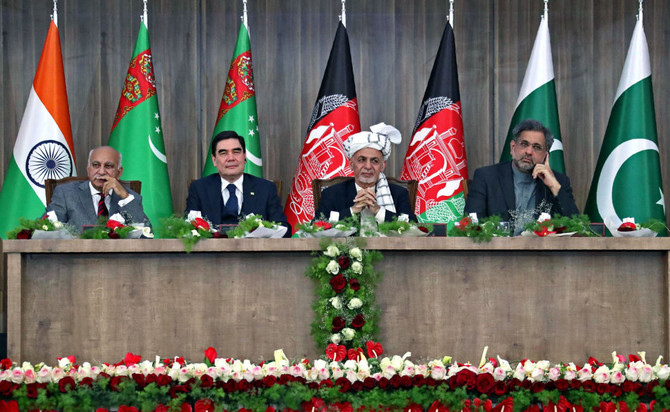
Afghan President Ashraf Ghani, center, with Gurbanguly Berdymukhamedov President of Turkmenistan, second left, Pakistani Prime Minister Shahid Khaqan Abbasi, right, and India’s External Affairs Minister Shri M. J. Akbar, left, look on during the (TAPI) gas pipeline project inauguration in Herat province on Feb. 23, 2018. (AFP)
Updated 23 February 2018
Follow

Afghan section of $8bn gas pipeline inaugurated by regional leaders

KABUL: Afghan President Ashraf Ghani and regional leaders inaugurated construction work on the Afghan section of the multibillion-dollar gas pipeline for exporting Turkmenistan’s gas to South Asia on Friday.
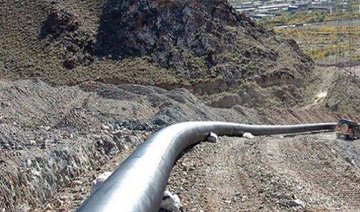
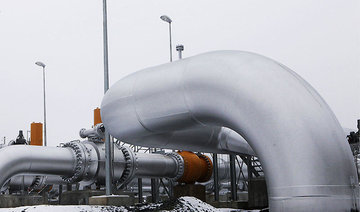
The 1,800-km pipeline, called Turkmenistan-Afghanistan-Pakistan-India (TAPI), is to carry 33 billion cubic meters of natural gas annually for 30 years to Pakistan and India, which urgently need gas supplies.
“South Asia is being connected with Central Asia through Afghanistan after more than a century … Afghanistan will change into a connecting hub for South and Central Asia,” said President Ghani at the inauguration ceremony held in Turkmenistan.
Turkmenistan President Gurbanguly Berdimuhamedow, Pakistani Prime Minister Shahid Khaqan Abbasi and India’s Minister of State for External Affairs M.J. Akbar attended the ceremony, along with a large number of foreign diplomats and officials.
“TAPI will lead from a gas pipeline into an energy and communication corridor,” Abbasi said at the ceremony.
The cost of the pipeline is estimated to be $8 billion and is backed by the US and the Asian Development Bank.
TAPI has been touted by Turkmenistan — one of the world’s key producers of gas — since the 1990s when Afghanistan was locked in a civil war that led to the arrival of the Taliban. Turkmenistan also aims to sell its electricity to Pakistan and India via Afghanistan, Afghan officials said.
Much of the pipeline will run through southwestern Afghanistan, where Taliban militants are most active and fight to topple the US-backed Afghan government in Kabul and push foreign forces out of the country.
But before the launch of the project on Friday, the Taliban reiterated its willingness to protect the project, which will earn Afghanistan $450 million annually, create jobs for Afghan people and allow the public to have access to gas in their area.
“There will be no delay in this important national project,” the Taliban said in a statement emailed to reporters.
The project is expected to be completed by the end of 2019, and the Afghan population hope the pipeline will bring sustained growth and stability to their country, which has been locked in decades of conflict and relies heavily on foreign aid.


Blair dropped from Gaza ‘peace board’ after Arab objections

Updated 4 sec ago
Follow

Blair dropped from Gaza ‘peace board’ after Arab objections

  • Former UK PM was viewed with hostility over role in Iraq War
  • He reportedly met Netanyahu late last month to discuss plans

LONDON: Former UK Prime Minister Tony Blair has been withdrawn from the US-led Gaza “peace council” following objections by Arab and Muslim countries, The Guardian reported.

US President Donald Trump has said he would chair the council. Blair was long floated for a prominent role in the administration, but has now been quietly dropped, according to the Financial Times.

Blair had been lobbying for a position in the postwar council and oversaw a plan for Gaza from his Tony Blair Institute for Global Change that involved Jared Kushner, Trump’s son-in-law.

Supporters of the former British leader cited his role in the Good Friday Agreement, which ended decades of conflict and violence in Northern Ireland.

His detractors, however, highlighted his former position as representative of the Middle East Quartet, made up of the UN, EU, Russia and US, which aimed to bring about peace in the Middle East.

Furthermore, Blair’s involvement in the Iraq War is viewed with hostility across the Arab world.

After Trump revealed his 20-point plan to end the Israel-Hamas war in September, Blair was the only figure publicly named as taking a potential role in the postwar peace council.

The US president supported his appointment and labeled him a “very good man.”

A source told the Financial Times that Blair’s involvement was backed by the US and Israel.

“The Americans like him and the Israelis like him,” the person said.

The US plan for Gaza was criticized in some quarters for proposing a separate Gaza framework that did not include the West Bank, stoking fears that the occupied Palestinian territories would become separate polities indefinitely.

Trump said in October: “I’ve always liked Tony, but I want to find out that he’s an acceptable choice to everybody.”

Blair is reported to have held an unpublicized meeting with Israeli Prime Minister Benjamin Netanyahu late last month to discuss plans.

His office declined to comment to The Guardian, but an ally said the former prime minister would not be sitting on Gaza’s “board of peace.”