MANILA: The Philippine president said Thursday that a ban on the deployment of workers to Kuwait, where a Filipino was found dead in a freezer, will continue and could be expanded to other countries where Filipino workers suffer “human degradation.”
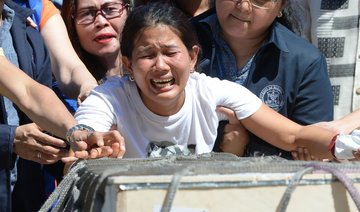
President Rodrigo Duterte made the remarks after attending the wake of Joanna Demafelis in the central Philippine town of Sara. He said he intends to file criminal charges against her employers, who are being hunted by Kuwaiti authorities.
Demafelis’s body was found stuffed in a food freezer on Feb. 6 in a Kuwait City apartment where it had reportedly been kept for more than a year. Duterte has said her body bore torture marks and there were indications she was strangled.
“The ban stays, no deployment of Filipinos whatsoever in Kuwait,” Duterte said outside the wake, where steamers and shirts worn by mourners bore messages demanding justice for the maid’s death. The ban applies only to new Kuwait-bound workers and the thousands already there, mostly maids, can continue working.
Duterte said the government is conducting an assessment to “find out the places where we deploy Filipinos and our countrymen suffer brutal treatment and human degradation.”
Her death is the latest overseas tragedy to befall workers from the Philippines, a major labor exporter with about a tenth of its more than 100 million people working abroad. The workers have been called the country’s heroes because the income they send home has propped up the Southeast Asian nation’s economy for decades, accounting for about 10 percent of its annual gross domestic product.
Duterte talked with the family of Demafelis and then briefly viewed her remains, gently touching her coffin with his hand.
Philippine officials are under increasing pressure to do more to monitor the safety of the country’s worldwide diaspora of mostly maids, construction workers and laborers.
Labor Secretary Silvestre Bello III told a Senate hearing Wednesday that he has recalled three Filipino labor officers from Kuwait to face an investigation. They failed to act on a request by Demafelis’s family for help after she went missing in January last year, he said.
Administrator Hans Leo Cacdac of the Overseas Workers Welfare Administration reported that at least 196 Filipinos had died in Kuwait in the last two years, mostly for unspecified medical reasons but also four who committed suicide. That prompted senators to ask why labor officials did not immediately order a ban on the deployment of workers to Kuwait with the spike in deaths.
A Philippine labor delegation left for Kuwait on Thursday to seek better protection for Filipino workers that may prompt the Duterte administration to lift its ban, officials said.
They will demand a stop to the practice of many Kuwaiti employers to hold on to the passports, travel papers and cellphones of Filipino maids, which has prevented them from reporting abuses and calling for help, the officials said.
Kuwait’s ruling emir has reportedly invited Duterte to his country next month to resolve the labor issues but Duterte has not said whether he will visit.
The sheer number of Filipino workers abroad makes monitoring their wellbeing an overwhelming task. That is often complicated by workers not having proper travel and work documents, such as in Kuwait, where nearly 11,000 of the more than 252,000 Filipino workers are in the country illegally or are not properly authorized.
Many desperate Filipinos have also chosen to stay in countries where the Philippines has banned Filipinos in the past, such as in war-torn Iraq and Syria.


![]()

Philippine labor ban to Kuwait stays, may be expanded, says Duterte
Philippine labor ban to Kuwait stays, may be expanded, says Duterte

Latest updates





© 2026 SAUDI RESEARCH & PUBLISHING COMPANY, All Rights Reserved And subject to Terms of Use Agreement.