OBBÜRGEN, Switzerland: Ukrainian President Volodymyr Zelensky on Saturday predicted “history being made” at the Swiss-hosted conference which aims to plot out the first steps toward peace in Ukraine even though experts and critics say little substance or few big breakthroughs are expected because Russia is not attending.
The presidents of Ecuador, Ivory Coast, Kenya and Somalia joined dozens of Western heads of state and government and other leaders and high-level envoys at the meeting, in hopes that Russia — which is waging war on Ukraine — could join in one day.
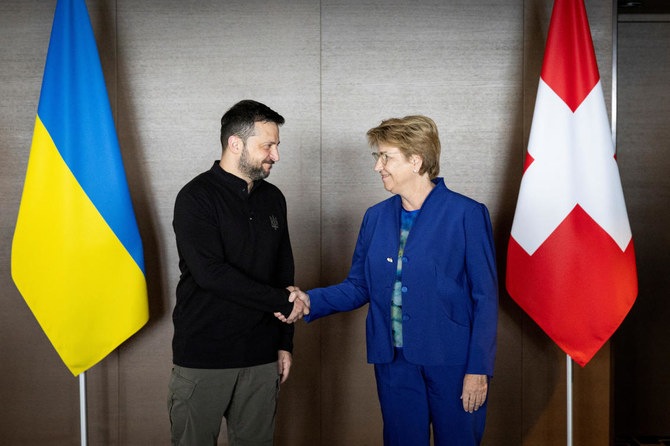
In a brief statement to reporters alongside Swiss President Viola Amherd, Zelensky already sought to cast the gathering as a success, saying: “We have succeeded in bringing back to the world the idea that joint efforts can stop war and establish a just peace.”
“I believe that we will witness history being made here at the summit,” he said.
Swiss officials hosting the conference say more than 50 heads of state and government will join the gathering at the Bürgenstock resort overlooking Lake Lucerne. Some 100 delegations including European bodies and the United Nations will be on hand.
Who will show up – and who will not – has become one of the key stakes of a meeting that critics say will be useless without the presence of Russian President Vladimir Putin’s government, which invaded Ukraine in February 2022 and is pushing ahead with the war.
As US Vice President Kamala Harris arrived at the venue, shuttle buses rumbled up a mountain road that snaked up to the site — at times with traffic jams — with police along the route checking journalists’ IDs and helicopters ferrying in VIPs buzzed overhead.
Meanwhile, Türkiye and Saudi Arabia have dispatched their foreign ministers while key developing countries like Brazil, an observer at the event, India and South Africa will be represented at lower levels.
China, which backs Russia, is joining scores of countries that are sitting out the conference, many of whom have more pressing issues than the bloodiest conflict in far-away Europe since World War II. Beijing says any peace process needs to have the participation of both Russia and Ukraine, and has floated its own ideas for peace.
Last month, China and Brazil agreed to six “common understandings” on a political settlement of the Ukraine crisis, asking other countries to endorse them and play a role in promoting peace talks.
The six points include an agreement to “support an international peace conference held at a proper time that is recognized by both Russia and Ukraine, with equal participation of all parties as well as fair discussion of all peace plans.”
Zelensky has recently led a diplomatic push to draw in participants to the Swiss summit.
Russian troops who now control nearly a quarter of Ukrainian land in the east and south have made some territorial gains in recent months. When talk of a Swiss-hosted peace initiative began last summer, Ukrainian forces had recently regained large swaths of territory, notably near the cities of southern Kherson and northern Kharkiv.
Against the battlefield backdrop and diplomatic strategizing, summit organizers have presented three agenda items: nuclear safety, such as at the Russia-controlled Zaporizhzhia power plant; humanitarian assistance and exchange of prisoners of war; and global food security — which has been disrupted at times due to impeded shipments through the Black Sea.
That to-do list, encapsulating some of the least controversial issues, is well short of proposals and hopes laid out by Zelensky in a 10-point peace formula in late 2022.
The plan includes ambitious calls, including the withdrawal of Russian troops from occupied Ukrainian territory, the cessation of hostilities and restoring Ukraine’s state borders with Russia, including Crimea.
Putin’s government, meanwhile, wants any peace deal to be built around a draft agreement negotiated in the early phases of the war that included provisions for Ukraine’s neutral status and limits on its armed forces, while delaying talks about Russia-occupied areas. Ukraine’s push over the years to join the NATO military alliance has rankled Moscow.
Ukraine is unable to negotiate from a position of strength, analysts say.
“The situation on the battlefield has changed dramatically,” said Alexander Gabuev, director of the Carnegie Russia Eurasia Center, saying that although Russia “can’t achieve its maximalist objectives quickly through military means, but it’s gaining momentum and pushing Ukraine really hard.”
“So, a lot of countries that are coming to the summit would question whether the Zelensky peace formula still has legs,” he told reporters in a call Wednesday.
With much of the world’s focus recently on the war in Gaza and national elections in 2024, Ukraine’s backers want to return focus to Russia’s breach of international law and a restoration of Ukraine’s territorial integrity.
On Friday, Putin called the conference “just another ploy to divert everyone’s attention.”
The International Crisis Group, an advisory firm that works to end conflict, wrote this week that “absent a major surprise on the Bürgenstock,” the event is “unlikely to deliver much of consequence.”
“Nonetheless, the Swiss summit is a chance for Ukraine and its allies to underline what the UN General Assembly recognized in 2022 and repeated in its February 2023 resolution on a just peace in Ukraine: Russia’s all-out aggression is a blatant violation of international law,” it said.
Experts say they’ll be looking at the wording of any outcome document, and plans for the way forward. Swiss officials, aware of Russia’s reticence about the conference, have repeatedly said they hope Russia can join the process one day, as do Ukrainian officials.
“Most likely, the three items under review will be endorsed by the participants. But then the big question is ‘OK, what comes next?’” Gabuev said. “And I don’t think we have a very clear answer to that question yet.”
As leaders headed to the conference venue, the war raged on.
Gov. Vyacheslav Gladkov of Russia’s southern Belgorod region, writing on social media, blamed Ukraine for shelling Friday that struck a five-story apartment building in the town of Shebekino, killing five people. There was no immediate comment from Kyiv.
In Ukraine, shelling killed at least three civilians and wounded 15 others on Friday and overnight, regional officials said. Gov. Oleh Syniehubov of the Kharkiv region, which has been the focus of a recent Russian offensive.


![]()

Zelensky eyes ‘history being made’ at Swiss-hosted Ukraine peace conference, but Russia’s absent
Short Url
https://arab.news/zubkb
Zelensky eyes ‘history being made’ at Swiss-hosted Ukraine peace conference, but Russia’s absent
- Zelensky said: “I believe that we will witness history being made here at the summit”
- Swiss officials hosting the conference say more than 50 heads of state and government will join the gathering


Latest updates


Recommended


© 2026 SAUDI RESEARCH & PUBLISHING COMPANY, All Rights Reserved And subject to Terms of Use Agreement.