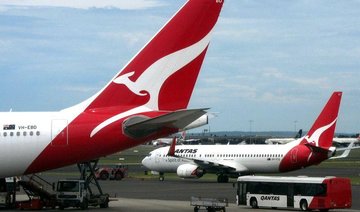
SYDNEY: Australia’s Qantas Airways said half-year profit jumped to a record on cost cuts and hikes in domestic fares — which combined with a share buyback sent its stock bounding higher.
The results are the latest in a slew of robust earnings for the aviation sector and Qantas CEO Alan Joyce was upbeat about future earnings prospects, noting that Australia’s all-important resources sector was growing for the first time in three years.
“We’ve a lot of work to do to maintain it, but if we deliver on that work I have no doubt that the company can keep on maintaining this kind of performance,” he told a news conference.
It also outlined plans for its own pilot academy to address a severe pilot shortage globally. The academy will start next year and aims to train 500 pilots a year when fully established.
The “Flying Kangaroo”, which controls nearly two-thirds of Australia’s domestic market, has pushed average domestic ticket prices to their highest levels in almost a decade while trimming capacity.
At the same time, demand has gathered pace. In addition to the pick-up in the resources sector, Joyce said growth in the financial services, construction and infrastructure sectors were driving business travel demand. Leisure demand was also strong, with international tourist numbers at record highs.
Underlying profit before tax, its most closely watched measure, surged 15 percent to A$976 million ($760 million) for the six months ending December 31, its best result for a first-half and around 3 percent higher than the top of its own guidance. Domestic revenue jumped by a fifth.
Investors also cheered a A$378 million buyback, sending its shares up as much as 10 percent, their biggest daily gain in three years. They last traded 6 percent higher.
“Capacity and capital discipline at a time where demand growth remains robust is driving the stock and its outlook,” said Sondal Bensan, an analyst at Qantas’ biggest shareholder, BT Investment Management wrote in an email.
” next leg will be in the international business that has been held back the past two years,” he said.
Other airlines and aviation firms are also basking in better times for the industry.
Also reporting on Thursday, Air New Zealand said it was destined for its second-highest annual profit ever on the back of a tourism boom.
Flight Center Travel Group, Australia’s biggest listed travel agency, sent its shares to a record high after beating half-year profit expectations and lifting its guidance. Its online rival Webjet saw it stock rocket 15 percent higher as revenue more than tripled.
Last week Singapore Airlines said it had lifted its quarterly profit by almost two-thirds as passenger numbers and cargo revenues rose.
Qantas also confirmed the purchase of 18 long-range Airbus A331LRneo aircraft for budget arm Jetstar.

Qantas soars to record profit, unveils buyback amid rosy outlook
First EU–Saudi roundtable on critical raw materials reflects shared policy commitment
RIYADH: The EU–Saudi Arabia Business and Investment Dialogue on Advancing Critical Raw Materials Value Chains, held in Riyadh as part of the Future Minerals Forum, brought together senior policymakers, industry leaders, and investors to advance strategic cooperation across critical raw materials value chains.
Organized under a Team Europe approach by the EU–GCC Cooperation on Green Transition Project, in coordination with the EU Delegation to Saudi Arabia, the European Chamber of Commerce in the Kingdom and in close cooperation with FMF, the dialogue provided a high-level platform to explore European actions under the EU Critical Raw Materials Act and ResourceEU alongside the Kingdom’s aspirations for minerals, industrial, and investment priorities.
This is in line with Saudi Vision 2030 and broader regional ambitions across the GCC, MENA, and Africa.
ResourceEU is the EU’s new strategic action plan, launched in late 2025, to secure a reliable supply of critical raw materials like lithium, rare earths, and cobalt, reducing dependency on single suppliers, such as China, by boosting domestic extraction, processing, recycling, stockpiling, and strategic partnerships with resource-rich nations.
The first ever EU–Saudi roundtable on critical raw materials was opened by the bloc’s Ambassador to the Kingdom, Christophe Farnaud, together with Saudi Deputy Minister for Mining Development Turki Al-Babtain, turning policy alignment into concrete cooperation.
Farnaud underlined the central role of international cooperation in the implementation of the EU’s critical raw materials policy framework.
“As the European Union advances the implementation of its Critical Raw Materials policy, international cooperation is indispensable to building secure, diversified, and sustainable value chains. Saudi Arabia is a key partner in this effort. This dialogue reflects our shared commitment to translate policy alignment into concrete business and investment cooperation that supports the green and digital transitions,” said the ambassador.
Discussions focused on strengthening resilient, diversified, and responsible CRM supply chains that are essential to the green and digital transitions.
Participants explored concrete opportunities for EU–Saudi cooperation across the full value chain, including exploration, mining, and processing and refining, as well as recycling, downstream manufacturing, and the mobilization of private investment and sustainable finance, underpinned by high environmental, social, and governance standards.
From the Saudi side, the dialogue was framed as a key contribution to the Kingdom’s industrial transformation and long-term economic diversification agenda under Vision 2030, with a strong focus on responsible resource development and global market integration.
“Developing globally competitive mineral hubs and sustainable value chains is a central pillar of Saudi Vision 2030 and the Kingdom’s industrial transformation. Our engagement with the European Union through this dialogue to strengthen upstream and downstream integration, attract high-quality investment, and advance responsible mining and processing. Enhanced cooperation with the EU, capitalizing on the demand dynamics of the EU Critical Raw Materials Act, will be key to delivering long-term value for both sides,” said Al-Babtain.
Valere Moutarlier, deputy director-general for European industry decarbonization, and directorate-general for the internal market, industry, entrepreneurship and SMEs at European Commission, said the EU Critical Raw Materials Act and ResourceEU provided a clear framework to strengthen Europe’s resilience while deepening its cooperation with international partners.
“Cooperation with Saudi Arabia is essential to advancing secure, sustainable, and diversified critical raw materials value chains. Dialogues such as this play a key role in translating policy ambitions into concrete industrial and investment cooperation,” she added.