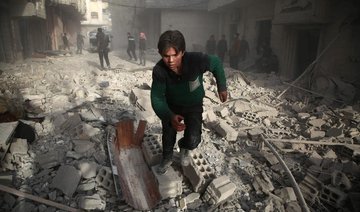
Eastern Ghouta bombing undermines political process amid international silence, says Syrian opposition

Smoke rises from buildings following bombardment on the village of Mesraba in the rebel-held besieged Eastern Ghouta region on the outskirts of the capital Damascus, on Feb. 19, 2018. (Hamza Al-Ajweh/AFP)
Updated 20 February 2018
Follow

Eastern Ghouta bombing undermines political process amid international silence, says Syrian opposition

A Syrian monitoring group and paramedics say Syrian government shelling and airstrikes on rebel-held suburbs of Damascus, killed at least 98 people on Monday.
The Britain-based Syrian Observatory for Human Rights says it was the deadliest day in three years in the area known as Eastern Ghouta.
Local Syrian Civil Defense, also known as White Helmets, said the shelling and airstrikes killed 98 and that more civilians are still under the rubble.
The Syrian opposition coalition condemned the International silence towards what is happening in Easter Ghouta. The umbrella of opposition groups to Assad’s regime said that “the Russian occupation forces and Iranian militias, have unleashed a large-scale terrorist ground attack on the Damascus suburb “
A statement published by the coalition added that “the brutal onslaught on eastern Ghouta is clearly aimed at undermining political solution and to bury the UN-led political process altogether” 
It accused Assad’s regime and his allies of “launching over 70 airstrikes and dropping 25 barrel bombs as well as targeting residential neighbourhoods with more than 150 Grad rockets, six surface-to-surface missiles, and a barrage of artillery fire.'
The Observatory says 20 children and 15 women were among those killed on Monday.
The targeted besieged suburbs have been subjected to weeks-long bombardment that has killed and wounded hundreds of people.
Opposition activists say government forces have brought in reinforcements in preparation for a wider offensive on the area — the last main rebel stronghold near Damascus


Morocco residents begin returning to northwest as flood waters recede

Updated 8 sec ago
Follow

Morocco residents begin returning to northwest as flood waters recede

RABAT: Moroccan authorities began organizing the gradual return of residents to the city of Ksar El Kebir ​and other flood-hit northwestern areas as weather conditions improved, state media showed on Monday.
Authorities backed by the army had helped evacuate 188,000 people since early February, to protect them from overflowing river waters that swept across 110,000 hectares in the northwest.
Most residents of Ksar El ‌Kebir, 213 ‌km north of Rabat, ​are now ‌allowed ⁠to ​return home, ⁠except for those living in a few neighborhoods, the interior ministry said on Monday.
Investment plan to upgrade infrastructure
Train and bus rides were offered free of charge to help transport residents who had sought shelter with relatives in other ⁠cities, or in centers and camps ‌provided by authorities, state ‌TV showed.
Morocco plans to spend ​3 billion dirhams ($330 million) ‌to upgrade infrastructure and support flood-affected residents, farmers ‌and shop-owners in the inundated areas, the prime minister’s office said last week, declaring the hardest-hit municipalities disaster areas.
The Oued Makhazine dam, which had reached 160 percent ‌of capacity, was forced to gradually release water downstream after exceptional inflows, leading to ⁠rising ⁠water levels in the Loukous river which inundated Ksar El Kebir and surrounding plains.
Rainfall this winter was 35 percent above the average recorded since the 1990s and three times higher than last year, official data showed.
Morocco’s national dam-filling rate rose to nearly 70 percent from 27 percent a year earlier, with several large dams being partially emptied to absorb new inflows.
The exceptional rainfall ended ​a seven-year drought ​that had pushed the country to ramp up investments in desalination.