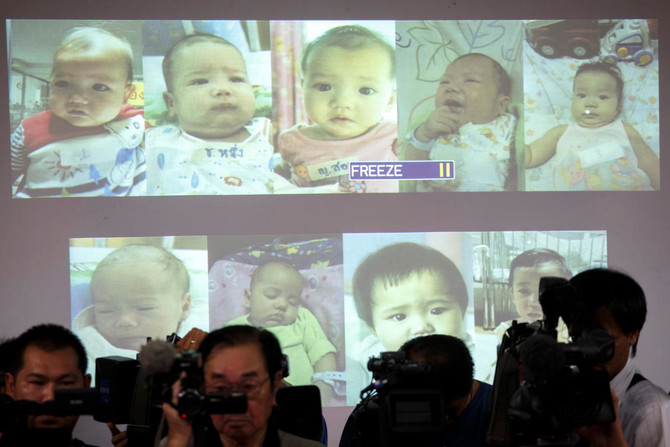
BANGKOK: A Thai court on Tuesday said it ruled in favor of a wealthy Japanese man who had fathered 13 surrogate children in Thailand, naming him their legal parent and sole guardian.
The case harks back to late 2014, when Thai police said they had found 13 babies fathered by a Japanese national with nine Thai surrogate mothers. The children were taken to foster homes and the father has petitioned for custody since early 2015.
The man had his sperm fertilize donor eggs, which were then planted in the wombs of the surrogate mothers in 2013, according to a press statement given by the court. No details were given where the donor eggs were from.
The scandal at the time shone an international spotlight on Thailand’s largely unregulated surrogacy business, prompting authorities to crack down on clinics with nationwide inspections and later to ban commercial surrogacy.
The Japanese man was given custody of the 13 children on Tuesday largely due to his financial and professional stability, and he was found to have no links to human trafficking, the court statement said.
Growing up with a biological parent will also be in the children’s best interests, the court added.
“The petitioner is an heir and president of a well-known company listed in a stock exchange in Japan, owner and shareholder in many companies, and receives dividend of more than 100 million baht ($3.18 million) from a single company in a year, which shows the petitioner has professional stability and an ample income to raise all the children,” the court said in a statement.
“Therefore, it is ruled that all the 13 children are legal children of the petitioner...and the petitioner is their sole guardian.”
The court gave no further details about the man, but said he plans to raise the 13 children in Japan where he lives, adding that he had previously raised his other surrogate children in Cambodia and Japan.
When the case was first lodged in 2014, Thai police had said the man was 24 years old.
The man’s Thai lawyer Kong Suriyamonthon said his client plans to raise the 13 children, who are aged around 4, in Japan.
When asked why the man would want so many children at the same time, Kong said: “He has personal and business reasons. He was born in a big family, so he wants his children to grow up together.”
Thailand was rocked by several surrogacy scandals in 2014, including allegations that an Australian couple had abandoned their Down Syndrome baby with his Thai birth mother taking only his healthy twin sister back to Australia with them.
Thailand passed a law banning commercial surrogacy in 2015 as a result, forcing clinics to move to Cambodia, where it was also later banned, and then Laos.

Thai court grants custody to Japanese father of 13 surrogate children
English museum shines light on Mary Shelley and her Gothic classic ‘Frankenstein’
- Museum in English city of Bath celebrates work of Mary Shelley
BATH: On a window of a Bath townhouse, one of the southwestern English city’s most famous residents looks out at passersby. Inside is Mary Shelley’s House of Frankenstein, a museum dedicated to the writer and her Gothic novel, published in 1818, which has inspired numerous screen adaptations, with the latest being Mexican filmmaker Guillermo del Toro’s Oscar contender.
“‘Frankenstein’ is regarded as one of the most important books in English literature ... It’s the world’s first science fiction novel,” said Chris Harris, co-founder and director of the immersive attraction.
“It’s a very modern story ... he’s trying to fit in, but he’s abandoned ... and rejected and has prejudice thrown toward him. And you think, well, from prejudice comes violence, which is happening nowadays.”
‘FEAR ABOUT CHANGE’
Born Mary Wollstonecraft Godwin, Shelley came up with the idea for “Frankenstein; or, the Modern Prometheus” at 18 years old. She and her future husband, poet Percy Bysshe Shelley, were staying by Lake Geneva in 1816 with Lord Byron when the latter challenged their group to write a ghost story. She found inspiration there.
Back in England, she moved to Bath, where she penned key chapters before finishing the book — about the scientist Victor Frankenstein, who brings to life a creature assembled from body parts — in the town of Marlow.
“It plays on people’s fears about change,” Harris said. “Now Frankenstein is a metaphor for anything we’re scared of.”
The first “Frankenstein” adaptation was a musical, he said.
“The Creature in her book is sensitive, he talks ... but in the play, he was rendered into a monster. He didn’t talk, he was mute. He just went around killing people,” Harris said.
“So, right from the off, he’s been sort of invented in a slightly different way. And that’s happened all the way through the evolution of film and theater ... So it’s interesting to see del Toro’s film; they’re exploring a different side of him.”
OSCAR AND BAFTA NOMINATIONS
That film, with nine Oscar nominations including best picture, shows actor Jacob Elordi’s Creature as gentle and hungry for knowledge but facing resentment. Elordi received Best Supporting Actor nods at the Oscars and Sunday’s BAFTA Film Awards, Britain’s top movie honors, where “Frankenstein” has eight nominations.
While del Toro’s movie differs from the book in several ways, including omitting the Creature’s murders, Harris said physically it was “a similar recreation” of Shelley’s description.
The museum has its own animatronic, standing in Victor Frankenstein’s recreated laboratory. Elsewhere, visitors learn about Shelley’s life, tragedies she faced and her interest in science.
Nearby, by Bath Abbey, is a 2018 plaque marking where Shelley lived in 1816-1817 and worked on the book. Bath is also associated with another female novelist, Jane Austen, who is celebrated annually with a festival. Harris, who opened his museum in 2021, says Shelley deserves more recognition.
“We just want people to understand that this is an extraordinary young woman who came up with one of the most enduring books ever written, that will never go out of fashion.”