ANKARA: The United States and Turkey agreed on Friday to try to rescue a strategic relationship that Washington acknowledged had reached a crisis point, with Turkey proposing a joint deployment in Syria if a US-backed Kurdish militia leaves a border area.
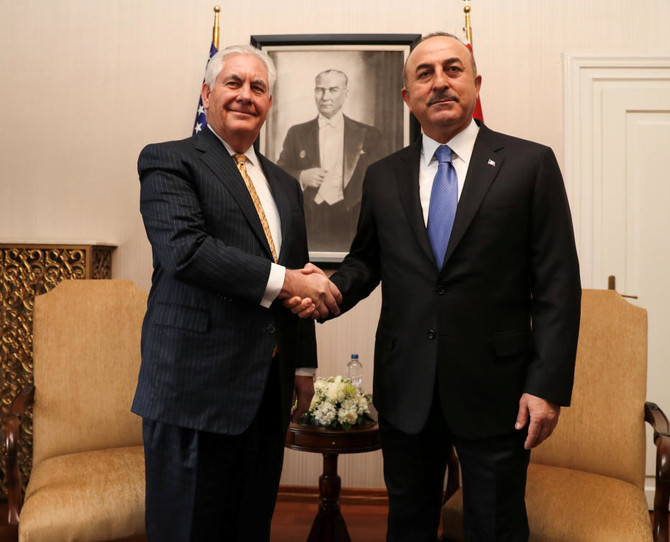
US Secretary of State Rex Tillerson met President Tayyip Erdogan during a two-day visit that followed weeks of escalating anti-American rhetoric from the Turkish government.
While relations between Washington and its main Muslim ally in NATO have been strained by a number of issues, Turkey has been particularly infuriated by US support for the Syrian Kurdish YPG militia, which it sees as terrorists.
Turkey launched an air and ground assault last month in Syria’s northwest Afrin region to sweep the YPG away from its southern border. The United States has armed, trained and aided YPG fighters with air support and special forces, as the main ground force in its campaign against Islamic State.
“We find ourselves at a bit of a crisis point in the relationship,” Tillerson told a news conference after meeting with Foreign Minister Mevlut Cavusoglu on Friday morning. He had met with Erdogan for a more than three-hour discussion on Thursday night.
“We’ve decided and President Erdogan decided last night we needed to talk about how do we go forward. The relationship is too important.”
The United States has no troops on the ground in Afrin, where the Turkish offensive has so far taken place. But Turkey has proposed extending its campaign further east to the town of Manbij, where US troops are based, potentially leading to direct confrontation with US-backed units.
In a proposal that could signal an important breakthrough in efforts to overcome the allies’ stark differences over Syria, a Turkish official told Reuters that Turkey had proposed that Turkish and US forces could deploy jointly in Manbij.
Such a joint deployment could take place if YPG fighters first withdrew to positions east of the Euphrates river, long a Turkish demand.
MANBIJ
Cavusoglu, the Turkish foreign minister, said Turkey would be able to take joint steps with the United States in Syria once the YPG left the vicinity of Manbij.
“What is important is who will govern and provide security to these areas,” he said. “We will coordinate to restore stability in Manbij and other cities. We will start with Manbij. After YPG leaves there, we can take steps with the US based on trust.”
He also said the two countries had created a “mechanism” for further talks and would meet again by mid-March to further hash out their differences.
Tillerson said issues around Manbij would receive priority in the talks.
Tillerson said he recognized Turkey’s legitimate right to defend its borders, but called on Ankara to show restraint in the Afrin operation and avoid actions that would escalate tensions in the area.
He also said the United States had serious concerns about local employees at its missions in Turkey and called on Ankara to release a US pastor and other Americans detained in Turkey.


![]()
US and Turkey agree to mend ties; Turks propose joint deployment in Syria
US and Turkey agree to mend ties; Turks propose joint deployment in Syria


Latest updates


© 2026 SAUDI RESEARCH & PUBLISHING COMPANY, All Rights Reserved And subject to Terms of Use Agreement.