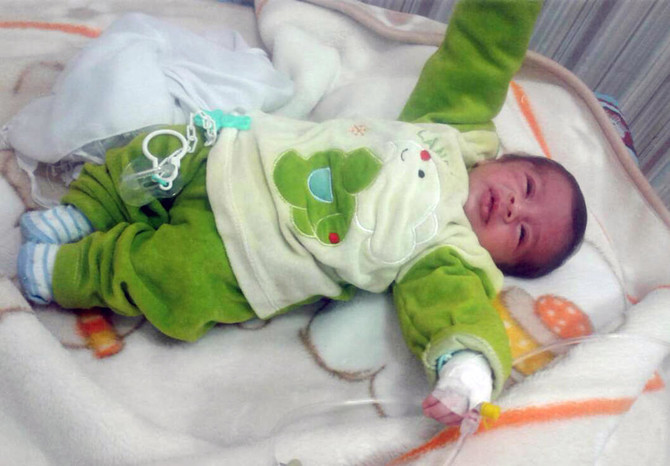
BEIRUT: One-month-old Heyim Hassan was receiving treatment for a chest infection in the Afrin general hospital in northern Syria when a shell landed a few meters (feet) away. His panicked father whisked him out of the building and spent hours looking for nebulizers to aid the infant’s breathing. No one was killed in the attack, but 30 children had to be evacuated to safety.
It was the third time Heyim’s father, Serbest, had to seek shelter for his family in the last month. Four days after the baby was born, Turkey launched an offensive in northwestern Syria, forcing them to flee their home and Serbest’s mobile phone shop to find safety in the district’s center.
Nearly a month into the offensive in Afrin, hundreds of thousands of Syrians like Hassan and his family are hiding from bombs and airstrikes in caves and basements, trapped in the Kurdish enclave while Turkey and its allies are bogged down in fierce ground battles against formidable opponents.
Crammed with 40 relatives into their new shelter, a three-bedroom apartment, the baby Heyim contracted the infection. Then the new neighborhood also got shelled while he was evacuated from the hospital.
“This is how it is in Afrin. It is not just me,” Hassan said in a series of messages to The Associated Press from inside Afrin, encircled and under attack since Jan. 20.
A slow-moving ground offensive, the assault on Afrin threatens to become a protracted standoff, deepening an already dire humanitarian situation. It could also prove costly for Turkey, diplomatically and militarily. So far, nearly 80 civilians in Afrin, according to the Syrian Observatory for Human Rights, and 31 Turkish soldiers have been killed. Turkey says it does all it can to avoid civilian casualties.
Turkey launched its offensive with more than 70 aircraft. Airstrikes were followed by a ground assault in which an estimated 10,000 allied Syrian rebel fighters took part, backed by Turkish artillery and other troops.
Fighting on six fronts, the Turkey-backed troops have met stiff resistance from the Kurdish People’s Defense Units, known as the YPG.
Turkish officials have made conflicting statements about the goals of the offensive, but have said they seek to push the Kurdish militia away from its borders.
The Kurdish fighters form the backbone of the U.S-backed Syrian Democratic Forces fighting Daesh group militants in eastern Syria, but are viewed by Turkey as an extension of its own insurgents, the Kurdistan Workers Party or the PKK.
Although Afrin is encircled from all sides by Turkey, the guerrilla fighters — with years to prepare for the defense of their 1,500-square-mile (3,885-square kilometer) district — have proven a challenge.
They targeted Turkish tanks and bases and claimed to have downed at least one helicopter. Eleven soldiers were killed in one day last week. The weather and geography have also slowed down the offensive, with fog and rain grounding jets and obstructing ground advances as fighters grappled to deal with the mountainous terrain.
The Observatory, which monitors in the war in Syria, estimates that Turkey has seized nearly 7 percent of district land along Afrin’s outer edges, including a strategic hill in the east, and Bulbul, Hassan’s hometown, in the north.
The YPG says 98 of its fighters have been killed. But the Observatory puts the toll at over 160, and estimated that over 200 Turkey-backed Syrian fighters have been killed.
YPG commanders hinted they could open new fronts against Turkey.
“We are in the first phase of the battle now,” said YPG commander Sipan Hemo. “This strategic battle will not end ... until we teach the Turkish occupation the right lessons, and they withdraw to their borders.”
Noah Bonsey, senior analyst with the International Crisis Group who recently returned from a visit to Kurdish-controlled territories in northern Syria, said Turkey may either remain along the edges of Afrin or attempt to gain additional ground inside the enclave.
“This is when things could really turn dangerous,” he said. “I think it is unclear where things are moving from here. All eyes are on (US Secretary of State Rex) Tillerson’s visit to Ankara.”
Tillerson met Thursday with Turkey’s President Recep Tayyip Erdogan and he and Turkish Foreign Minister Melvut Cavusoglu planned a news conference Friday after meetings were concluded. Ultimately, Ankara wants Washington to halt its support for the Syrian Kurdish militia.
Meanwhile, the offensive has emboldened Washington’s adversary, the Syrian government, which with Russia’s aid, is presenting itself as the solution to the bloody, unpredictable conundrum. Russia has tried to secure the return of some form of government presence to Afrin, asking the Kurdish militia to cede control of security and borders to Damascus.
Although the YPG rejected the proposal, it remains the only idea on the table and Kurdish commanders have recently called publicly on the Syrian government to assume its role guarding Afrin’s borders.
The UN, which has no access to Afrin, said it was “extremely difficult” to verify numbers of displaced, estimating in the first week of February that between 15,000 to 30,000 people were uprooted inside the enclave.
Local Kurdish official Arefeh Bakr said it was a struggle assisting people holed up with relatives in small apartments and caves to escape airstrikes. She herself is hosting 25 people in her home, relatives displaced from nearby villages.
“We don’t want aid or help,” Bakr said. “We just want an end to the airstrikes.”
Jiwan Mohamed, director of the Afrin general hospital, said with a staff of about 250 doctors and nurses, the hospital has so far been able to cope, but it was becoming overwhelming, particularly with a lack of blood transfer products and emergency kits. The UN said there are four other facilities in the district center, including one operated by a UN partner.
Fuel and food supplies have come in through government-held areas, ensuring that prices have not gone up. A water treatment plant was damaged, temporarily affecting supply to one area in the north.
According to the UN, local authorities have prevented people from leaving the enclave, except for critical medical cases allowed out by the Syrian government and Afrin authorities.
For Hassan, the return the Syrian government to Afrin is the least bad option. Although Afrin was one of the first areas to join the protests against the Syrian government that eventually turned into the current conflic, he said the prospect of Turkey-backed rebels swarming their town is frightening.
Dozens of videos have surfaced showing Turkey-backed rebels taking hostages in Afrin, mistreating the elderly and mutilating the body of a female Kurdish fighter.
“This shows what will happen to us,” Hassan said. “We are waiting in anticipation and watching videos.”
In Turkey, the offensive in Afrin is popular, playing to nationalist and anti-Kurdish sentiments ahead of the 2019 elections. Turkish opposition lawmaker and member of the defense committee, Dursun Cicek, said the operation is progressing slowly.
“But Turkey is not in any hurry,” he said.


![]()
Civilians have no place to run as Turkey offensive drags on
Civilians have no place to run as Turkey offensive drags on

Latest updates





© 2026 SAUDI RESEARCH & PUBLISHING COMPANY, All Rights Reserved And subject to Terms of Use Agreement.