Tillerson says Hezbollah ‘part of political process’ in Lebanon

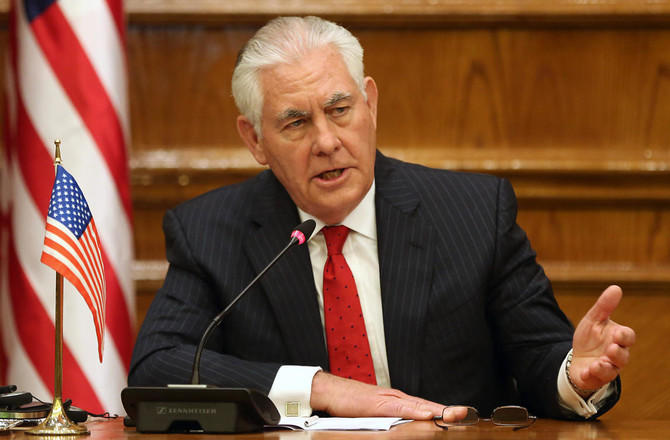
US Foreign Secretary Rex Tillerson speaks during a joint press conference with Jordanian foreign minister in Amman on February 14, 2018. (AFP)
Updated 14 February 2018
Follow

Tillerson says Hezbollah ‘part of political process’ in Lebanon

AMMAN: US Secretary of State Rex Tillerson on Wednesday conceded that Iran-backed Hezbollah is part of the “political process” in Lebanon, appearing to soften Washington’s tone ahead of a visit to the country.
“We support a free, democratic Lebanon free of influence of others, and we know that Lebanese Hezbollah is influenced by Iran. This is influence that we think is unhelpful in Lebanon’s long-term future,” Tillerson said at a press conference in Jordan.
“We also have to acknowledge the reality that they also are part of the political process in Lebanon.”
Hezbollah — the only faction to have retained its weapons after Lebanon’s civil war — is a member the Lebanese government of Prime Minister Saad Hariri.
Despite being branded a “terrorist” organization by the United States and targeted with economic sanctions, Hezbollah has risen to play a decisive role in regional conflicts including Syria.
The US Justice Department in January announced the creation of a special task force to investigate what it called “narcoterrorism” by the powerful movement.
The United States levied sanctions in early February against six individuals and seven business with alleged links to Hezbollah financier Adham Tabaja.
In the wake of the crisis Lebanon’s political players — including Hezbollah — agreed to stick to the country’s official policy of “disassociation” to stay out of regional conflicts.
Tillerson is due to meet Lebanon’s political leadership Thursday as part of a tour of the Middle East.


Syrian Kurdish enclave on alert amid shaky ceasefire

Armed Kurdish volunteers pose for a picture while standing guard at a checkpoint in Qamishli, Syria, January 26, 2026. (REUTERS)
Updated 5 sec ago
Follow

Syrian Kurdish enclave on alert amid shaky ceasefire

  • The SDF is clinging on in its northeastern enclave — one of several where Kurds — an oppressed group under the ‌ousted Assad dynasty — established ‌de facto autonomy during the civil war

QAMISHLI, Syria: With Syria’s Islamist-led government bearing down on Kurdish forces, residents of their last major enclave are on alert, mindful of last year’s violence against other minority groups and determined to preserve their self-rule.
In the Kurdish-majority city of Qamishli in the northeast, a mechanic, a storekeeper, and ​a student were among those taking part in a nighttime volunteer patrol this week, vowing to defend their area and putting little faith in a shaky ceasefire.
“We’re going out to guard our neighborhoods, to stand with our people and protect our land,” said Yazan Ghanem, 23. “This is our land. We won’t accept any outside interference in our areas.”

’FEARS AND DOUBTS’ WEIGH ON KURDS, SAYS RESIDENT
It reflects simmering tensions despite the US-backed ceasefire, which was extended on Saturday for 15 days. Some clashes have taken place since then.
Having taken swathes of the north and east from the Kurdish-led Syrian Democratic Forces (SDF), President Ahmed Al-Sharaa’s government is pressing its demand for the integration of the remaining Kurdish-run enclaves with the state.
The SDF is clinging on in its northeastern enclave — one of several where Kurds — an oppressed group under the ‌ousted Assad dynasty — established ‌de facto autonomy during the civil war.
While Sharaa has repeatedly vowed to uphold Kurdish ‌rights — he ⁠recognized ​Kurdish as ‌a national language earlier this month — the residents patrolling Qamishli on Monday had little confidence in the former Al-Qaeda commander.
“We have fears and doubts about the government because, quite simply, wherever it has entered, there have been massacres and killing,” said Radwan Eissa, brandishing a gun.
Fears among Syrian minorities grew last year during several bouts of violence in which the Sunni Muslim-led government clashed with members of the Alawite community in Syria’s coastal region, and Druze communities in Sweida province, with government-aligned fighters killing hundreds of people.
Sharaa has promised accountability.
A senior Syrian government official said Kurdish fears were “understandable” based on abuses committed by army personnel in Sweida and some violations carried out by troops as they pressed into Kurdish-held ⁠areas in recent weeks.
The official said two people had been arrested for the recent abuses and a third was on the run, but being pursued. “We are keen to learn from ‌past experiences, and we did,” he added.
The prosecutor general last year pressed charges ‍against some 300 people linked to armed factions affiliated with the Syrian ‍army over the violence in the coastal region, and around 265 who belonged to Assad-era paramilitary groups.
Human Rights Watch said ‍on January 25 that both parties appeared to have committed abuses that violated international law during the current escalation in the northeast.

SDF READY ‘FOR WAR AND POLITICAL SOLUTIONS’
Government forces have advanced to the outskirts of SDF-held Hasakah, an ethnically mixed city some 70 km (45 miles) south of Qamishli. They have also encircled Kobani, or Ain Al-Arab, a Kurdish-held town at the Turkish border.
The SDF has vowed to protect Kurdish regions.
In an interview with Kurdish broadcaster Ronahi ​on Sunday, SDF commander Mazloum Abdi said dialogue continued with Damascus, and that after the 15-day period “serious steps” would be taken toward integration.
“Our forces are ready for war and political solutions,” he said. “The Kurds must get their rights ⁠in this region, and join the Syrian state,” he said.
The Syrian official said the January 18 integration deal aimed to reassure Kurds by stipulating that Syrian troops would not enter Kurdish areas and by spelling out how local communities would be able to delegate their own representatives.
The SDF’s territory grew as it partnered with the United States against Islamic State in Syria.
But its position weakened as Washington deepened ties to Sharaa over the last year. President Donald Trump said on January 20 Washington was trying to protect the Kurds.
Syria’s dominant Kurdish group, the PYD, follows a political doctrine emphasising leftism and feminism.
Giwana Hussein, a 23-year-old Qamishli student, said she hoped the ceasefire showed that both sides wanted a political solution. She urged Damascus to let Kurds run their own affairs, and said she was afraid that if the government took control, women’s rights would be marginalized.
The Syrian official said the government wanted to ensure a new constitution addressed Kurdish concerns, but said that it could only come after an integration deal was agreed and implemented. “Once we merge, we can discuss everything,” the official said.
Ivan Hassib, a Kurdish activist critical of the PYD, said Sharaa’s ‌decree recognizing Kurdish rights was positive but only a first step, saying they must be enshrined in the constitution and not limited to cultural rights: “The lasting solution ... is for the Kurds and other groups to obtain some form of autonomy.”