

Nasdaq leaves door open for potential Saudi Aramco IPO

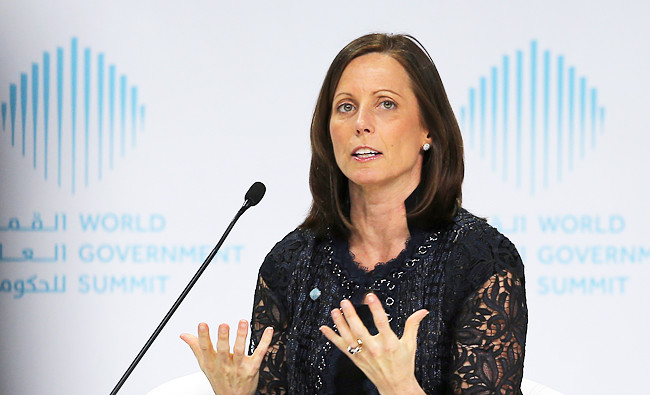
Adena Friedman, president and CEO of Nasdaq,speaks at the World Government Summit in Dubai. (AP)
Updated 13 February 2018
Follow

Nasdaq leaves door open for potential Saudi Aramco IPO

DUBAI: Adena Friedman, president and chief executive of Nasdaq, has left the door of the second New York stock exchange wide open for a listing of Saudi Aramco, the Kingdom’s oil giant aiming for an initial public offering this year.

At the World Government Summit in Dubai, she was asked by Hadley Gamble, CNBC’s Middle East anchor, if Aramco could go for a dual listing on the Riyadh market and Nasdaq and replied: “With any company of that size and liquidity you could support a dual listing and allow fungibility (interchangeability) across markets.”

She insisted she was not referring to any specific company, but went on to say that Nasdaq was home to the four largest companies in the world, and that it had attracted $350 billion-worth of listings from companies moving from the New York Stock Exchange to the newer and smaller Nasdaq.

“Companies want to be part of the future, not the past, and want to be associated with all the other companies that want to be part of the future,” she said.

Her comments will revive Nasdaq’s ambitions to take part in the Aramco listing, which could be worth $100 billion if the Saudi company opts for a foreign listing in addition to a flotation on the Tadawul in Riyadh.

The New York Stock Exchange had been the assumed favorite among the American markets bidding for the IPO, but President Trump last year included Nasdaq in a tweet requesting Aramco go for a New York listing. Nasdaq is the second-largest market in the world by market capitalization, behind NYSE but ahead of London, also vying for the Aramco IPO.

Nasdaq has been a partner of the Riyadh market for 20 years, cooperating on share trading technology and systems. “We’ve been working with them to help provide a fair market place and to help their market expand,” she said.

Friedman said she was impressed by the expansion of regional markets, but added that transparency in markets and companies would aid their growth. Nasdaq is also a partner of the Dubai Financial Market and the Nasdaq Dubai stock exchange, and also has trading agreements with the Abu Dhabi Securities Exchange.

Asked about the volatility in global stock markets recently, which some have blamed on computerised trading and volatility linked instruments, she said: “I think markets have been through human emotions and human logic.

“In a growth environment, with low unemployment, tax reform and rising wages, it looks like interest rates will have to rise. It is human emotion to say: ‘I’ve made 30 percent this year and it’s time to cash out,’ especially for retail investors. Humans are in charge of decisions on the markets.”

She said that the US exchange authorities believed it was too early to set up exchange traded funds in bitcoin, the beleaguered cryptocurrency. “The markets that underly the bitcoin price are still imperfect markets,” she said.

Acwa signs key terms to develop 5GW of renewable energy capacity in Turkiye

Updated 23 February 2026
Follow

Acwa signs key terms to develop 5GW of renewable energy capacity in Turkiye

JEDDAH: Saudi utility giant Acwa has signed key investment agreements with Turkiye’s Ministry of Energy and Natural Resources to develop up to 5 gigawatts of renewable energy capacity, starting with 2GW of solar power across two plants in Sivas and Taseli.

Under the investment agreement, Acwa will develop, finance, and construct, as well as commission and operate both facilities, according to a press release.

The program builds on the company’s first investment in Turkiye, the 927-megawatt Kirikkale Independent Power Plant, valued at $930 million, which offsets approximately 1.8 million tonnes of carbon dioxide annually, the statement added.

A separate power purchase agreement has been concluded with Elektrik Uretim Anonim Sirketi for the sale of electricity generated by each facility.

Turkiye aims to boost solar and wind capacity to 120GW by 2035, supported by around $80 billion in investment, while recent projects have already helped prevent 12.5 million tonnes of CO2 emissions and reduced reliance on imported natural gas.

Turkiye’s energy sector has undergone a rapid transformation in recent years, with renewable power emerging as a central pillar of its strategy.

Raad Al-Saady, vice chairman and managing director of ACWA, said: “The signing of the IA (implementation agreement) and PPA key terms marks a pivotal moment in Acwa’s partnership with Turkiye, reflecting the country’s strong potential as a clean energy leader and manufacturing powerhouse.”

He added: “Building on our long-standing presence, including the 927MW Kirikkale Power Plant commissioned in 2017, this step elevates our partnership to a new level,” Al-Saady said.

In its statement, Acwa said the 5GW renewable energy program will deliver electricity at fixed prices, enhancing predictability for grid planning and supporting long-term industrial investment.

By replacing imported fossil fuels with domestically generated clean energy, the initiative is expected to reduce Turkiye’s exposure to global energy market volatility, strengthening energy security and lowering long-term power costs.

The company added that the economic impact will extend beyond the anticipated investment of up to $5 billion in foreign direct investment, with thousands of jobs expected during the construction phase and hundreds of high-skilled roles created during operations.

The energy firm concluded that its existing progress in Turkiye reflects a strong appreciation for Turkish engineering, construction, and manufacturing capacity, adding that localization has been a strategic priority, and it has already achieved 100 percent local employment at its developments in the country.
