

Disconnect — or risk ‘digital addiction’, summit told

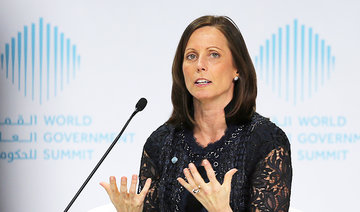
Arianna Huffington says it is more important to take time out than to brag about working long hours (File/AFP)
Updated 13 February 2018
Follow

Disconnect — or risk ‘digital addiction’, summit told

DUBAI: Arianna Huffington, former publisher turned lifestyle counsellor, shook the World Government Summit in Dubai out of its technology-inspired dreams with a call to disconnect — at least temporarily — from the digital world “in order to reconnect with ourselves and our loved ones.”

She startled the audience, which for the past 24 hours had been hearing about the beneficial power of technology, digital communications and artificial intelligence, with the warning: “We’ve heard a lot about artificial intelligence, how it will become more intelligent than humans. But it will never be more creative, compassionate and loving than we are.”

Some technophiles in the audience even looked away from their screens to listen to her.

Huffington, who left the news and opinion website Huffington Post in 2016 to concentrate on her health project Thrive Global, was just as concerned about the medical implications of technology overuse, especially for women and children.

“We take better care of our smartphones than we do of ourselves. We know exactly how much battery is in our phone, but do you know when you’re running on empty?” she asked.

Huffington listed the negative implications of over-dependence on modern technology, including stress, anxiety, heart problems and diabetes. All were worsened by overuse of phones and other electronic devices, she said.

Modern connectivity causes stress because people never switch off — literally as well as metaphorically — leading to cases of “burn-out” in office workers and others, she warned.

“Burnt-out workers are 30 percent more likely to lose their jobs and to suffer diseases that make them less efficient. About 70 percent of health care issues are related to stress. The way we are working is not working.

The implications of technology overload are most serious for children and for women, Huffington said.

“Children who spend five hours a day on social media, as some studies suggest, are much more likely to be depressed, and women face greater risks from heart disease and diabetes,” she said.

She warned people against sleeping with their smartphones near their bed, claiming that the habit leads to less and lower-quality rest.

She quoted Jeff Bezos, founder of Amazon, who recently wrote an article entitled “Why my getting eight hours’ sleep is good for Amazon shareholders.”

Huffington said: “Machismo burn-out leads to terrible business decisions. The world of work was designed by men, and it is not working. Women have to redesign it.”

She also levelled criticism at the tech giants. “We are addicted to devices, and the social media companies know how to capture and monetise our addiction. We are drowning in data and starved of wisdom,” she said.

It was the second time at the summit that an on-stage speaker had attacked modern smartphone practices.

Earlier, Richard Quest, anchor for CNN International, asked the audience to hold up their phones screens facing the stage, and turn the devices off for the duration of his session.

Oman to establish international financial center to drive economic vision

Updated 10 sec ago
Follow

Oman to establish international financial center to drive economic vision

RIYADH: Oman is set to establish an International Financial Center, in a move to diversify the national economy and position the nation as a leading global hub.

According to a press release, the new establishment aims to draw international investment, advance innovation across various services, and strengthen Oman’s standing in the global financial ecosystem. It will function with full administrative, regulatory, and legislative autonomy from its headquarters in Madinat Al Irfan.

With a legal decree now in place, the coming months will focus on finalizing the regulatory framework, engaging stakeholders, and establishing operational structures.

The aim is to launch the center’s activities and commence full operations before the end of the year, marking a significant milestone in realizing Oman Vision 2040.

Officials hailed the decree as a transformative step. The president of the Oman Investment Authority stated that the center reflects the Sultan’s vision to “create an attractive investment environment” and will provide a “secure and transparent” hub distinguished by stability and efficiency.

“The aspiration is that the center will become a strategic destination and a source of capital inflows,” Abdulsalam Mohammed Al-Murshidi added, linking it directly to Oman’s broader goals of economic diplomacy and diversification.

A key feature of IFC Oman is its legal foundation. It will develop a comprehensive regulatory and judicial framework aligned with international standards and based on English Common Law, a system trusted by global investors and institutions.

To ensure robust and transparent governance, the establishment will be overseen by an IFC Oman board appointed by Sultan Haitham bin Tariq.

Three independent entities will operate under the law: an authority for management, a regulator for oversight, and a dispute resolution authority to handle legal matters.

Aiming to be a magnet for investment, IFC Oman will offer a compelling package of incentives for qualifying firms, including tax exemptions for up to 50 years. The center plans to focus initially on financial activities and their supporting sectors.

Mahmood Abdullah Al-Aweini, chairman of the IFC Oman Executive Committee, positioned the move as a natural progression following Oman’s recent credit rating improvements. He emphasized that IFC Oman will offer competitive costs, regulatory agility, and reliable services to ease business establishment and global market access.

“Together with our strategic partners, we aim to work toward bringing this ambitious vision into reality,” Al-Aweini said, expressing confidence in the center’s future.