Smart living can improve quality of life — but at a cost

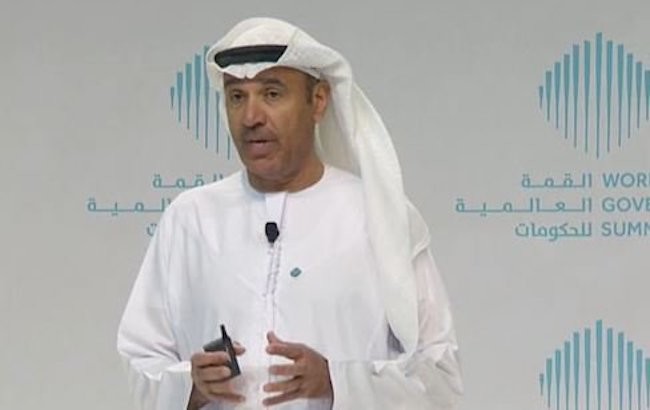
Hussein Lootah, director general of Dubai Municipality
Updated 13 February 2018
Follow

Smart living can improve quality of life — but at a cost

DUBAI: Digital technology and communication represent opportunities to improve living standards and advance economic growth, but they also potentially present a threat to established social systems and governance, according to several experts at the World Government Summit in Dubai.

Karuna Gopal, president of the Foundation for Futuristic Cities, said that “smart living” should not be about automated homes or robots serving breakfast, but “giving quality of life to the poorest of the poor, and infusing quality into everybody’s life.”
But, she added, “technology is a double-edged sword. It can lead you into a ‘cognitive cloud’ which destroys your powers of discretion.”

The risks of advanced technology were raised by many of the participants in a session devoted to smart cities, innovation and technology. Achim Steiner, administrator of the UN Development Program, said that technology and innovation were making governments better because they enabled citizens to participate more in decision-making.

But he warned against the concentration of power in a few private technology companies: “It is not a desirable outcome for ten companies to control all the data.”

That was echoed by Francis Fukyama, futurist academic and best-selling author, in a separate session entitled “The future of global governance and net states.”

He said: “The five big tech companies — Facebook, Google, Microsoft, Apple and Amazon — are all American. They provide world services but they’re territorially based in the USA ... They are global utilities that have to be regulated, and that will become an issue.”

Hussein Lootah, director general of Dubai Municipality, also highlighted the issue of access to information held outside national boundaries:

“We wish to have information attained and sought by any way that is proper. The most important challenge with artificial intelligence is the future of humanity. Countries and cities have to be ready for the changes ahead.”


Saudi POS spending jumps 28% in final week of Jan: SAMA

Updated 06 February 2026
Follow

Saudi POS spending jumps 28% in final week of Jan: SAMA

RIYADH: Saudi Arabia’s point-of-sale spending climbed sharply in the final week of January, rising nearly 28 percent from the previous week as consumer outlays increased across almost all sectors. 

POS transactions reached SR16 billion ($4.27 billion) in the week ending Jan. 31, up 27.8 percent week on week, according to the Saudi Central Bank. Transaction volumes rose 16.5 percent to 248.8 million, reflecting stronger retail and service activity. 

Spending on jewelry saw the biggest uptick at 55.5 percent to SR613.69 million, followed by laundry services which saw a 44.4 percent increase to SR62.83 million. 

Expenditure on personal care rose 29.1 percent, while outlays on books and stationery increased 5.1 percent. Hotel spending climbed 7.4 percent to SR377.1 million. 

Further gains were recorded across other categories. Spending in pharmacies and medical supplies rose 33.4 percent to SR259.19 million, while medical services increased 13.7 percent to SR515.44 million. 

Food and beverage spending surged 38.6 percent to SR2.6 billion, accounting for the largest share of total POS value. Restaurants and cafes followed with a 20.4 percent increase to SR1.81 billion. Apparel and clothing spending rose 35.4 percent to SR1.33 billion, representing the third-largest share during the week. 

The Kingdom’s key urban centers mirrored the national surge. Riyadh, which accounted for the largest share of total POS spending, saw a 22 percent rise to SR5.44 billion from SR4.46 billion the previous week. The number of transactions in the capital reached 78.6 million, up 13.8 percent week on week. 

In Jeddah, transaction values increased 23.7 percent to SR2.16 billion, while Dammam reported a 22.2 percent rise to SR783.06 million. 

POS data, tracked weekly by SAMA, provides an indicator of consumer spending trends and the ongoing growth of digital payments in Saudi Arabia.  

The data also highlights the expanding reach of POS infrastructure, extending beyond major retail hubs to smaller cities and service sectors, supporting broader digital inclusion initiatives.  

The growth of digital payment technologies aligns with Saudi Arabia’s Vision 2030 objectives, promoting electronic transactions and contributing to the Kingdom’s broader digital economy.